Get Full Government Meeting Transcripts, Videos, & Alerts Forever!
Get email alerts on the Health Insurance Regulation topic
No spam. Unsubscribe anytime.
Ohio Senate committee hears competing testimony on SB 100 to authorize Farm Bureau health plans
Summary
At a third hearing for Senate Bill 100, health advocacy groups warned the bill would expose Ohioans with preexisting conditions to financial and medical risk, while farm representatives and a Farm Bureau administrator said the plans provide affordable coverage for farm families who fall outside subsidy eligibility.
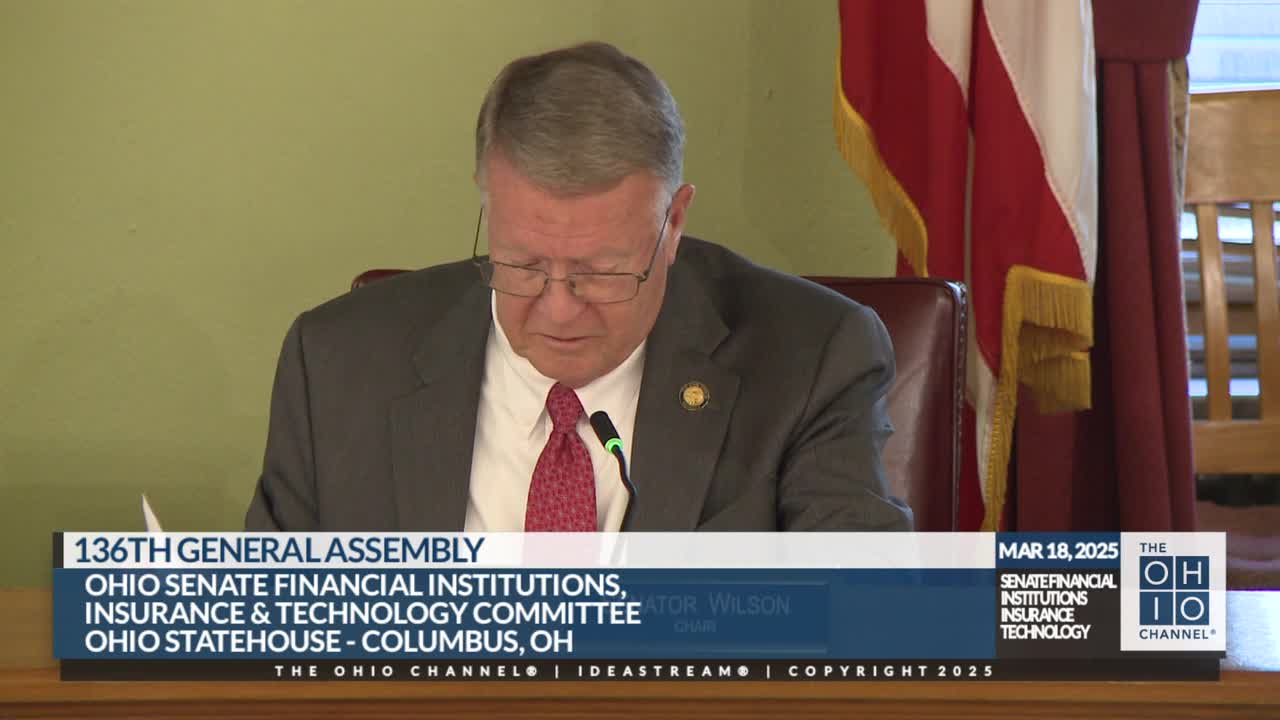
COLUMBUS — The Senate Financial Institutions, Insurance and Technology Committee held a third hearing on Senate Bill 100, which would allow nonprofit agricultural membership organizations to offer Farm Bureau health plans that are not classified as state-regulated health insurance. Testimony came from public-health and patient-advocacy groups opposed to the bill and from farmers and Farm Bureau representatives who urged lawmakers to approve the change.
Advocates representing illness-specific and patient-advocacy organizations told the committee SB 100 would expose Ohioans with preexisting conditions to “financial and health risk.” Kezia Ofosuwata, director of advocacy for the American Lung Association in Ohio, said the proposed Farm Bureau plans would not be required to provide the same protections as marketplace plans and “expose and release to financial and health risk inherent in substandard coverage.” She told senators those products could use “misleading and deceptive marketing practices,” charge higher premiums to people with preexisting lung disease, or decline coverage.
Lee Almeida, Ohio government relations director for the American Cancer Society Cancer Action Network, told the committee that SB 100 would allow plans “that look like health insurance but offer none of the state law safeguards important to diagnosing and treating cancer.” Almeida said the bill would remove state enforcement and appeals mechanisms, could permit underwriting that charges higher premiums for people with prior diagnoses, and risk leaving patients without coverage during critical treatment windows.
The National Multiple Sclerosis Society also opposed the bill. Its witness cautioned that the plans would not have to meet Affordable Care Act standards for essential health benefits, network adequacy, minimum medical loss ratios, or prohibitions on annual and lifetime limits — protections patient groups said are especially important for people who rely on specialists, durable medical equipment, and ongoing prescription therapy.
Witnesses opposing the bill cited studies and examples from other states. Testimony referenced a 2017 U.S. Department of Agriculture finding that about two-thirds of farmers report at least one preexisting condition and included anecdotal accounts of individuals in other states who said Farm Bureau plans imposed prolonged exclusions or denied care after enrollment.
Farmers and proponents told a different story. Sarah Eisen, a co-owner of Flourish and Roam who described herself as a rancher and small-business owner, said marketplace premiums had become unaffordable for her household after a spouse’s employer coverage ended and that Farm Bureau plans are a needed alternative for families caught above subsidy thresholds. She provided household premium figures from her experience with the federal marketplace and tax credits, showing substantial year-to-year increases in her monthly payment.
Benjamin Sanders, representing Farm Bureau Health Plans of Tennessee, described a long-operating membership model and defended it as a self-funded option for members who are not eligible for ACA subsidies or employer plans. Sanders said his organization uses third-party administrators and national networks — UnitedHealthcare for claims processing and OptumRx for pharmacy benefits — and asserted that by contract the plans cannot be canceled for an enrollee’s change in health status: “By contract, the only 2 reasons we can drop someone is if they drop their Farm Bureau membership or if they stop paying their premiums.” He said most members select plans with robust cost sharing and that, in Tennessee, retention and claims experience have been favorable.
Committee members asked opponents and proponents similar questions about real-world impacts: whether farmers truly lack affordable options, whether Farm Bureau plans “cherry-pick” healthy enrollees, how underwriting and network adequacy operate, and how the plans interact with the Affordable Care Act marketplace. Opponents emphasized cases in other states where enrollees reported gaps in coverage and the absence of state enforcement; proponents said their acceptance rate on applications runs about 85–90% and that many enrollees choose comprehensive plan tiers.
No vote or committee action was taken during the hearing. The committee’s proceedings concluded after testimony and questions; members invited additional written materials from witnesses.