Get Full Government Meeting Transcripts, Videos, & Alerts Forever!
Get email alerts on the Health Insurance topic
No spam. Unsubscribe anytime.
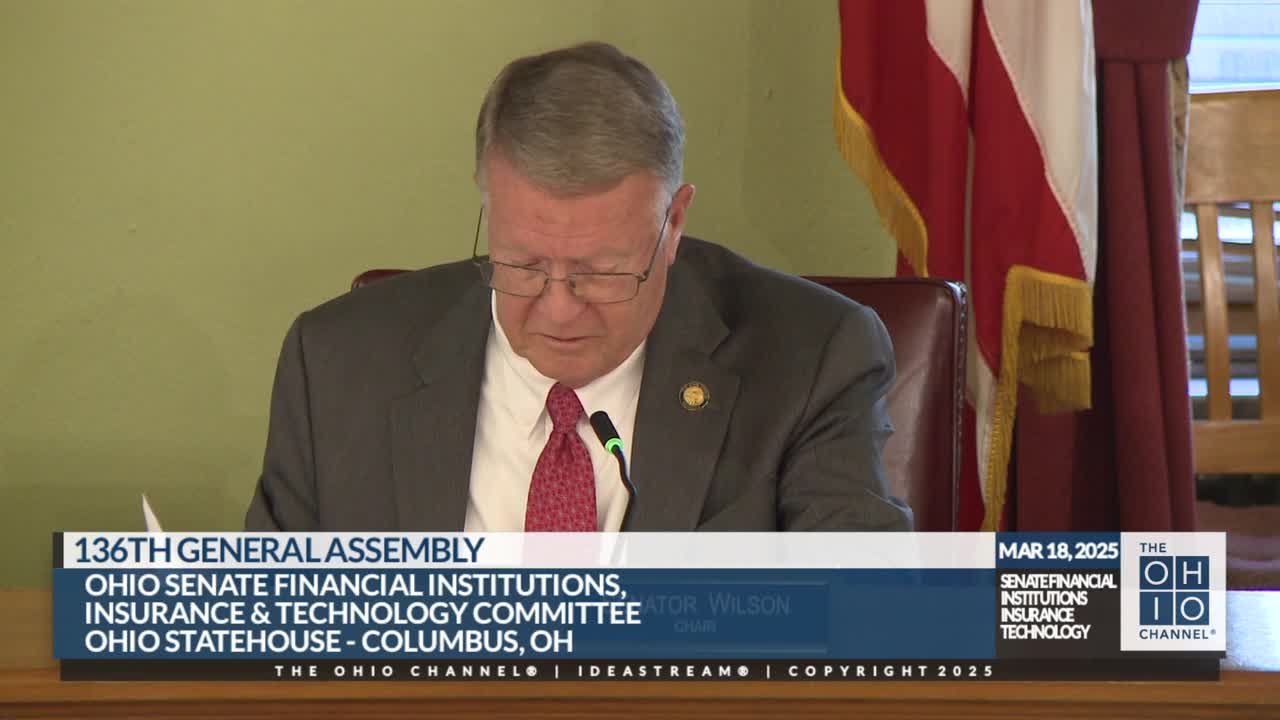
Ohio Senate committee holds third hearing on bill to authorize Farm Bureau health plans
Summary
The Senate Financial Institutions, Insurance and Technology Committee on Tuesday held a third hearing on Senate Bill 100, which would allow nonprofit agricultural membership organizations to offer Farm Bureau health plans that the bill describes as not being ‘‘health insurance’’ and would not be subject to state insurance regulation.
The Senate Financial Institutions, Insurance and Technology Committee on Tuesday held a third hearing on Senate Bill 100, which would allow nonprofit agricultural membership organizations to offer Farm Bureau health plans that the bill describes as not being ‘‘health insurance’’ and would not be subject to state insurance regulation.
Advocates for people with chronic and serious illnesses told the committee the bill could expose Ohioans with preexisting conditions to higher costs, coverage gaps and retrospective denials. Kezia Ofosuwata, director of advocacy for the American Lung Association in Ohio, said Farm Bureau plans ‘‘lack regulation at the state level’’ and could market misleading products that fail to cover essential treatments for asthma, COPD, lung cancer and other lung diseases.
The concerns were echoed by Lee Almeida, Ohio government relations director for the American Cancer Society Cancer Action Network, who said SB 100 plans would not have to follow state consumer protections such as coverage for cancer screenings, limits on out-of-pocket costs or access to clinical trials and oral chemotherapy. Almeida said that, in past cases, cancer patients have faced large medical bills or been denied coverage after diagnosis and warned that two-thirds of farmers have a preexisting condition, a statistic she cited from USDA data discussed in testimony.
Holly Pindell, associate vice president of the National Multiple Sclerosis Society, said the bill would permit medical underwriting, waiting periods and lifetime or annual limits — practices barred under the Affordable Care Act for regulated plans — and that the bill contains no required consumer disclosures informing buyers that the plans are not insurance and may not meet ACA standards.
Proponents told the committee the plans respond to a gap for farmers and small producers who earn too much to qualify for ACA subsidies but cannot access employer-sponsored coverage. Sarah Eisen, a rancher and co-owner of Flourish and Roam, described household premium increases her family experienced through the marketplace and said marketplace premiums can account for more than 20% of some farm household income.
Benjamin (Ben) Sanders of Farm Bureau Health Plans in Tennessee described his organization’s long history administering membership-based plans and said Tennessee statutes allowed Farm Bureau plans there to operate as self-funded membership organizations. Sanders said the plans accept most applicants — “our acceptance rate on applications is 85 to 90 percent” — and that the Tennessee program uses evergreen contracts that, he said, prevent cancellation based on an enrollee’s health status except for nonpayment or membership lapse. He also said Farm Bureau contracts in other states use UnitedHealthcare as a third-party administrator and OptumRx for pharmacy benefits, and he gave ranges for premiums in Tennessee: individual plans $200–$600 (average about $270) and family plans roughly $500–$1,500 (average about $750), while acknowledging members choose a range of plan tiers.
Committee members pressed proponents on preexisting-condition protections, network adequacy and grievance handling. Sanders said the plans typically rent a broad statewide UnitedHealthcare provider network and that Farm Bureau maintains grievance processes and voluntary cooperation with state insurance departments even where statutory regulation does not apply; he said the organization processes roughly 2,800,000 claims a year and receives about 250 complaints annually through its internal processes.
Several witnesses pointed to experience in other states. Almeida and Pindell cited examples from Tennessee and other states in which advocates say Farm Bureau plans left consumers without promised coverage; Pindell described instances where conditions such as diabetes or prior findings on imaging led to exclusions or long waiting periods. Sanders acknowledged complaints and said some members choose limited “catastrophic” designs at lower premiums, which can carry exclusions by member choice; he also said many members remain satisfied, citing a roughly 98% retention rate in his testimony.
The hearing included questions from senators including Senator Craig, Senator DeMora, Senator Manning and others about alternative coverage routes, premium dynamics, membership eligibility and the relationship between Farm Bureau plans and the ACA marketplace. Witnesses offering opponent testimony urged the committee to protect consumers by preserving regulatory oversight, citing the potential for market segmentation that could raise premiums in the regulated individual market.
The committee concluded the hearing without a vote; SB 100 remains under consideration. The committee record includes written testimony and the verbal testimony summarized here.