Get Full Government Meeting Transcripts, Videos, & Alerts Forever!
Get email alerts on the Hemp Regulation Thc Limits topic
No spam. Unsubscribe anytime.
Senate committee hears wide opposition to SB 86's proposed THC caps on hemp products; businesses, doctors and grocers urge regulatory alternatives
Summary
At a third hearing on Senate Bill 86, business owners, medical professionals and trade groups urged lawmakers to reject strict THC caps that they say would cripple small Ohio hemp businesses and push consumers to unregulated markets; witnesses called for targeted regulation, testing standards and enforcement against synthetic cannabinoids.
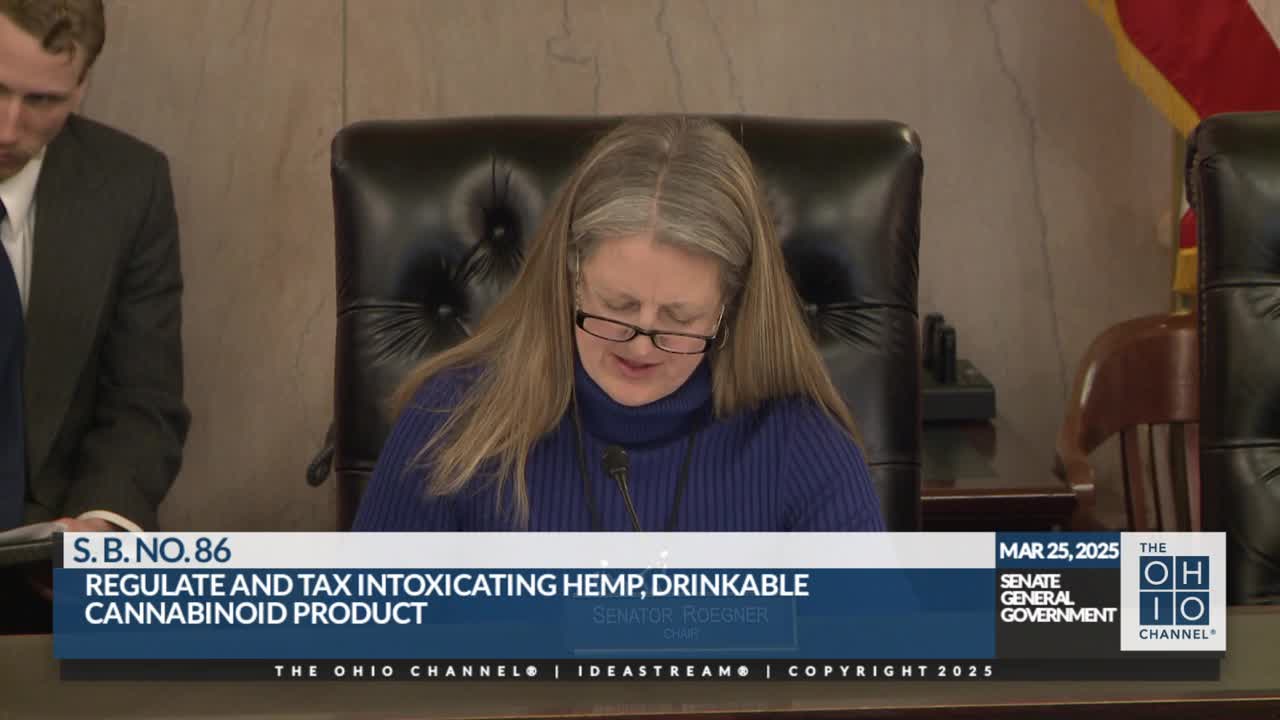
Opponents of Senate Bill 86 told the Senate General Government Committee that the bill's proposed THC caps and placement of many hemp products into the marijuana dispensary system would harm small businesses, reduce patient access to hemp-derived therapeutics and strengthen illicit markets. The committee held an extended third hearing with dozens of in-person witnesses representing retailers, manufacturers, medical practices and trade associations.
Robert McClure, owner of SunMed Your CBD Store in Centerville, said the bill’s proposed limits — 0.5 milligrams of delta‑9 THC per serving and 2 milligrams per package as presented in testimony — would place many full‑spectrum hemp products out of reach. "Senate Bill 86 ... would put myself and many others who are doing it right out of business," McClure said, describing his store's 3,000‑milligram full‑spectrum tincture (about 2.5 mg THC per serving and roughly 75 mg per bottle) and a 40:1 CBD to THC ratio that he argued moderates psychotropic effects.
Other small business witnesses made related points. Jim Higdon, cofounder of Cornbread Hemp, warned of dormant commerce‑clause litigation if Ohio restricts out‑of‑state hemp manufacturers from selling lawful hemp products in Ohio. "By restricting sales ... this body would prevent out of state manufacturers like Cornbread from doing business in Ohio," he told the committee.
Industry and medical witnesses urged regulatory alternatives rather than an outright transfer of hemp products into the marijuana dispensary framework. Dr. JJ Coombs, CEO of Arvida Labs, Alpha Brands and Melofelo, summarized the industry's request for "clear and sensible regulation" and described testing and traceability practices his companies use. He told the committee the hemp‑derived cannabinoid sector in Ohio contributes significant economic activity and employs thousands of workers, figures he said the industry wanted lawmakers to weigh when writing regulation.
Physicians and patient‑facing businesses emphasized patient access and safety. Dr. Bridget Cole Williams, a board‑certified family physician and medical cannabis specialist, said many patients rely on hemp‑derived therapeutics and would avoid dispensaries; she urged education, testing and targeted enforcement instead of an across‑the‑board ban from retail.
Several witnesses focused on illicit synthetic cannabinoids and enforcement. Don Wirtschafter, an attorney with experience in cannabis pharmaceuticals, said many illegal or unapproved synthetic products are already misbranded or adulterated and argued the state should more vigorously enforce existing law and provide regulators with resources rather than adopt blunt potency caps. "These are adulterants... This is all illegal already. We don't need new laws to get rid of these synthetics out of our products. We simply need to enforce the law," Wirtschafter said.
Retail and grocery representatives asked the committee to preserve options for age‑restricted retail sales with strict labeling, testing and child‑resistant packaging. Kristen Mullins of the Ohio Grocers Association and John Lynch, a licensed beverage producer, urged measured potency standards and carve‑outs so non‑intoxicating products and certain beverages would remain available at conventional retailers.
Committee members repeatedly asked witnesses to clarify which formats and product types the bill would affect. During the hearing Senator Mora confirmed with staff that — as the chair clarified on the record — topical products and some oils are carved out of the bill's proposed retail prohibitions; witnesses nonetheless warned that the proposed per‑serving and per‑container caps would remove many existing retail items from store shelves.
No formal committee votes on SB 86 appear in the transcript; the hearing concluded with written testimony filed and the committee moving on to other agenda items.