Get Full Government Meeting Transcripts, Videos, & Alerts Forever!
Get email alerts on the Hemp Regulation topic
No spam. Unsubscribe anytime.
Ohio hemp industry warns proposed THC caps would push products into illicit channels and harm small businesses
Summary
At a March committee hearing on Senate Bill 86, hemp retailers, manufacturers, doctors and grocers urged lawmakers to reject strict THC limits they say would shut out lawful products from retail shelves, push consumers to unregulated markets and impose heavy compliance costs.
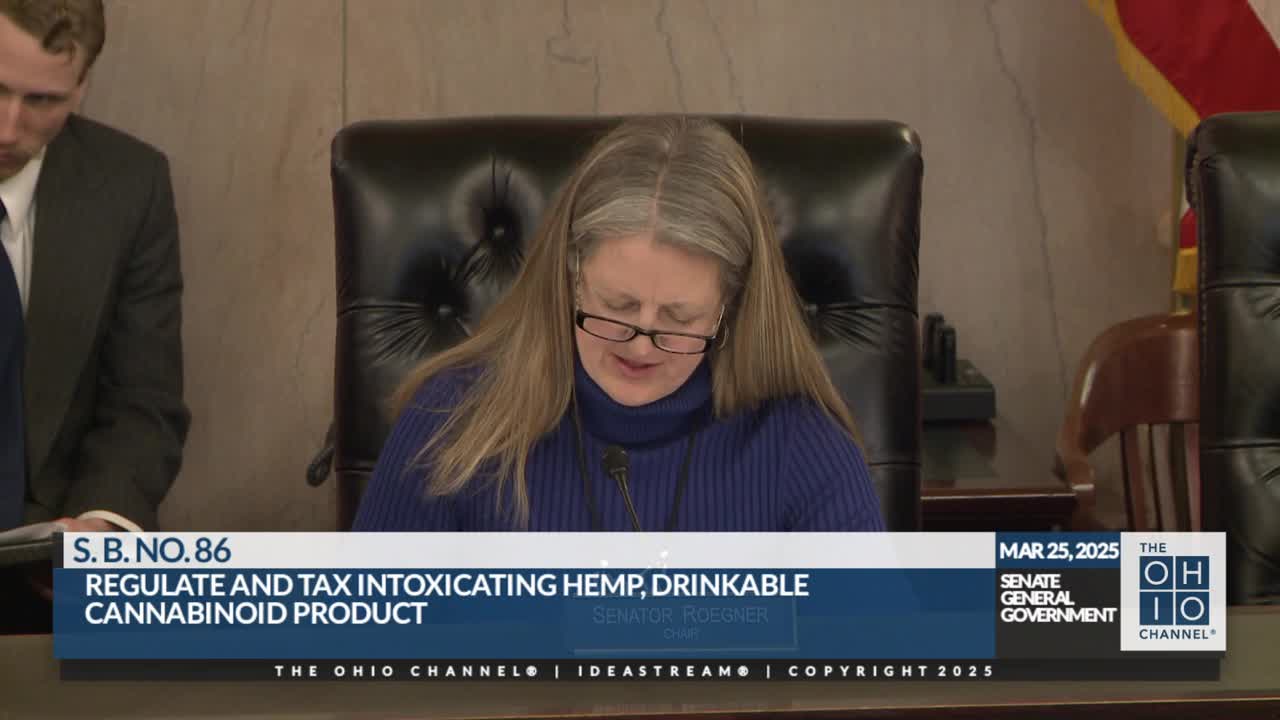
Senate General Government Committee members heard more than two hours of mostly opponent testimony March 18 on Senate Bill 86, legislation that would set low THC caps for hemp-derived products and largely move potentially intoxicating hemp items into the state’s marijuana dispensary system.
Supporters of the bill argue it would protect young people and public safety by restricting intoxicating hemp sales to regulated dispensaries. But dozens of Ohio small-business owners, hemp manufacturers, grocers and medical professionals told the committee that the proposal’s proposed limits — cited in testimony as 0.5 milligrams of delta-9 THC per serving and 2 milligrams per package — are arbitrary, would eliminate most full‑spectrum hemp products from retail shelves, and would shrink consumer access and local businesses’ markets.
“Senate Bill 86 would shut down the line of education from our stores,” said Robert McClure, a U.S. Marine veteran and owner of SunMed Your CBD Store in Centerville. McClure said his top-selling full‑spectrum tincture contains roughly 2.5 milligrams of delta‑9 THC per serving in a 30‑day supply and that a 40:1 CBD:THC ratio in his products reduces any intoxicating effect.
Other witnesses gave similar testimony. Jim Higdon, co‑founder of Cornbread Hemp, told senators that the bill would force federally legal hemp products into a dispensary system that he said is both inappropriate and likely to be vulnerable to a dormant‑commerce‑clause challenge if out‑of‑state manufacturers are excluded. “By restricting sales ... into the existing recreational marijuana regulatory framework, this body would prevent out‑of‑state manufacturers ... from doing business in Ohio,” Higdon said.
Manufacturers and lab experts warned about practical problems in the draft language. JJ Coombs, a PharmD and CEO with manufacturing experience, called for “clear and sensible regulation,” including product traceability and targeted measures to remove bad actors without crippling legitimate businesses. Wesley Bryant, a licensed hemp manufacturer, urged the committee to define “intoxicating” precisely, to protect work‑in‑progress (WIP) materials used in lawful processing, and to include federal safe‑harbor language protecting interstate shipments of hemp.
Some witnesses emphasized consumer and patient access. Dr. Bridget Cole Williams, a board‑certified family physician and medical‑cannabis specialist, said restricting access to non‑prescription hemp products would “severely limit treatment options for thousands of Ohioans” who rely on local retailers and would likely drive consumers to unregulated online sources.
Opponents proposed alternatives: strict testing and labeling requirements, child‑resistant packaging, product registration and a targeted enforcement approach aimed at synthetics and bad actors rather than broad product bans. Several witnesses said the legislature should adopt a framework modeled on states that regulate hemp rather than fold hemp into the existing adult‑use dispensary regime.
Committee members asked multiple witnesses whether special‑purpose stores could be differentiated from gas stations and other retailers; whether oils and topicals are affected; and how many products would be removed. The chair clarified during the hearing that committee staff had advised that some oils and topicals are carved out of the bill’s draft language; witnesses repeatedly urged clearer statutory text.
No final committee action was taken. The hearing record shows broad industry opposition and multiple requests for substitute language that refines definitions, preserves lawful hemp commerce, and targets synthetics and noncompliant products.
Ending: The committee accepted written testimony and signaled further work on the bill. Sponsors and opponents both said they expect additional drafting and a possible separate regulatory bill to follow; no formal vote on SB 86 was recorded at this hearing.