Get Full Government Meeting Transcripts, Videos, & Alerts Forever!
Get email alerts on the Hemp Regulation Intoxicating Products topic
No spam. Unsubscribe anytime.
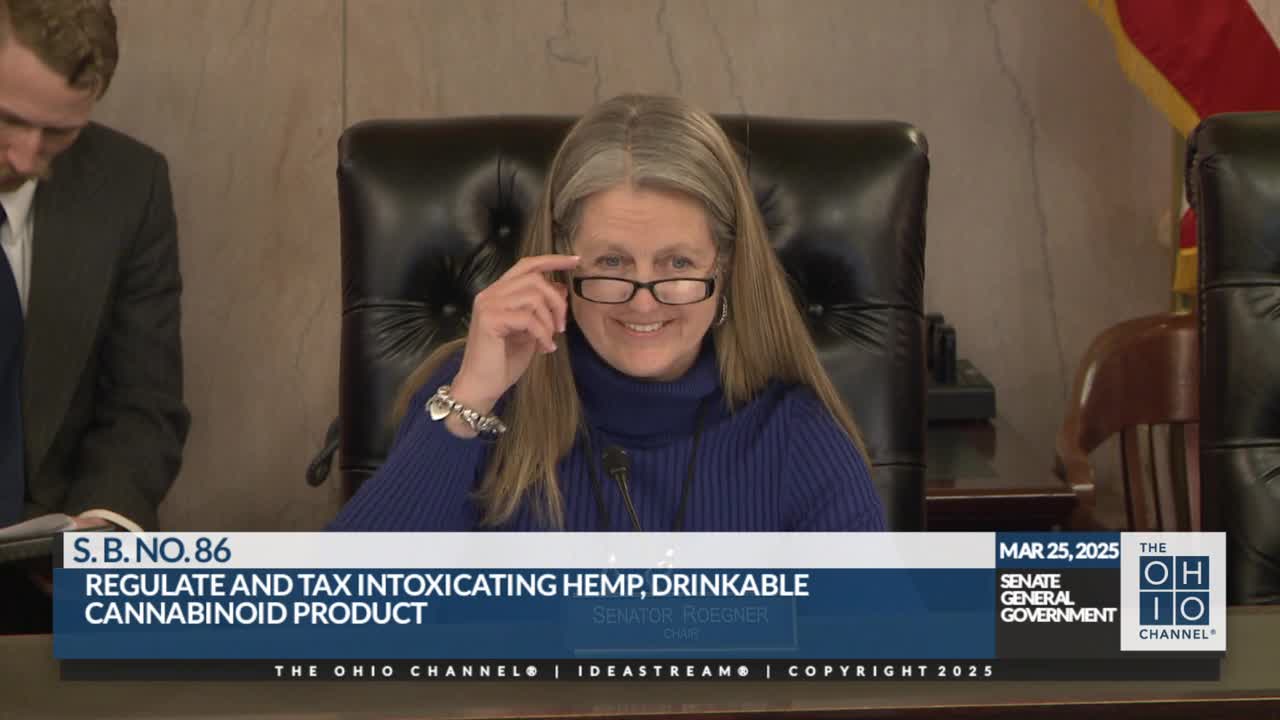
Large panel of hemp business owners, health professionals urge regulation over ban in SB 86 hearing
Summary
Retailers, manufacturers and medical professionals told a Senate committee that Senate Bill 86’s THC caps and plan to move intoxicating hemp products into marijuana dispensaries would harm small businesses and patients and would likely push demand into unregulated channels.
Dozens of business owners, manufacturers and health professionals told the Senate General Government Committee during a third hearing on Senate Bill 86 that the bill’s proposed THC caps and a plan to shift intoxicating hemp products into the regulated marijuana dispensary system would inflict severe harm on Ohio’s hemp industry and on patients who rely on hemp-derived therapeutics.
Opponents argued for a regulatory approach focused on testing, labeling, registration and age restrictions rather than an outright ban or wholesale transfer to dispensary sales. Robert McClure, a U.S. Marine veteran and owner of SunMed Your CBD Store, said, “Senate bill 86 … would put myself and many others who are doing it right out of business,” explaining that his full-spectrum CBD tinctures rely on naturally occurring THC at levels that would be excluded under the bill’s proposed 0.5 mg per serving and 2 mg per package limits.
Jim Higdon, cofounder of Cornbread Hemp, said he supports regulation but warned that the proposed limits could trigger dormant commerce clause challenges and block out-of-state manufacturers that currently sell federally legal hemp products in Ohio retail outlets. “By restricting sales…this body would prevent out of state manufacturers like cornbread from doing business in Ohio,” he said.
Dr. JJ Coombs, a pharmacist and industry CEO, emphasized the economic scale of the sector and urged targeted rules: “Ohio businesses in the hemp industry require precise guidelines to ensure compliance and promote legitimate operators, ultimately protecting consumers and fostering economic stability.” Industry witnesses gave numeric estimates for the sector’s contribution (testimony cited figures such as $704,000,000 annual contribution and 8,000 employees), and urged that regulation target “bad actors” and synthetic cannabinoids rather than lawful full–spectrum hemp products.
Several retail and grocer representatives warned that moving hemp products to marijuana dispensaries would reduce access for older adults and patients who rely on nonintoxicating hemp formulations, and could drive consumers to online or illicit sources. Kristen Mullins of the Ohio Grocers Association said members “take responsibility of selling a wide range of adult products…We appreciate language within Senate Bill 86 that would allow certain types of hemp beverages to continue to be sold at retail locations. However, we have concerns that the language in the Bill will ban most of the other types of hemp products from retail sale and driving them into an unsafe illicit environment.”
Don Wirtschafter, a lawyer with long experience in cannabis-related products, urged enforcement of existing laws against synthetic and adulterated products rather than adopting numeric tolerances that are difficult to measure. “What this bill tries to do is … regulate the unregulatable. You don't know what delta 8 CBD or delta 8 THC is. You can't measure it,” he testified.
Proponents of regulation suggested compromise measures testified in writing and in person: mandatory third‑party testing, child‑resistant packaging, product registration, clear labeling of cannabinoid ratios (CBD:THC), and age‑restricted sale (21+). Several witnesses referenced the 2018 federal Farm Bill as the baseline for legal hemp and urged alignment between state rules and federal safe-harbor and interstate-transport provisions.
Committee members asked technical questions about product formats, testing certification, and how limits would operate (serving vs. package, oils vs. gummies). Some committee members clarified that certain topical and oil products were intended to be carved out of the proposed restrictions, though witnesses urged explicit statutory protections for those formats to avoid confusion.
No formal committee vote on SB 86 took place during the hearing. Several witnesses said they would work with legislators on targeted amendments to preserve patient access, support compliant businesses, and remove synthetic adulterants from the market.
The hearing record includes dozens of in‑person witnesses representing retail chains, manufacturers, medical professionals, industry trade groups and hemp businesses.