Get Full Government Meeting Transcripts, Videos, & Alerts Forever!
Get email alerts on the Hemp Regulation topic
No spam. Unsubscribe anytime.
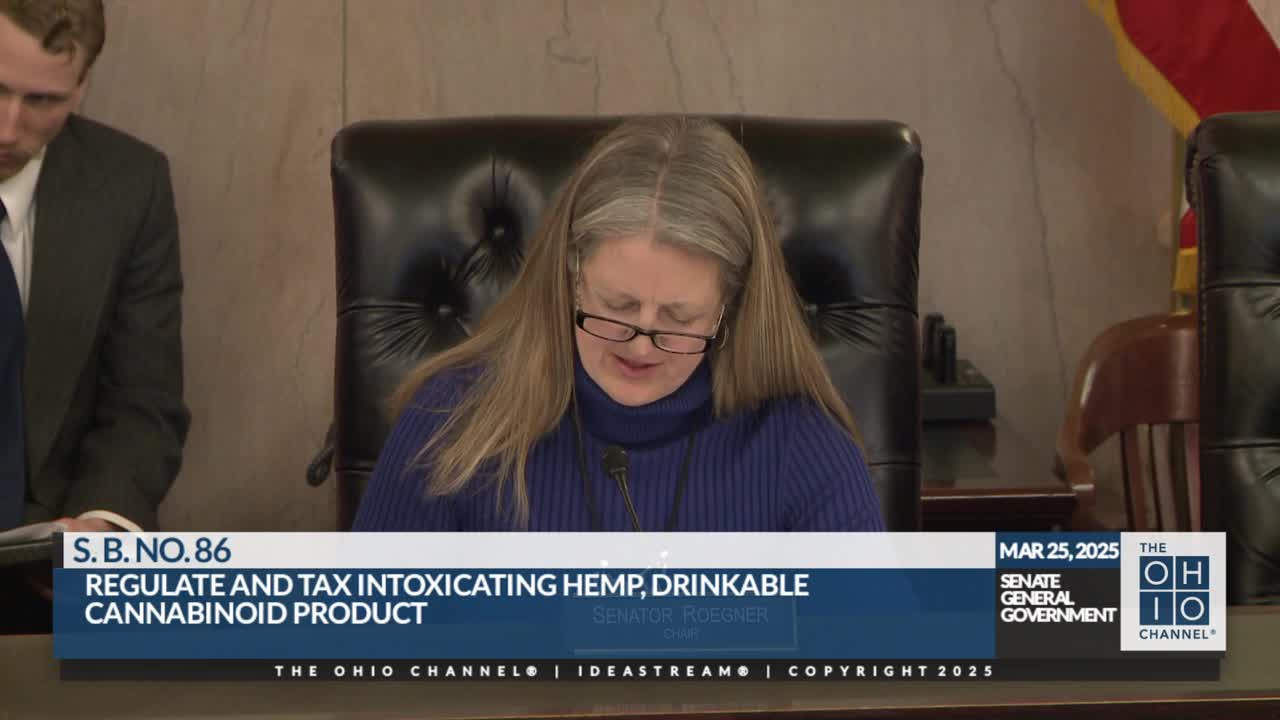
Senate hearing on SB 86 draws industry opposition; retailers and medical professionals seek regulation, not ban
Summary
Retailers, manufacturers and medical professionals told the Senate General Government Committee that proposed THC caps and moving hemp products into dispensaries would harm small businesses, patients and the supply chain; witnesses offered regulatory alternatives.
A third hearing on Senate Bill 86 drew broad testimony from Ohio hemp business owners, manufacturers, retailers and medical professionals who said the bill’s proposed controls on “intoxicating hemp products” would hurt patients, small businesses and the state supply chain.
Opponents—many of them small-business owners and manufacturers—told the Senate General Government Committee that the bill’s THC limits and a proposal to restrict many hemp products to the recreational marijuana retail system would be economically and operationally harmful. Robert McClure, owner of SunMed Your CBD Store, said of the bill as written, “Senate Bill 86 … would put myself and many others who are doing it right out of business.” Co-founder Jim Higdon of Cornbread Hemp said the limits would push lawful out-of-state manufacturers out of Ohio markets and could raise dormant-commerce-clause legal issues.
Manufacturers and testing experts asked the committee to calibrate regulation instead of a near‑ban. Doctor JJ Coombs, a pharmaceutical scientist and industry executive, testified that clear, measurable standards and enforcement targeted at bad actors would protect consumers while avoiding devastating economic impacts. The Ohio Grocers Association’s Kristen Mullins urged strong age restrictions, labeling and testing rules so responsible grocery and convenience retailers could continue to sell adult products without driving consumers to illicit channels. Dr. Bridget Cole Williams, a family physician, said restricting access to local hemp products would limit treatment options for patients who turn to hemp-derived therapeutics.
Several witnesses described product specifics and industry practices. McClure said his top-selling full-spectrum tincture is a 3,000-milligram product he estimates contains approximately 2.5 milligrams of delta-9 THC per serving and roughly 75 milligrams per 30-day bottle; he and others stressed CBD-to-THC ratios and third-party batch testing as safeguards. Industry representatives warned that nonplant synthetic cannabinoids and unregulated isolates—often sourced from out of state—are a separate enforcement challenge that regulation can and should address.
Opponents and industry groups advanced alternatives: age 21 purchase requirements, childproof packaging, out-of-state product registration, mandatory third-party testing and specific potency/serving metrics for beverages and other formats. Producers also asked the committee to distinguish work‑in‑progress material, which can temporarily exceed federal 0.3% THC thresholds during processing, from finished consumer products.
Not all witnesses opposed all restrictions; John Lynch, a licensed hemp beverage producer, said he “fully support[s] a limit for the amount of THC allowable in containers” while urging a technical exception for small-volume “shot” containers. A committee clarification toward the close of testimony noted that oils and topical creams would be carved out of the bill’s most restrictive provisions, a point a senator confirmed to the audience.
No formal committee action or final vote on SB 86 appears in the transcript; members and witnesses repeatedly urged the drafting of targeted regulation to remove unsafe products and protect legitimate businesses and patients.