Get Full Government Meeting Transcripts, Videos, & Alerts Forever!
Get email alerts on the Exhibitions And Programs topic
No spam. Unsubscribe anytime.
Kingston arts director reports strong turnout for "Freedom" exhibit, outlines funding needs and programming
Summary
Kit, director of Kingston's Department of Arts and Cultural Affairs, reported about 280 visitors to the current "Freedom" exhibition, described ongoing and upcoming public programs, noted lighting and accessibility needs at City Hall, and summarized small sponsorships and ARPA funding supporting the department.
Kit, Director of the Department of Arts and Cultural Affairs, told the Kingston Arts Commission that the current exhibition, titled the “Freedom” exhibition, drew roughly 280 visitors at its opening and produced offers to buy several works. “It was a blazing success, the freedom exhibition,” Kit said, adding that “about 280 souls walked through the door.”
The director reported one artist accepted a sale and “two others who have had offers as well.” Kit said Richard Fromis donated materials and supplies for the show, and that Trina Green paid for two light stands to improve foyer lighting. The statue related to the exhibition currently remains on view and the director said a pickup date has been set but described the schedule only as “the fourth with the arrangement of the fifth.”
Kit outlined facility and access issues at City Hall: two gallery lights are failing due to wiring (not simple bulb replacements), and the building needs a lighting-system assessment by an expert electrician before any new fixtures can be installed. The director said the lights donated for the statue “are making a difference” but that longer-term solutions require fundraising and technical review.
On programming, Kit summarized seasonal and special events: the Sojourner Truth Walk (noting it begins at Kingston Plaza on Feb. 15 this year), a textile art showcase on March 29 with 24 presenters, a shortened Music in the Parks season because of budget cuts, and a family-oriented monthly free program tied to exhibitions. Kit thanked the Art Society of Kingston for acting as fiscal sponsor for Woodstock Weavers and noted Ulster Savings pledged $2,000 to support an April youth program.
Kit said the department’s budget is listed on the city website and includes one month’s salary funding and an obligation of $10,000 from federal ARPA funds. The director also reported that the commission collected more than $2,000 in donations at the end-of-year event and that these proceeds were given to the People’s Place.
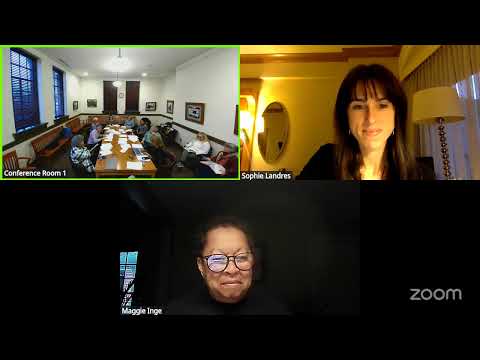
Kit described efforts to expand inclusion and accessibility: partnerships with Bloomberg Connects to provide exhibition content in multiple languages; outreach to Kingston schools; and work to make exhibits ASL-accessible. Cedric Castro, a newly introduced commissioner who works in community engagement for CPW, described community outreach and youth programming linked to the department. Sophie Landres, newly appointed commissioner and curator at the Dorsky Museum at SUNY New Paltz, said she is “ecstatically happy to be part of this commission” and emphasized bringing curatorial experience to local programming.
The director also previewed multi-year events connected to national anniversaries and to Kingston milestones: planning for the U.S. semiquincentennial (250th) in 2026–2027, coordination with local historians and state partners, and a confirmed performance by Bard Conservatory for the 2026 “Burning of Kingston” finale.
Questions from commissioners included rain-date planning for outdoor concerts (Kit said the high school has not agreed to partner and that the municipal chambers have been used on occasion as an indoor alternative), and the department’s need for additional staff and funding to support a full public-art implementation phase. Kit closed by saying the meeting was “the best Kingston Arts Commission meeting I’ve ever attended” during her nearly four years as director.
Ending: The director’s report emphasized outreach, small sponsorships, and short-term facility needs (lighting and accessibility) while flagging larger funding and staffing work that the commission and administration will need to address in coming months.