Get Full Government Meeting Transcripts, Videos, & Alerts Forever!
Get email alerts on the Instruction Time topic
No spam. Unsubscribe anytime.
Sponsor urges adding 53 instructional hours to reverse years of lost classroom time
Summary
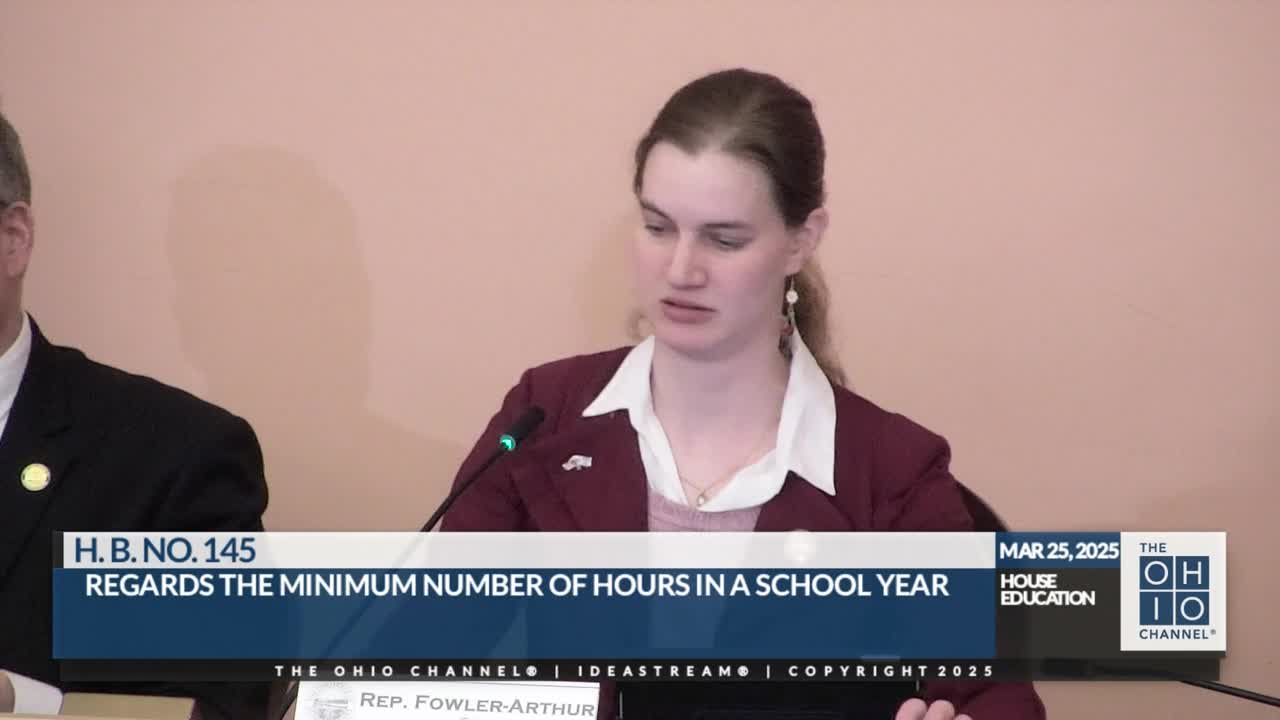
The House Education Committee conducted a first hearing on House Bill 145, a proposal from Representative Byrd to add 53 instructional hours to current state minimums for public school instruction.
The House Education Committee conducted a first hearing on House Bill 145, a proposal from Representative Byrd to add 53 instructional hours to current state minimums for public school instruction.
Representative Byrd (sponsor) said the bill is intended to “return lost instructional time” that he said was removed when the General Assembly shifted from a days‑based requirement (180 days) to an hours‑based system in 2014. Byrd described the change as having reduced instructional time by roughly 14 to 20 school days, depending on a district’s daily schedule, and said HB145 would raise the minimum total to 1,054 hours.
Byrd argued that increasing instructional hours supports student achievement and cited comparative figures provided in testimony: Kentucky (1,062 hours), Michigan (1,098), West Virginia (1,080), Texas (1,260), and an international example, South Korea (1,300 hours). He referenced education research and pilot programs as part of the rationale, saying, "Time in front of a teacher matters."
Committee members pressed on implementation and cost. Representative Miller and others asked how the bill would affect teacher contracts, professional development time, bus schedules and daily orders, and whether districts should or would compensate teachers for additional time. Byrd said he expects districts and collective‑bargaining arrangements to be addressed in amendment language and that he does not want to impose unworkable requirements without sufficient lead time. He said some districts already have teacher contracts that include non‑instructional days that could be repurposed.
Representative Robinson asked whether the timeline would allow districts to adjust; Byrd said he hoped for enactment in time for the 2026‑27 school year but acknowledged scheduling and bargaining concerns and said he would accept amendments to address timing. Vice Chair Odioso and others asked about daily‑operation impacts (start/end times, lunches, transportation); Byrd replied the bill adds hours rather than prescribing how districts must use them, preserving local scheduling flexibility.
Ending: Sponsors asked for continued consideration and signaled willingness to work with members on bargaining, compensation, and implementation timelines; no committee vote was taken at the first hearing.