Get Full Government Meeting Transcripts, Videos, & Alerts Forever!
Get email alerts on the Education topic
No spam. Unsubscribe anytime.
Sponsors push bill to add instructional hours to Ohio school year
Summary
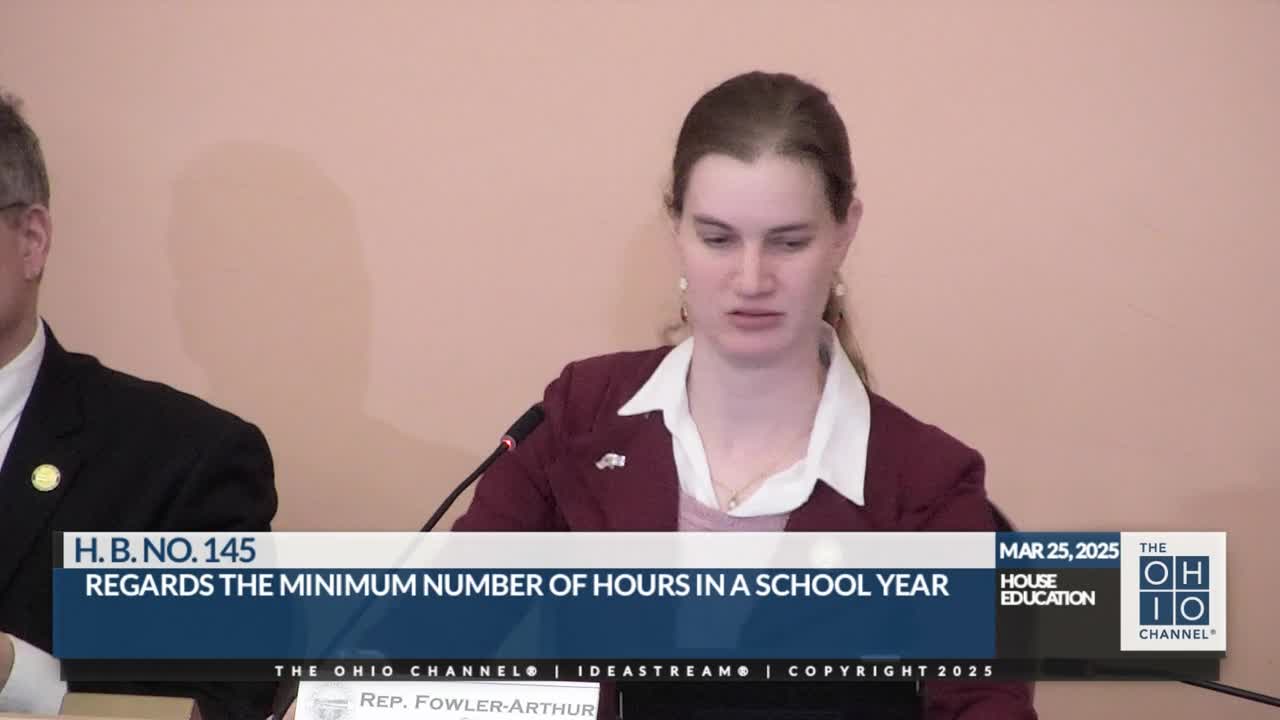
House Bill 145 would add 53 hours to the state minimum instructional requirement, sponsors said at a House Education Committee hearing, arguing the change would restore time lost when the state moved from a days‑based to an hours‑based requirement in 2014.
House Bill 145 would add 53 hours to Ohio’s minimum instructional‑time requirement for public schools, sponsors told the House Education Committee at a first hearing, raising the state standard to 1,054 hours from the current statutory level cited in testimony.
Representative Byrd, the bill’s sponsor at the hearing, said the change would reverse a long‑term ‘‘erosion’’ of classroom time that began when the General Assembly replaced a days requirement (180 days) with hours in 2014. "Time in front of a teacher matters," Byrd told the committee, citing research and out‑of‑state comparisons offered during testimony.
During testimony sponsors cited current statutory hours as a thousand and one hours for grades 7 through 12 and 910 hours for grades K through 6, and said the bill would add 53 hours to those totals. Byrd compared Ohio’s proposed standard to other states and international examples mentioned in testimony: Kentucky (1,062 hours), Michigan (1,098), West Virginia (1,080), Texas (1,260) and South Korea (1,300), and referenced studies that sponsors said show gains from increased instructional time.
Committee members raised several implementation concerns. Lawmakers asked about the impact on teacher contracts, professional‑development days and district scheduling, including bus routes and lunch schedules. Byrd said he did not foresee immediate added costs but acknowledged that collective‑bargaining agreements and local scheduling would require review and that language could be amended to allow phased implementation. He said the sponsor would welcome amendments and LSC review before any effective date.
Members also questioned whether the legislature had data showing improved outcomes from added hours and whether the change would allow enough time for districts to adjust; sponsors said the measure was intended to take effect with adequate lead time but were open to modification. The committee did not vote on the bill at the hearing.