Get Full Government Meeting Transcripts, Videos, & Alerts Forever!
Get email alerts on the Instructional Hours topic
No spam. Unsubscribe anytime.
Sponsor proposes adding 53 instructional hours statewide to reverse decline since 2014
Summary
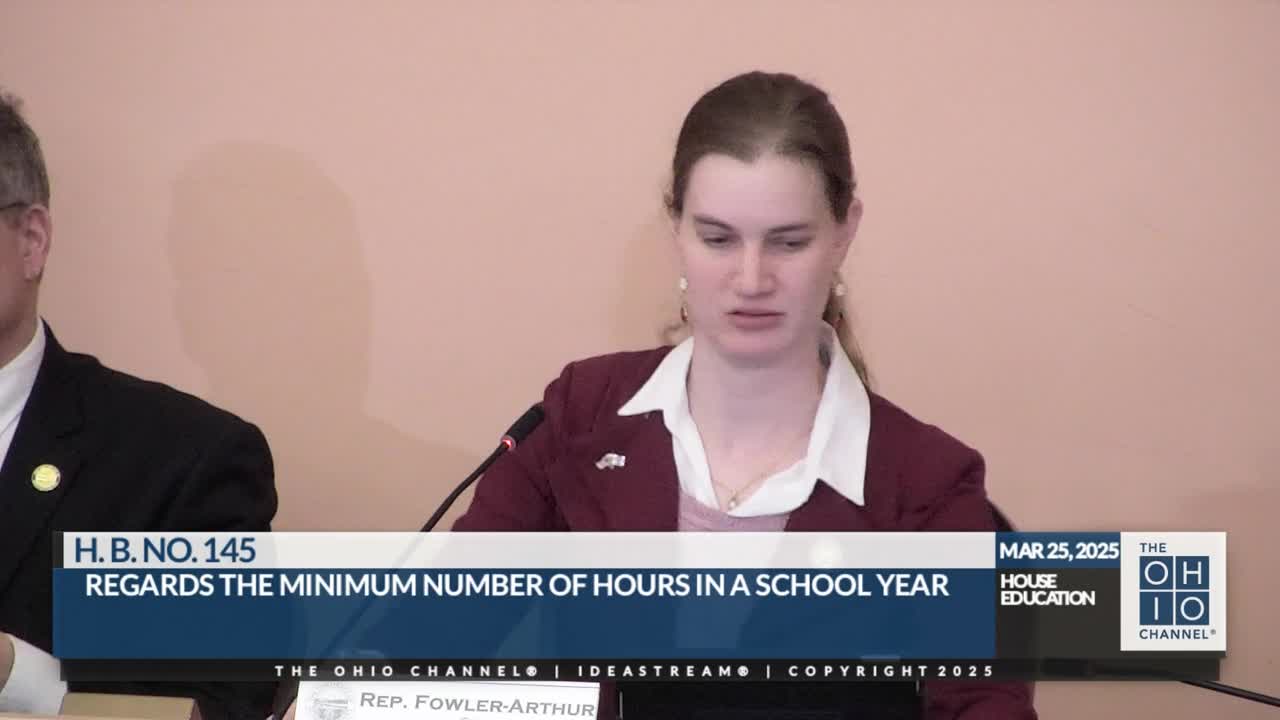
Representative Byrd presented House Bill 145, which would add 53 instructional hours to current statewide requirements to partially restore time lost when Ohio moved from a days-based to an hours-based requirement in 2014; committee members raised implementation, bargaining, cost and scheduling concerns.
Representative Byrd told the House Education Committee that House Bill 145 would add 53 instructional hours to current statewide requirements — increasing the standard from 1,001 hours to 1,054 hours — to reverse what he described as an erosion of students’ time in class since the state shifted from days to hours in 2014. "If this bill were to pass and add 53 hours, we'd go from a thousand and 1 hours in grades K to 12 to 1,054 hours," Byrd said during testimony.
Byrd said the 2014 change from a 180‑day standard to the current hours standards reduced students’ time in class by roughly two to three weeks depending on daily schedules, and he cited comparisons with neighboring states (for example, Kentucky 1,062 hours; Michigan 1,098 hours) and international examples to argue that additional instructional time correlates with achievement.
Committee members asked practical questions about implementation, collective bargaining, and costs. Representative Miller asked how the additional hours would affect teachers’ contracts and whether teachers should be compensated for added time; Byrd said teachers’ time is valuable and that the bill should respect existing collective bargaining agreements and allow time for districts to adapt. Vice Chair Odioso and others raised logistical concerns about daily schedules, bus runs, lunch and other operational impacts; Byrd said local districts would retain scheduling flexibility and that the bill does not return the state to a strict 180‑day requirement.
Sponsors discussed possible timelines and said they would consider amendments to address collective bargaining and implementation. This was a first hearing; the committee took testimony but did not vote on the measure.