Get Full Government Meeting Transcripts, Videos, & Alerts Forever!
Get email alerts on the Kindergarten Admissions topic
No spam. Unsubscribe anytime.
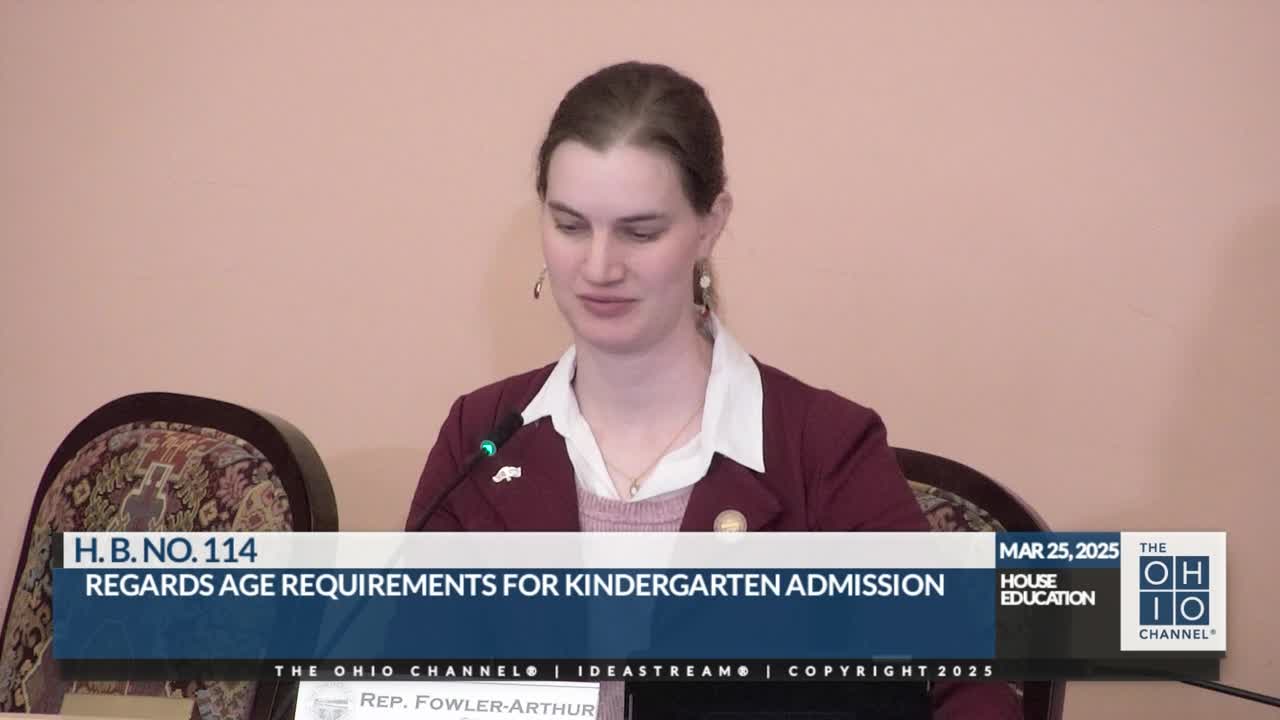
Sponsors seek uniform kindergarten cutoff in first hearing on House Bill 114
Summary
House Bill 114 would require Ohio public schools to admit children who are 5 by the first day of instruction and remove processes allowing early admittance for certain children; committee held a first hearing and asked sponsors for possible amendments on flexibility for accelerated children.
The House Education Committee held the first hearing on House Bill 114, a measure that would require public schools to admit to kindergarten any child who would be 5 years old by the district’s first day of instruction and would remove statutory processes that now permit early admission under certain conditions.
Representative Ritter and Representative Byrd, who presented sponsor testimony, said the bill seeks to create a uniform statewide standard. “Our bill, House Bill 114, is quite simple. It would do 3 things,” Ritter told the committee, listing: (1) require admission for children who turn 5 by the first day of instruction; (2) eliminate the referral and evaluation process that permits a child who will be 5 by January 1 to be evaluated for early admittance; and (3) eliminate the statutory allowance for early admission under a district’s student acceleration policy for children who would not be 5 by January 1.
Sponsors told members the change responds to constituent confusion where some school boards set a cutoff of Aug. 1 while others use Sept. 30, producing situations in which children miss by a day or two. Representative Byrd said constituents have urged consistency and that the bill would create a statewide standard while acknowledging local school-start-date differences.
Committee members asked whether the bill removes useful flexibility for families of children who are close to the cutoff or who are academically advanced. Representative Pickcolantonio said she was concerned about removing the referral/evaluation route for early admittance for children who may be ready; Representative Byrd said he would work with members on potential amendments to preserve flexibility for accelerated students.
Members also asked whether the bill would add costs to districts; sponsors said they do not foresee added costs but would coordinate with the Legislative Service Commission (LSC) on any technical fiscal questions. Representative Bridal asked whether the state should assist districts if costs arise; sponsors repeated that no added costs were anticipated.
The committee took no vote at the first hearing and sponsors said they are open to amendments, including language to address collective-bargaining agreements and potential timelines for implementation.
Ending: The first hearing closed with committee members requesting follow-up detail and sponsors indicating a willingness to craft amendments; no formal action was taken.