Get Full Government Meeting Transcripts, Videos, & Alerts Forever!
Get email alerts on the Higher Education Policy topic
No spam. Unsubscribe anytime.
Senate concurs in House amendments to Substitute Senate Bill 1 after hours of debate over DEI and academic freedom
Summary
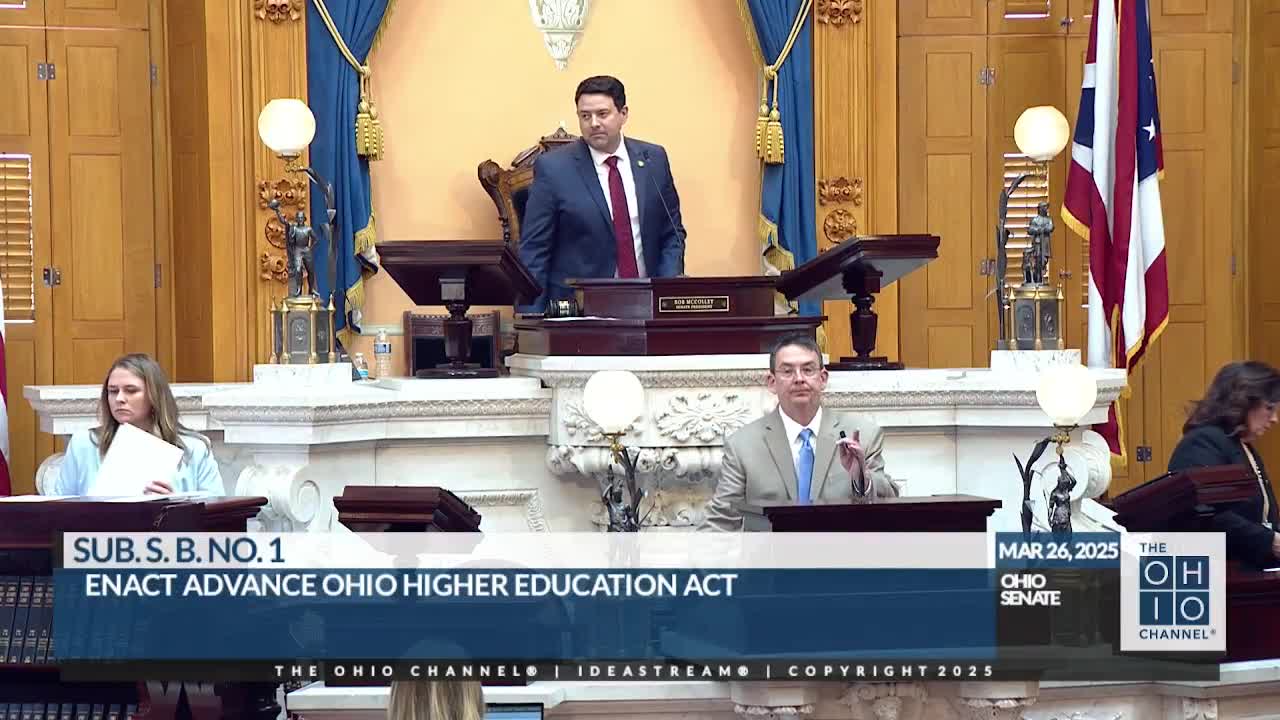
The Ohio Senate voted 20-11 to concur in House amendments to Substitute Senate Bill 1, known as the Advance Ohio Education Act. Supporters said the bill protects free expression and reforms higher education; opponents said it attacks academic freedom and collective bargaining and warned of chilling effects on university instruction.
The Ohio Senate on a 20-11 vote agreed to concur in House amendments to Substitute Senate Bill 1, sending the Advance Ohio Education Act to the governor after several hours of floor debate that split members over diversity, equity and inclusion policies, faculty rights and curriculum standards.
Senator Serino, the bill's sponsor on the floor, told colleagues the House made three specific changes and urged concurrence. "Mister president and members of the Senate, I strongly urge concurrence," he said, describing exemptions the House added for certain civics coursework and limited exceptions to the DEI prohibitions for compliance with state and federal law.
The bill matters because it changes statewide policy for public colleges and universities, including instructions on allowable training and orientation activities, a required American civic literacy course or equivalent, and new compliance procedures tied to the chancellor's office. Supporters said the measure restores viewpoint neutrality and academic freedom. Opponents said it micromanages campuses, curtails union activity and could harm recruitment and accreditation.
Opponents framed the bill as sweeping and punitive. "I oppose concurrence. I oppose this legislation. As I said, this is the worst piece of legislation this body has ever voted on since I became a senator 3 years ago," Senator DeMora said on the floor. Senator Smith argued the legislation is "the worst attack on academic freedom in Ohio in modern history" and warned that some provisions strike at collective bargaining and the right of faculty to strike.
Supporters pressed a different view. Senator Roegner called the bill a "landmark piece of legislation" and credited Serino's long effort to build consensus. Senator Reynolds framed the measure as removing labels that divide and urged colleagues to embrace what she described as a vision of "no labels, just neighbors." Senator Johnson thanked Serino for the effort of outreach to university leaders.
Key provisions discussed on the floor included three House changes Serino described: reinstating an exemption from the American civics literacy course if a student already completed a comparable three-credit history or government course; clarifying that the DEI prohibitions do not prevent institutions from complying with disability services requirements or permitting student organizations such as fraternities and sororities; and permitting institutions to request an exemption from the DEI prohibition for necessary orientation or training tied to accreditation or state compliance, subject to a written review by the chancellor.
Several senators repeatedly questioned how the bill would be enforced and who would adjudicate complaints about classroom speech or training content. Senator Ingram warned about narrowing academic discussion and urged caution about mandating another collegiate course when K-12 civics requirements already exist. Senator Antonio and others said constituents support the measure as restoring balance and accountability.
The chair then called a roll call. The Senate recorded 20 yeas and 11 nays, and the body announced it would send the bill to the governor.
The measure now awaits the governor's action; the Senate recorded concurrence in its final form and did not send the bill back to conference.
Votes on this bill and other floor business occurred during the same session; separate votes on Medicaid work requirements and veterans' mental health resolutions were taken later in the day.