Get email alerts on the Act 235 Judicial Shielding topic
No spam. Unsubscribe anytime.
Register of deeds warns Act 235 will affect county systems, data sharing and software needs
Summary
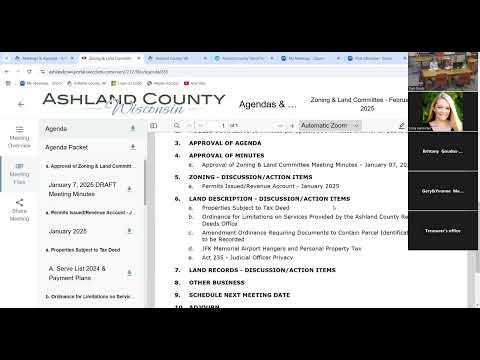
Julie Gleason briefed the committee on Act 235 (judicial officer shielding aka Daniel's law), saying the law will let judges request certain records be shielded and that compliance will require confidentiality agreements, software changes, and coordination with court counsel and the Wisconsin Counties Association.
Julie Gleason, Ashland County register of deeds, told the committee that Act 235 (sometimes called Daniel's Law) will allow judicial officers and qualifying family members to request that certain personal information be shielded from public records starting this year.
"The intent of the act was to provide an avenue for them, for the judges to request their information be shielded from the public record," Gleason said. She briefed the committee on practical implications for the register of deeds and related county offices: shielded items could include grantor/grantee name lines, document return-to lines, and other fields typically used by title companies and assessors. Gleason said title companies will likely need confidentiality agreements to receive shielded documents.
Committee members discussed the operational burden and potential liability. Staff noted the law contains a short compliance window (a 10-day turnaround for certain shielding requests was discussed) and that the statute creates criminal penalties if shielded information is improperly released; members therefore recommended consulting court counsel and the Wisconsin Counties Association (WCA) guidance and templates.
IT and software issues were raised: some committee members suggested contacting software vendors now (TriMin and others were mentioned) to learn whether a confidential flag or other functionality would meet statutory requirements and what costs would be involved. Committee members also noted the law is an unfunded mandate and that counties will likely need to budget for software or process changes.
Next steps the committee endorsed included consulting court counsel, monitoring WCA guidance and possible confidentiality-agreement templates being prepared by WCA, and contacting software vendors to estimate any required changes.
AI generated
The text on this page is AI generated. Summaries, highlights, analysis, and video transcripts are all produced from the original source material.
AI can make mistakes, so if you spot one, and we will fix it for everyone.
Note: the source content is unaltered by us. Any content source we link to, be it a video, an audio recording, or a document, is presented exactly as its publisher released it. That publisher is usually a government body, sometimes an individual official or another organisation.