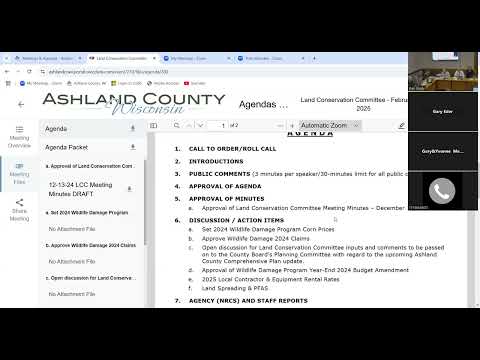
Ashland County committee urges PFAS testing, flags land‑spreading practices for comprehensive plan
Summary
Committee members discussed growing concerns about PFAS ("forever chemicals") in municipal biosolids and septic sludge, called for a county PFAS profile and recommended coordination with health and human services and regional partners to identify testing and funding options.
Members of the Ashland County Land Conservation Committee raised concerns about PFAS contamination from historically spread municipal biosolids and private septage and urged the county to build a testing and mitigation plan to inform the upcoming comprehensive plan update.
The committee framed the issue as both a public‑health and land‑use policy question: PFAS compounds accumulate in soils and can leach into groundwater and wells, and recent federal and agency guidance has lowered advisory levels. Committee members asked staff to map known biosolids and septage‑spreading sites, explore funding options, and bring PFAS to the county health and human services agenda for cross‑agency coordination.
Mary Jo, Land Conservation Department staff, explained how PFAS enters county waters and soils and summarized the local exposure pathways she has encountered: “PFAS contamination is very high in wastewater sludge,” she said, describing how laundering water, dishwashing and other household flows can carry PFAS into treatment systems. She told the committee that testing for PFAS is substantially more expensive than routine well tests — she cited an example lab charge of about $600 per PFAS sample versus roughly $60 for standard well sampling — and that there is currently limited grant funding targeted to county‑level soil testing.
Committee member Charlie Ortman urged that Ashland develop a “PFAS profile” — a prioritized map of sites that have received biosolids or septic spreading — so leaders can identify where soils and wells merit testing. Ortman noted recent federal moves to tighten advisory levels and said the county needs baseline data to guide future decisions about spreading practices.
Other members raised funding and legal options. Dan (committee member) told the group that recent biennial budget activity at the state level has included a multi‑million dollar appropriation for PFAS testing and remediation research that had not yet been released to counties; he advised staff to track those funds. Another member suggested tracking litigation and potential producer claims against manufacturers of PFAS; committee members compared the situation to earlier national litigation over other contaminants.
The committee discussed short‑term actions it could take: map permitted septage‑spreading sites (the department’s records show roughly 50 permitted private spreading locations), ask the county GIS staff to attach landowner contact data, coordinate with public health staff for well testing priorities, and seek regional grant writers and the Northwest Regional Planning Commission to identify funding opportunities. Members also proposed outreach and education for residents about products that contain PFAS and appropriate household disposal practices.
No formal vote or ordinance was taken; the committee treated the item as a planning and information request and directed staff to pursue mapping, interagency coordination, and research on funding options.
Ending: The committee asked staff to bring PFAS mapping results and a recommended scope for a county PFAS testing profile to a future meeting and to add the topic to the Health and Human Services agenda for coordinated action.
AI generated
The text on this page is AI generated. Summaries, highlights, analysis, and video transcripts are all produced from the original source material.
AI can make mistakes, so if you spot one, and we will fix it for everyone.
Note: the source content is unaltered by us. Any content source we link to, be it a video, an audio recording, or a document, is presented exactly as its publisher released it. That publisher is usually a government body, sometimes an individual official or another organisation.