Get Full Government Meeting Transcripts, Videos, & Alerts Forever!
Get email alerts on the Airport Hangar Taxation topic
No spam. Unsubscribe anytime.
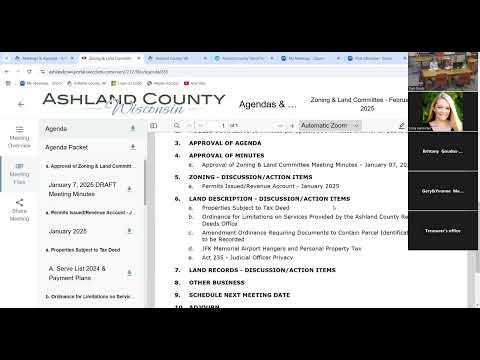
Committee discusses converting airport hangars from personal to real property tax treatment
Summary
Members reviewed challenges in assigning parcel IDs and apportioning tax liability for privately built hangars on leased airport land; options discussed include surveyed meets-and-bounds parcels or prorating taxes through lease changes.
Committee members and staff reviewed complications arising after Wisconsin eliminated separate personal property taxation in February 2023 and the resulting shift of hanger taxation to the underlying real property.
Members said that hangars built by private parties on leased airport land were previously taxed as personal property and now must be assessed as real property on the underlying parcel. That shift created practical problems for the county and the city of Ashland in associating pins (parcel identifiers) with individual hangars and in recapturing the tax burden from hangar users.
Staff noted a range of potential solutions: (1) engineers could prepare meets-and-bounds legal descriptions filed with the register of deeds to create parcel IDs; (2) the airport could prorate a combined tax bill among hangar renters and reflect the apportionment in leases; or (3) the county or city could pursue a detailed survey, which would be costly. Committee members stressed the cost problem: a formal surveyor'led boundary survey runs to thousands of dollars and the airport does not have that budget.
The committee discussed a lower-cost aerial-survey approach that local engineers proposed; one county official said that approach produced a near-complete mapping product used successfully at some small airports, though a meets-and-bounds legal description remains the typical best practice. Committee members recommended county and city staff coordinate with the airport manager and the city to determine whether to pursue parcels by survey, include a prorated tax clause in leases, or pursue another solution.
No formal vote was taken. Members agreed the topic requires further discussion with the City of Ashland and the airport manager because the airport property, leases, and operational responsibility intersect city and county authority.