Get Full Government Meeting Transcripts, Videos, & Alerts Forever!
Get email alerts on the Wildlife Damage topic
No spam. Unsubscribe anytime.
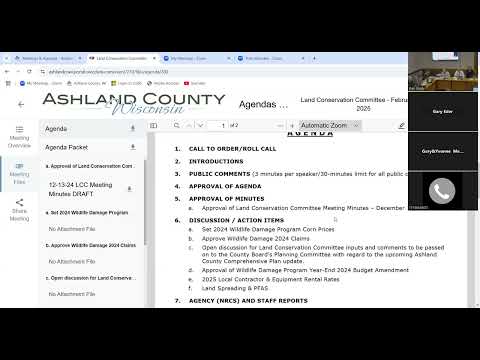
Ashland County committee adopts 2024 wildlife-damage prices and approves five claims totaling about $21,534
Summary
The Ashland County Land Conservation Committee voted unanimously to adopt the 2024 wildlife-damage crop and equipment prices recommended by USDA Wildlife Services and to approve five damage claims from the 2024 season totaling about $21,533.93.
The Ashland County Land Conservation Committee voted unanimously to adopt the 2024 wildlife-damage crop and equipment prices recommended by USDA Wildlife Services and to approve five damage claims from the 2024 season that together total about $21,533.93.
The price-setting and claims approvals matter because the adopted unit prices determine individual claim payouts and the county’s reimbursement requests to the Wisconsin Department of Natural Resources (DNR). Committee members heard a season recap from the USDA administrator who said last year’s weather and food conditions produced unusually heavy wildlife damage.
Ethan Rosing, USDA Wildlife Services administrator for Ashland, Bayfield and Iron counties, told the committee he compiled the price list by averaging monthly market prices from multiple sources and matching local replacement receipts for equipment and hive items. “I’m the administrator for Ashland, Bayfield, Iron County,” Rosing said. He also described the season’s response: trapping and relocating nuisance bears, using repellents for elk problems and issuing shooting permits where damage met program thresholds.
Rosing provided a written overview of the five approved claims: Mark Joma (deer damage to soybeans; pre-deduction appraised damage listed at $25,308.45; final payment capped at the program maximum of $10,000); Morgan Peck (combined elk and bear enrollments; final payment $6,398.86); Dave Kretschmar (small claim split across Ashland and Iron counties; final payment $521.33); Thomas Cunningham (equipment and bee-replacement receipts; final payment $1,008.75); and John Bridal (primarily elk damage; final payment $3,605.19). Rosing said receipts and sampling records supporting those figures are in each claimant’s file.
Rosing summarized broader season metrics: more enrolled participants, an increase in nuisance and agricultural wildlife incidents compared with the prior year, and expanded use of abatement tools. He said county teams trapped and relocated substantially more bears in 2024 than in 2023 and that DNR-placed lure crops and targeted repellent spraying produced “decent results” in some locations. He also reported that 43 deer were harvested under shooting permits issued through the damage program and that some elk trapping and relocation has been discussed for the Marengo and Butternut areas pending suitable winter conditions for capture.
Committee members asked for clarification about funding flows. Rosing explained that abatement costs such as repellent spraying are billed to the county and later reimbursed by DNR; claim payments are handled by DNR after committee approval. “The we get billed directly for the abatement measure, which is spraying, and then we pay that bill, and then we seek reimbursement from the DNR,” Rosing said.
The committee made a motion to adopt the price schedule recommended by the DNR/USDA representative and to sign the related paperwork; the motion was seconded and approved by voice vote. Later the committee moved to approve the five claims presented; the motion carried by voice vote.
Committee members noted variability in season conditions — a wet early summer followed by a dry late season — and discussed program mechanics such as field-level sampling (three undamaged samples and three to four damaged-area samples per field), program enrollment rules and the requirement that landowners who enroll for an animal species allow managed public hunting for that species. Several members also asked whether NRCS or other data sources might help streamline sampling; Rosing said he prefers field-specific samples to capture within-field variation.
The committee directed staff to collect signatures on the approved price and claim paperwork for submission to DNR and to retain receipts and sampling documentation in claim files. No litigation or ordinance action was proposed at the meeting.
Ending: Committee members thanked staff and the USDA representative for the season overview and approved the administrative paperwork necessary to submit the county’s reimbursement package to the DNR.