Get Full Government Meeting Transcripts, Videos, & Alerts Forever!
Get email alerts on the Tax Deed Sales topic
No spam. Unsubscribe anytime.
Ashland County committee approves ordinance draft to clarify tax-deed sales, timelines and proceeds distribution
Summary
The Ashland County Zoning and Land Committee voted March 18 to send an ordinance on tax-deed land sales and distribution of proceeds to the full County Board, after an extended discussion about timelines, title reports, special assessments and how the county recoups staff time and interest on tax-roll charges.
ASHLAND COUNTY — The Ashland County Zoning and Land Committee voted March 18 to send an ordinance governing the sale of tax-deed land and the distribution of proceeds to the full County Board, after an extended discussion about how the county will handle special assessments, title-report timelines and reimbursement for county staff time.
Carisha Flint, the zoning administrative assistant, presented the draft ordinance and said it assembled the committee’s prior revisions into the version before the committee. “All I did for the document that's before us today was, take all of our revisions that we had mentioned and put them in,” Flint said.
The discussion focused on two practical questions: how the county treats special assessments (for example, unpaid water or street-assessment charges) when those assessments are placed on the property tax roll, and how much time a former owner has to order a title report and clear liens before the county lists the property for sale.
Why it matters: the ordinance sets the county’s internal timeline and procedures for reclaiming properties and selling tax-deeded land, which affects property owners with delinquent utility or assessment charges, the county’s ability to recover administrative costs and the timing of foreclosure and resale. Committee members repeatedly pressed for language that would be simple to explain to property owners and that ensured the county is reimbursed for its time.
Pat Kenny, a committee member, raised concerns about how special-assessment collections interact with county charges. “Once you send this to the county, the county is gonna charge 18%,” Kenny said, referring to the interest and penalty the treasurer applies when assessments are placed on the tax roll. Kenny urged that any payments received be applied first to county time and expense so the county is not left unpaid for staff work on these accounts.
Committee members and staff clarified current practice: payments applied by the treasurer’s office are typically credited first to special assessments or delinquent charges, before being applied to general tax amounts. Committee members also noted the county retains any interest and penalties collected once a charge appears on the tax roll.
Committee members debated the draft ordinance’s timeline language. The draft contained several reference points: a 90-day window for a former owner to request a title report, a 30-day window after the title report to pay liens, a 120-day deadline for county acquisition-related actions and a requirement to list tax-deeded land for sale after 180 days. Several members argued that the varying reference points added complexity and could give some reclaiming owners an uneven advantage.
“From the time the county takes it on tax deed, you have 120 days to come in, pay for title search, and pay all liens due,” Blake Lisonbee, a committee member, said in favor of a single reference point. Pat Kenny and others advocated keeping a firm 120-day deadline from county acquisition as the primary reference; committee staff suggested keeping the 90/30 structure as a way to give former owners some certainty about when their individual windows begin.
Carisha Flint said she would reword the ordinance to clarify the timing and clean up stray edits and strikeouts before it goes to the County Board. Committee members also confirmed that state law requires listing tax-deeded property on the multiple-listing service (MLS), and the county’s policy is to list through a licensed real-estate broker or agent.
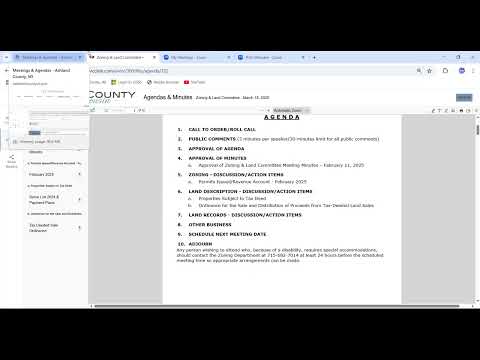
The committee voted to forward the ordinance to the full County Board with suggested edits. Pat Kenny moved to approve the draft ordinance for referral to the board with the committee’s suggested edits; Gary Eder seconded. The motion passed on a voice vote.
Votes at a glance: - Motion to send the ordinance on sale and distribution of proceeds from tax-deed and land sales to the full County Board (mover: Pat Kenny; second: Gary Eder): approved by voice vote (unanimous among members present). - Motion to approve the meeting agenda (mover: Gary Eder; second: Jim Moe): approved by voice vote. - Motion to approve minutes of the Feb. 11, 2025, Zoning and Land Committee meeting (mover: Pat Kenny; second: Gary Eder): approved by voice vote.
The committee also discussed next steps for properties already in the county’s possession and the schedule for foreclosure discussions. Members asked staff to prepare valuations and listings for properties the county already owns and to bring those to a future meeting. The committee scheduled a follow-up meeting for April 15 to review properties proposed for foreclosure and to act on listings and valuations.
Committee members said they intend to clarify the ordinance language between the committee vote and the full County Board meeting slated for March 26 so that the board sees a cleaner, single-reference timeline (committee consensus leaned toward a clear 120-day standard from county acquisition, with staff retaining discretion to account for title-report timing when appropriate).
The meeting also included a brief public-comment exchange about missing Zoom links on the posted agenda; Carisha Flint acknowledged the posting error and said she would correct future agendas so the public’s remote-access links match county board listings.
The committee adjourned at the end of its agenda.