Get Full Government Meeting Transcripts, Videos, & Alerts Forever!
Get email alerts on the Comprehensive Plan Update topic
No spam. Unsubscribe anytime.
Ashland County planning committee maps comprehensive-plan process, names citizen lead and readies consultant briefing
Summary
On March 19, 2025, the Ashland County Planning Committee assigned members to sections of a comprehensive-plan update, approved a citizen appointee to lead a plan element, set a rough outreach and review timetable, and prepared to receive a presentation from Northwest Regional Planning about consultant services and timeline.
The Ashland County Planning Committee on March 19, 2025 advanced work on a multi-year update to the county comprehensive plan, assigning committee members to lead individual plan elements, approving a citizen member to take the lead on one element, and setting a rough schedule for department outreach, public input and consultant engagement.
The committee said it will seek background work from a consultant, Northwest Regional Planning, once the county board finalizes hiring and grant acceptance. Dan Grady, county staff, told the group that “the board is voting to hire them” at the upcoming board meeting and that the consultant will present its scope and timeline to the board and answer questions for committee members.
Why it matters: the comprehensive plan will guide county land-use policy, infrastructure investment and related grant applications for the next decade. Committee members tied the plan timetable to a pending Community Development Block Grant (CDBG) award and to consultant availability, and said early outreach to departments and townships will make later consultant work more efficient.
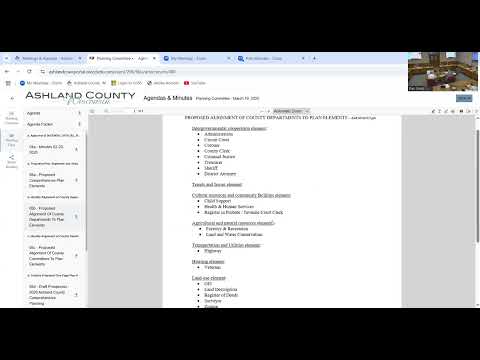
Most important actions and assignments: committee members agreed on a framework of plan elements and who will serve as point persons. The assignments discussed were: intergovernmental cooperation and trends — full committee support with Charlie Ortman taking a lead role; cultural resources and community facilities — Elizabeth Franek; agricultural and natural resources (including forestry) — Pat Kenny; transportation and utilities — George Boussay; housing — Bradley Ray; economic development (with land-use links) — Gary Martick; risk and opportunities and implementation — committee-wide involvement and later consolidation. The chair said implementation and final compilation would be performed by the consultant and staff when engaged.
Committee members debated whether to keep “community facilities” and “utilities” together (as in the prior plan) or split them for flow and to reduce repeated attendance by invited parties. Alyssa Lisonbee urged keeping annual review of the plan, saying she recommended “that you spend... a couple of hours going through it every year” to avoid letting the plan lapse.
Outreach and engagement plans: the committee discussed a multistep outreach timetable: invite department and committee input by June (allowing for quarterly schedules), seek township and municipal input by September, hold public informational meetings and at least some formal public hearings by December, and expect a consultant-drafted plan by the following March for further revision. Members emphasized mixing formats — electronic surveys, paper forms and in-person visits — to reach residents without broadband access and to capture input from the county’s southern townships. Rachel (staff) set up a central folder and advised members she had already shared a link; the committee also created a generic outreach email address for public responses (countyoutreach@ashlandcounty.wa was referenced as the address in draft outreach material).
Consultant funding and schedule: members discussed using a CDBG grant to pay consultant costs. The committee noted the county board must accept the CDBG award and execute the consultant contract; staff said the board’s vote to hire Northwest Regional Planning is scheduled for the next board meeting and that acceptance timelines for the grant could require an expedited acceptance within 45 days of award. Committee members agreed it was useful to begin internal outreach before the consultant’s formal start so departments and committees will be prepared when the consultant begins work.
Public input tools: members recommended drafting multiple survey templates — tailored versions for county departments, for committees, and for the general public — and using short, paper-friendly forms for in-person events such as senior lunches. Rebecca (committee member) described prior outreach to a group interested in countywide outdoor-recreation connections and recommended linking that constituency into the plan’s relevant elements.
Citizen appointment and voting items: the committee recorded a motion to include citizen appointee Charlie Ortman among the members leading a plan element. Pat Kenny moved to include Ortman and Bradley Ray seconded; the committee approved the motion by voice vote. Ortman stated he was “free to participate however the committee sees fit” but that he was “not free to do is, commit the city to any kind of activity without talking to them first and getting the approval of the council or the department” — a limitation he said would require consultation with his city council or department before agreeing to city commitments.
Next steps: Northwest Regional Planning will present to the county board (the meeting referenced for the consultant presentation was scheduled for Wednesday, March 26, at 9:00 a.m., per staff remarks). The planning committee tentatively set a placeholder for its next meeting on April 23, subject to adjusting the date so Northwest Regional Planning representatives can attend. The committee prioritized drafting survey instruments and a dissemination plan as its main agenda items for the next meeting.
The meeting adjourned after no public comments were offered during the public-comment period.