Get Full Government Meeting Transcripts, Videos, & Alerts Forever!
Get email alerts on the Veterans And Public Safety topic
No spam. Unsubscribe anytime.
House Bill 1 would bar 'foreign adversary' ownership near military bases and critical infrastructure, sponsors say
Summary
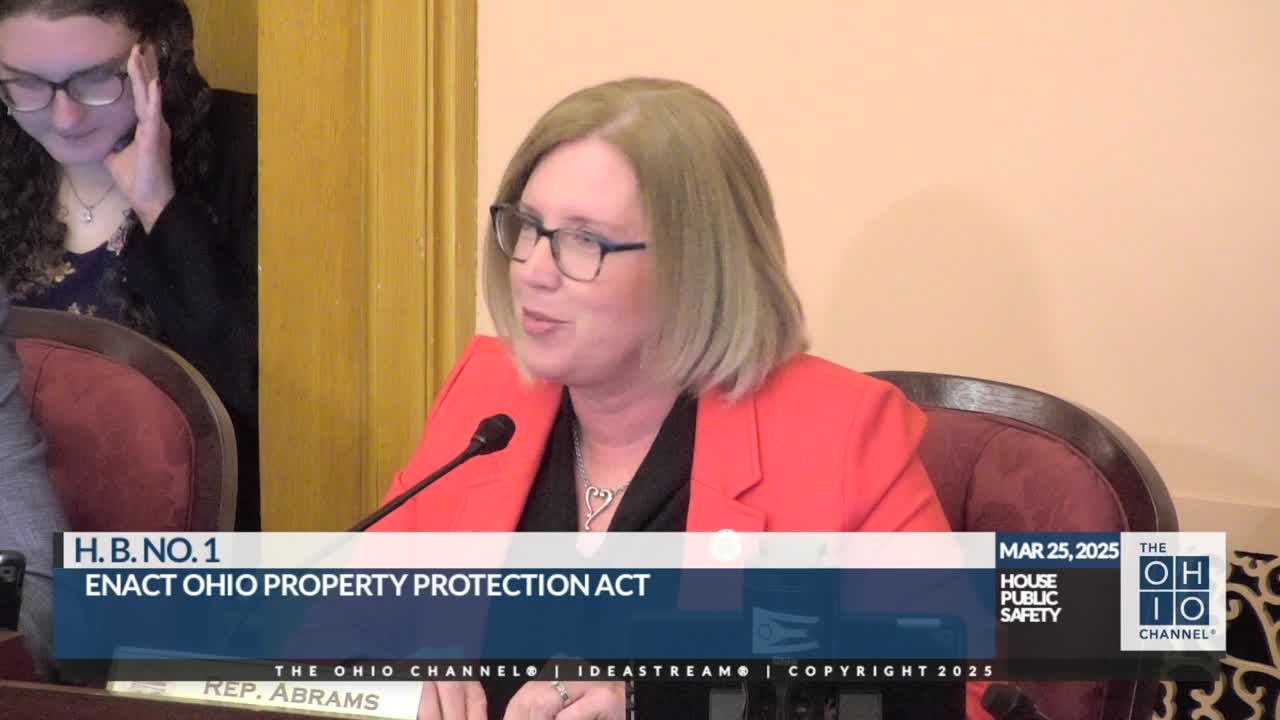
House Bill 1, the Ohio Property Protection Act, would bar citizens of designated foreign-adversary countries from buying property within 25 miles of military installations and certain critical infrastructure, sponsors told the House Public Safety Committee.
House Bill 1, presented as the Ohio Property Protection Act, would prohibit nationals of designated foreign-adversary countries from purchasing property within 25 miles of military installations or specified critical infrastructure facilities, sponsors said during a House Public Safety Committee hearing. Supporters framed the bill as a national‑security measure intended to reduce espionage, sabotage and economic surveillance risks from state-aligned buyers.
"As legislators, we have a responsibility to protect Ohio," Representative Angie King said in sponsor testimony, citing concerns about foreign companies and investors acquiring farmland, distribution centers and land near military facilities. Co-sponsor Representative Ray Klopfenstein said the bill would implement a conveyance form requiring buyers to affirm they are not prohibited under the statute and would give county sheriffs authority to investigate suspected violations and refer cases to county prosecutors.
Committee members raised questions about the scope and potential consequences for lawful residents and businesses. Vice Chair Williams and Representative Willis noted that the bill exempts U.S. citizens and dual citizens and does not require divestiture by existing owners; sponsors confirmed that current owners would be grandfathered. Representative Brewer and others asked whether the definition of "critical infrastructure" (which the bill borrows from existing federal and state lists) could make broad swaths of the state functionally restricted; sponsors said the bill targets defined facilities such as refineries, electric-generating stations, water-treatment facilities and transportation infrastructure and that similar measures exist in other states (sponsors cited other states' mileage limits, including Indiana's 10-mile standard).
Members also asked about enforcement challenges: sponsors acknowledged that opaque ownership structures — multi‑layered LLCs and deception — will complicate enforcement and said the bill relies on conveyance affidavits and local investigation to identify violations. Sponsors said federal lists (the testimony referenced federal determinations of adversaries) would indicate which countries are covered; the bill relies on federal designation rather than local determinations.
No vote was taken. Sponsors asked for committee support and said they would work on language and implementation details in subsequent discussions.
Ending: First hearing concluded; sponsors said the measure is intended to add a layer of local scrutiny to land conveyances near sensitive sites and that existing lawful owners would be grandfathered.