Get Full Government Meeting Transcripts, Videos, & Alerts Forever!
Get email alerts on the Foreign Adversary Property Restrictions topic
No spam. Unsubscribe anytime.
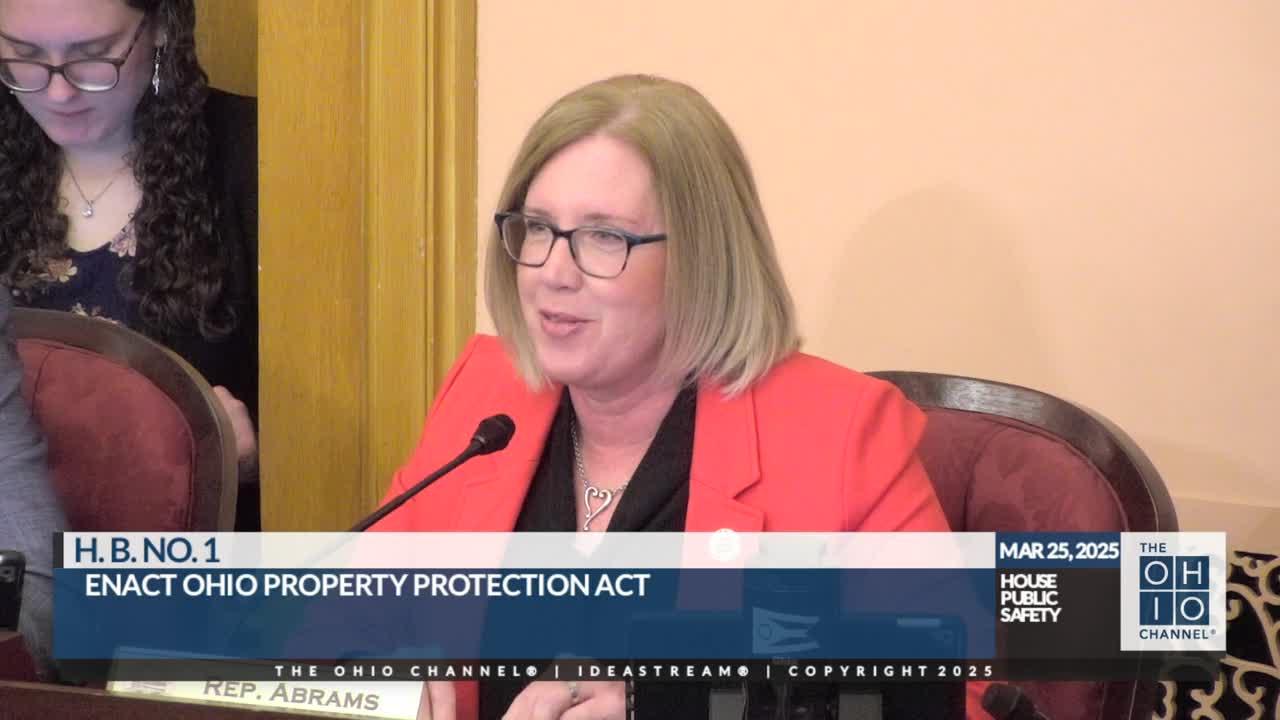
Committee hears sponsors of Property Protection Act to limit land purchases by foreign adversaries near military and critical infrastructure
Summary
House Bill 1 would bar persons tied to federal lists of foreign adversaries from purchasing real property within 25 miles of military bases or designated critical infrastructure, require an attestation on conveyance forms, and authorize local sheriff investigation and referral to prosecutors.
Sponsors presented House Bill 1 as a state response to perceived national‑security risks from land purchases by entities tied to foreign adversaries. Representative Angie King and Representative Ray Klopfenstein said the bill would prohibit purchases by persons from a federal list of foreign adversaries within 25 miles of military bases or defined critical infrastructure, require a conveyance form with an attestation from the buyer, and give county sheriffs the ability to investigate suspected violations and refer cases to the county prosecutor.
"Ohio's Property Protection Act is long overdue," Representative King told the committee, framing the bill as safeguarding military installations and critical infrastructure from actors tied to adversarial governments. Sponsors referenced federal concerns about foreign investment near military and intelligence facilities and gave examples cited in testimony — including a reported pending purchase near the U.S. Army Cyber Command and corporate ties noted in media reporting.
Committee members raised implementation and equity concerns. Members asked which countries would be considered "foreign adversaries"; sponsors said the designation would come from federal lists rather than local determination. Representative Mullins and others asked whether the bill could address cybersecurity threats tied to land ownership; sponsors said deceptive ownership structures (multiple LLC layers) make detection challenging but that the conveyance form would create a record for later investigation.
Members representing urban districts and health‑care employment centers raised questions about incidental impacts. Representative Willis — citing hospitals and airports in her district — asked how the bill would affect doctors, staff and other lawful residents who are foreign nationals or on visas. Sponsors replied the bill targets persons who are citizens of, or controlled by, adversarial governments; they noted the bill does not require divestiture by current lawful owners and would not affect U.S. or dual citizens.
Representative Brewer asked whether the broad definition of critical infrastructure could leave large portions of the state effectively restricted; sponsors said critical infrastructure is a defined category and insisted the bill is targeted at security‑sensitive nodes. Sponsors said they had consulted the Farm Bureau, the governor's office and economic development offices early in the process and said discussions would continue to assess economic impacts.
The committee took no action. Sponsors said they will continue discussions with stakeholders to refine definitions, enforcement mechanisms and carve‑outs.
Ending
The hearing ended with sponsors thanking the committee and agreeing to additional stakeholder meetings to refine language and address concerns raised in the hearing.