Get Full Government Meeting Transcripts, Videos, & Alerts Forever!
Get email alerts on the Foreign Land Ownership topic
No spam. Unsubscribe anytime.
Sponsors present Property Protection Act to bar specified foreign adversaries from buying land near critical infrastructure
Summary
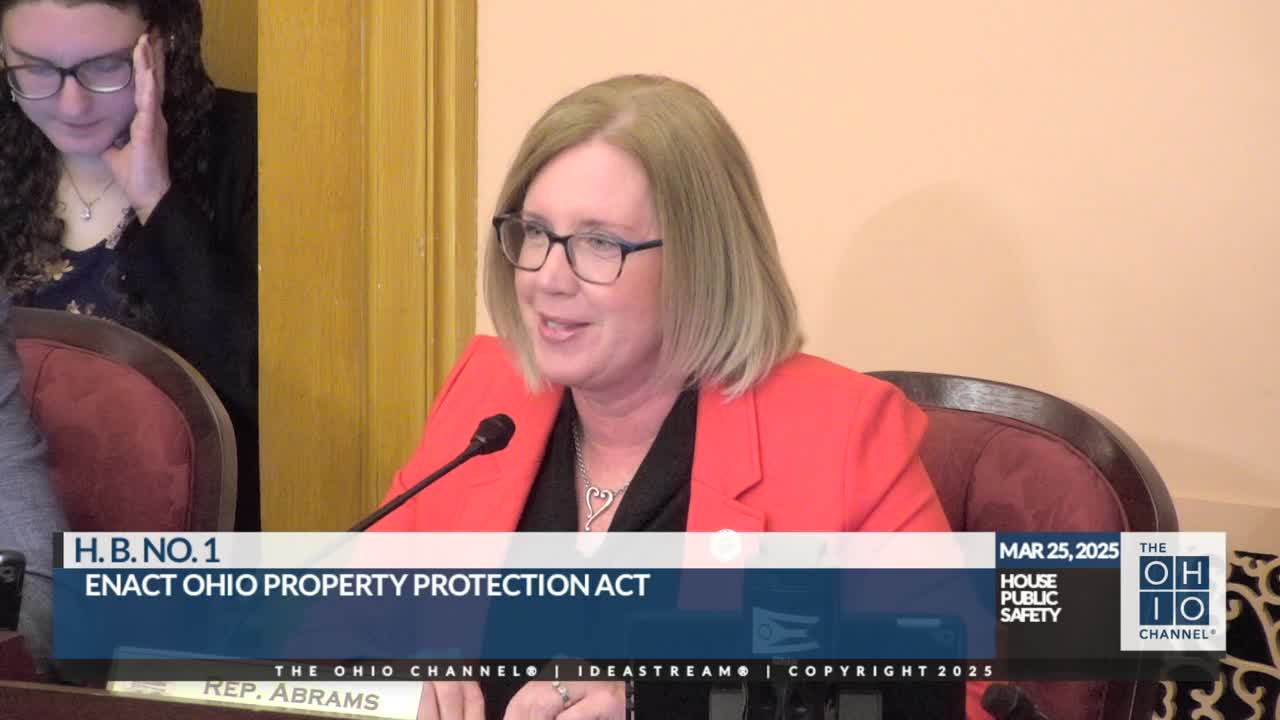
House Bill 1 would bar citizens of specified foreign adversary countries from purchasing property within 25 miles of military bases and certain critical infrastructure in Ohio, sponsors told the Public Safety Committee.
Representatives Angie King and Ray Klopfenstein testified on House Bill 1, the "Property Protection Act," which would prohibit citizens of specified foreign adversary countries from purchasing property within 25 miles of military installations or designated critical infrastructure in Ohio.
"Ohio's Property Protection Act is long overdue," Representative Angie King said, framing the bill as a response to national-security concerns about foreign-adversary land ownership near military bases, electrical grid assets, water treatment facilities and other critical nodes. Sponsors said the measure would require a conveyance form in which buyers affirm they are not prohibited from purchasing under the bill and would give local sheriffs the authority to investigate suspected violations and refer cases to county prosecutors.
Sponsors said the restriction would not apply to U.S. citizens or dual citizens and would not require existing owners to divest. They emphasized that enforcement would rely on federal lists—sponsors described the determinations of "foreign adversary" as coming from federal designations rather than a local list. Representative Klopfenstein said the bill aims to close gaps that allow actors to use layered LLCs or deceptive ownership structures to hide ultimate beneficial owners.
Members asked how broadly the bill would apply and whether it would effectively bar people from buying in large parts of the state. Representative Brewer asked whether a wide definition of critical infrastructure could make most of Ohio "protected property;" sponsors replied that the bill targets specified categories of critical infrastructure (refineries, power plants, water treatment, rail, ports, telecommunications, etc.) and that very remote land would remain available. Representative Willis and others raised concerns about impacts on legal residents who are noncitizens, doctors and other professionals recruited to Ohio; sponsors said lawful noncitizens and dual citizens would not be affected and the bill does not apply to leases.
Members asked about enforcement practicality. Sponsors acknowledged the difficulty of tracing layered LLC ownership but said a conveyance attestation and local investigatory authority would create a paper trail and help identify illicit purchases, and that existing federal national-security designations would define the covered adversaries.
The committee did not vote. Sponsors said they would continue to engage with interested stakeholders, including Farm Bureau and local law enforcement, and indicated willingness to refine geographic and definitional elements.