Get Full Government Meeting Transcripts, Videos, & Alerts Forever!
Get email alerts on the First Responder Scene Buffer topic
No spam. Unsubscribe anytime.
Committee hears first testimony on bill to create 14-foot buffer around first responders
Summary
Sponsors of House Bill 20 testified for a misdemeanor offense and 14-foot "halo" buffer to keep bystanders back at emergency scenes; committee members raised questions about overlap with existing obstruction laws, enforcement, and carve-outs for grieving relatives.
House Public Safety Committee members heard sponsor testimony Tuesday on House Bill 20, which would allow first responders to establish a 14-foot buffer — described by sponsors as a "halo" — around emergency scenes and make breaching that zone a misdemeanor.
The bill’s sponsors, Representative Thomas Hall and Representative Phil Plummer, said the measure is intended to keep police, firefighters and EMS able to work without interference. "This is simply providing the first the first responders the ability and opportunity to do their jobs more effectively and remain focused on the incident at hand," Hall told the committee. Plummer described the measure as "very simple legislation" and said it includes a warning before enforcement: "Just give us 14 feet to do our jobs, and we will work on the other issues."
Supporters said the 14-foot figure provides a clear, portable measure to protect responders when there is no time to set up tape or barriers. "We're arriving on scene to, like I said, an unresponsive victim or a serious crash with entrapment. Taking care of the patients ... a lot of times we don't have the extra few seconds to go around and set that perimeter. So with this bill, we set the the 14 feet," Hall said. He noted other states have adopted similar rules — "Florida, they passed a bill that does the same thing. Theirs is 25 feet."
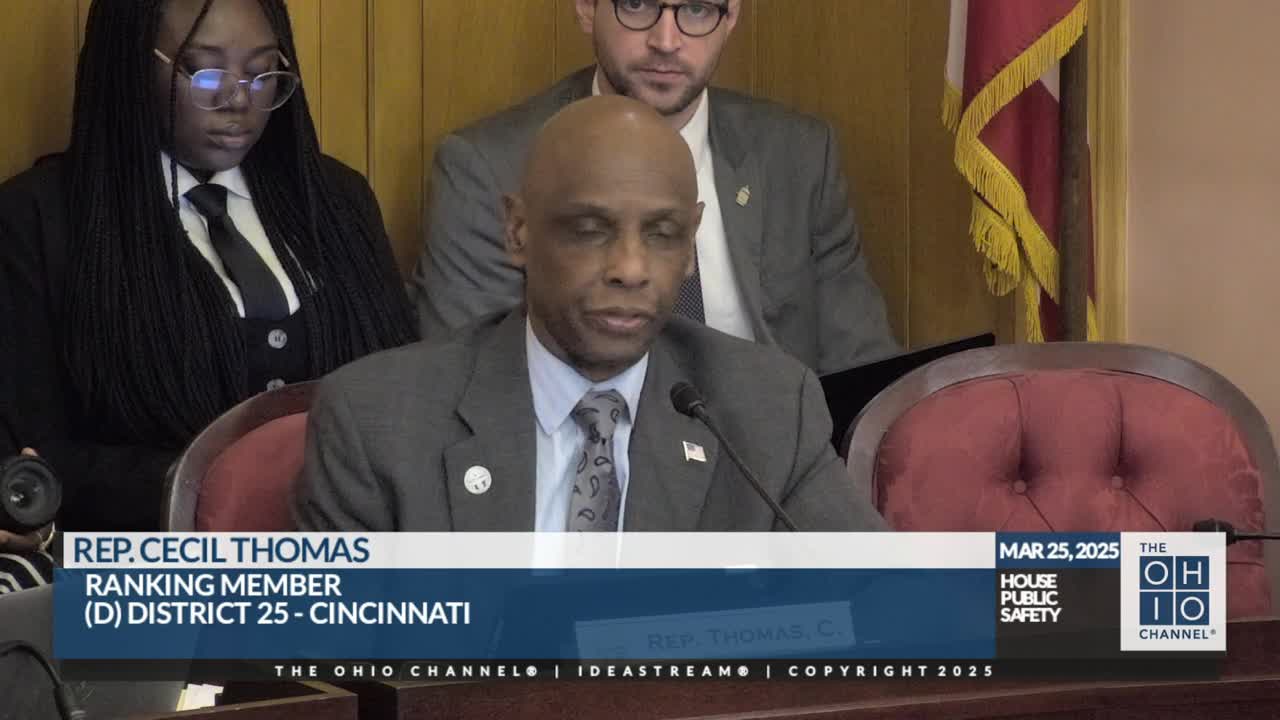
Committee members raised multiple practical and civil‑liberty questions. Ranking Member Thomas and Representative Humphrey asked whether the conduct targeted by the bill already falls under existing obstruction or "obstructing official business" statutes. Ranking Member Thomas said officers can now arrest for obstruction if a person "insists on continuing his behavior," and asked why a separate statutory offense is needed. Hall replied the sponsors see the bill as a way to "tighten it up for the citizens to understand the meaning and the intent of the law," not to duplicate existing statutes.
Several members probed enforcement mechanics and exceptions. Representative Brent asked how "reasonable fear" — a term used in the bill — would be defined; sponsors said the bill contemplates warnings and that arrests would be an immediate action when warnings are ignored rather than a later complaint process. "Through the chair, it'll be more of the first responder just warning you enough to get back. And if you don't, they'll arrest you for this newly committed offense," Plummer said. Members asked whether the offense should be reduced from a first‑degree misdemeanor (M1) to a lower level; Plummer said the sponsors are open to lowering it to an M2.
Members also asked whether the bill would cover protesters and whether officers or responders would be required to announce the law at the scene. Plummer said the sponsors would work with the committee on amendments, including potential language requiring responders to give notice if the committee favored that change.
Committee members repeatedly emphasized prosecutorial and officer discretion and concern about unintended consequences. Representative Brewer warned that bystanders trying to stop misconduct could be caught up in prosecutions; she and others sought assurance that grieving relatives who approach a scene would not be prosecuted. Sponsors said officers exercise discretion and the courts can address cases where an arrest is inappropriate.
The committee did not take action on HB20; sponsors said they will work with members on amendments.
Ending
The hearing concluded with the chair thanking sponsors and noting the committee would continue work on adjustments and possible amendments in subsequent hearings.