Get Full Government Meeting Transcripts, Videos, & Alerts Forever!
Get email alerts on the Public Safety First Responders topic
No spam. Unsubscribe anytime.
Sponsors seek 14-foot buffer around emergency scenes in first hearing on House Bill 20
Summary
Sponsors of House Bill 20 told the Ohio House Public Safety Committee the bill would create a 14‑foot “halo” around emergency scenes to give first responders space to work; members questioned legal overlap with existing obstruction statutes, penalty levels and enforcement details.
Representatives Thomas Hall and Philip Plummer, sponsors of House Bill 20, told the Ohio House Public Safety Committee on March 5 that the bill would create a 14‑foot buffer around emergency scenes to help police, firefighters and emergency medical personnel carry out life‑saving tasks.
The sponsors said the proposal is intended to give first responders “space to do our jobs” when there is no time to set up physical barriers. Representative Thomas Hall said the bill “is simply providing the first responders the ability and opportunity to do their jobs more effectively and remain focused on the incident at hand.” Representative Philip Plummer told the committee the bill is “very simple legislation” that would include a warning before enforcement and is intended to stop people who “throw a camera in your face” or otherwise impede care.
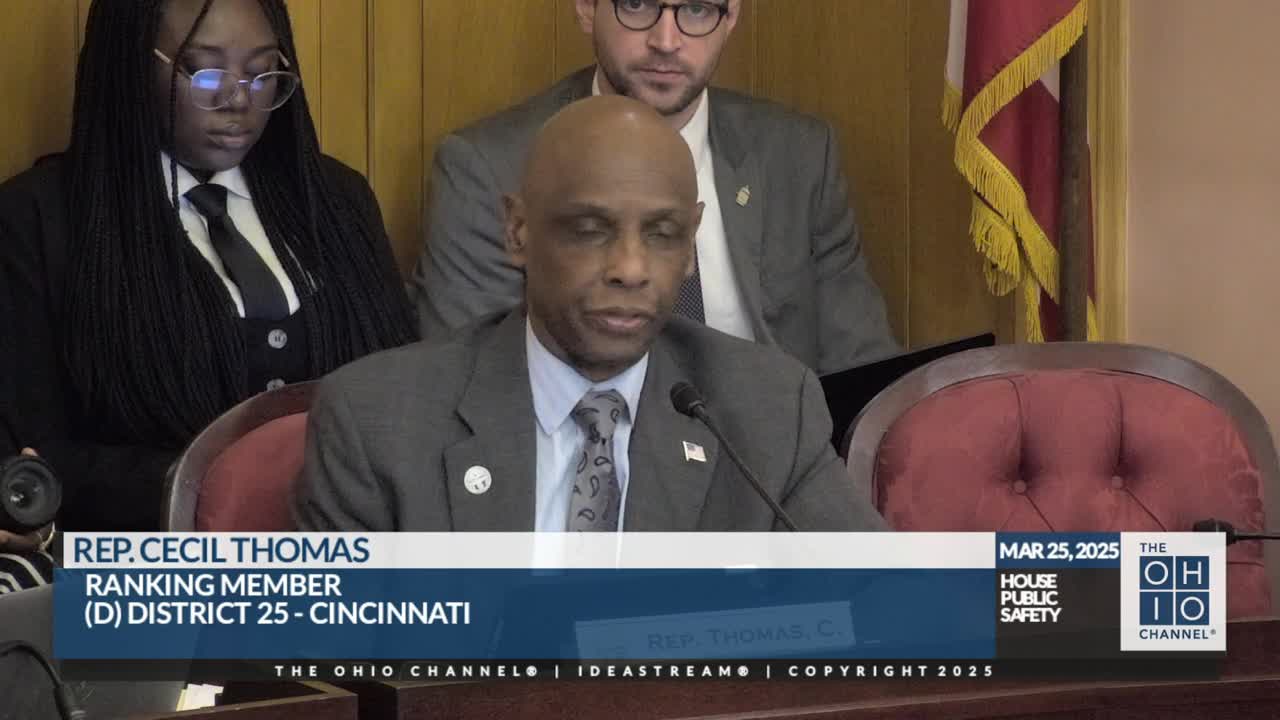
Committee members pressed sponsors on several operational and legal details. Ranking Member Thomas — a former police officer — questioned whether the change is necessary because officers can already charge people under existing obstructing‑official‑business statutes. Representative Brent and others asked how “reasonable fear” would be defined, how non‑police first responders would document incidents, and whether a prosecutor could charge people who were trying to aid someone at a scene.
Representative Hall said prosecutors and the county prosecutor association had been consulted and that Florida has a similar law with a 25‑foot buffer; he and Plummer said they were open to committee amendments including reducing the penalty level or adding language to require officers or responders to announce the requirement at the scene.
On penalties the sponsors proposed a first‑offense misdemeanor level the committee discussed as an M1; members suggested lowering it to an M2 so the charge would be less severe and avoid making low‑risk incidents felonies through stacked charges. Representative Plummer said officers have discretion and court processes can mitigate unfair prosecutions, and that the sponsors would work with the committee to refine the bill.
No formal action or vote was taken; the committee concluded the first hearing and said sponsors and members would work on amendments.
Members and sponsors repeatedly framed the proposal as both an educational measure and a legal tool to address people who intentionally interfere with emergency work.
Ending
The committee left the bill at first hearing and invited sponsors to work with members on clarifying language about the buffer distance, penalty level and enforcement procedures. Committee members asked for clearer complaint or reporting procedures for non‑police first responders and for statutory language that avoids duplication with existing obstruction statutes.