Get Full Government Meeting Transcripts, Videos, & Alerts Forever!
Get email alerts on the Veterans And Public Safety topic
No spam. Unsubscribe anytime.
House bill targets work‑zone safety with education, cameras and penalties
Summary
Sponsors of House Bill 82 proposed mandatory driver education on construction-zone safety, authorizing private contractors to install speed-monitoring devices and video, and increasing fines and course requirements for offenses in work zones; committee members asked about overlap with existing Ohio Revised Code sections and the cost of cameras.
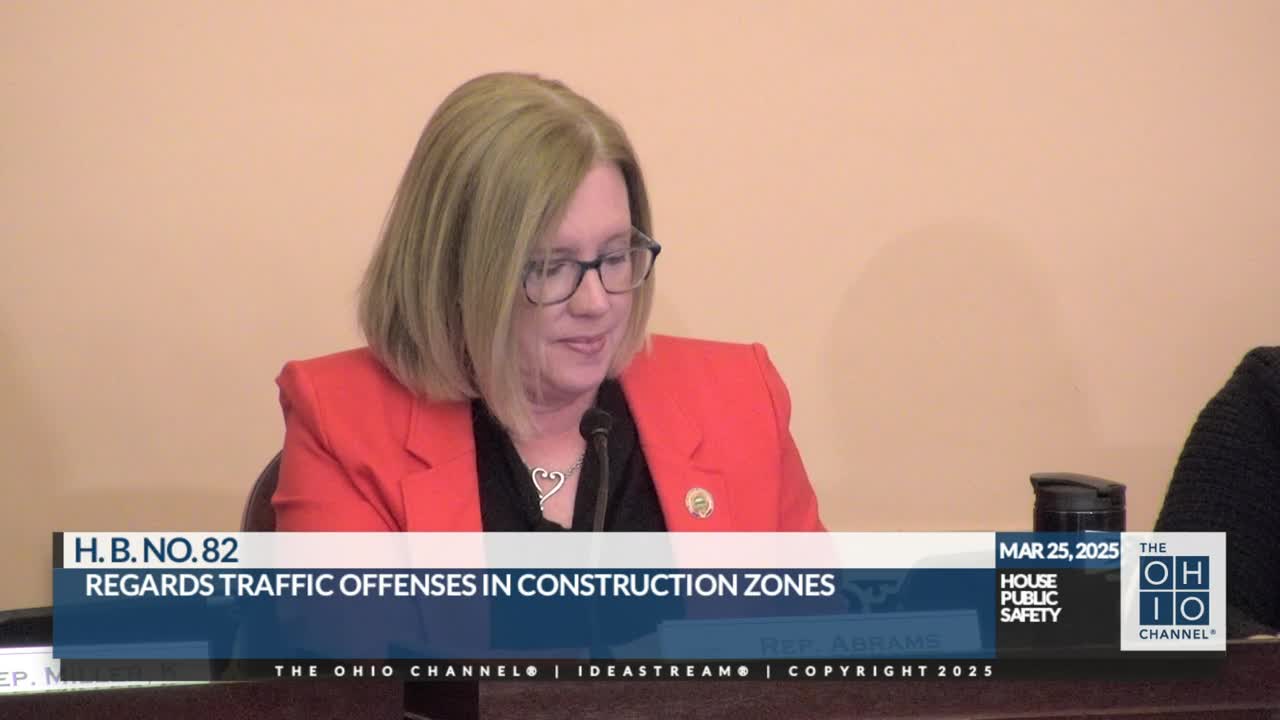
Representatives Gary Click and Mark Johnson told the House Public Safety Committee that House Bill 82 would expand work‑zone safety measures by requiring driver-education instruction about construction zones, mandating a safety course after a work‑zone offense, allowing private contractors to install speed-monitoring and flashing advisory devices, and enhancing fines and reporting requirements.
“House Bill 82 is a step to ensuring that more Ohio families stay healthy,” Representative Gary Click said in sponsor testimony, describing statistics on work-zone injuries and fatalities and proposing an education-focused approach with targeted enforcement tools.
The bill’s provisions described in testimony include requiring driver's‑education courses to include construction‑zone safety, making completion of a director‑approved safety course mandatory after an offense in a work zone (with a proposed $400 penalty if the offender fails to complete the course within 30 days), permitting private contractors to install cameras and speed‑monitoring devices on certain projects, and strengthening reporting and data-sharing between ODOT and local law enforcement.
Why it matters: Sponsors pointed to a rising number of incidents in Ohio work zones and said the combination of education, on‑site monitoring and stiffer consequences would reduce crashes and save workers’ lives. They proposed allowing contractors to include monitoring devices in bid specifications for larger interstate or multi‑lane projects and allowing law enforcement access to recorded images during investigations.
Discussion highlights - Legal overlap and enforcement: Representative Brent cited existing Ohio Revised Code sections covering traffic-control devices and reckless operation, and asked why new language was needed. Sponsors said the measure emphasizes education and provides permissive tools such as video evidence that agencies can use in investigations, not automated citation programs. - Cost and implementation: Members asked who would pay for cameras. Sponsors described the devices as permissible items that could be specified in construction bids; they noted the current draft does not require ODOT to issue automated citations, only to allow evidence collection for investigations. - Penalties and course structure: Sponsors said the $400 enhanced fine would be dismissible if the offender completes the required safety course; judicial-conference suggestions may lead to changes that require assessing the fine and dismissing it after course completion.
Committee reaction and next steps: Members supported increased education and tools but asked for a fiscal analysis on camera costs and for clearer limitations on when devices would be used. Sponsors said they would refine language and consider proposed amendments.
Ending: The committee closed the first hearing and invited further drafting and stakeholder consultation.