Get Full Government Meeting Transcripts, Videos, & Alerts Forever!
Get email alerts on the Bicycle Priority Network topic
No spam. Unsubscribe anytime.
Spokane Plan Commission unanimously recommends Bicycle Priority Network to city council
Summary
The Spokane Plan Commission voted 8-0 to recommend the Bicycle Priority Network to Spokane City Council after staff presented the plan’s purpose, development process and next steps for grant-driven implementation.
The Spokane Plan Commission on March 26, 2025, voted unanimously to recommend the Bicycle Priority Network to Spokane City Council after a staff presentation and no public comment.
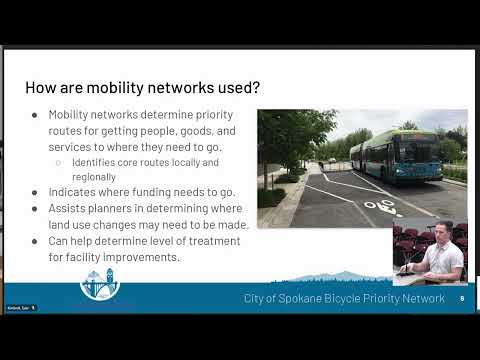
Tyler Kimbrell, planner at the City of Spokane, presented the network and said, "The Bicycle Priority Network sets the foundation for future bicycle improvements, and it prioritizes ultimately safety, through designing, for predictable behavior." He described the network as a narrowed, prioritized subset of routes drawn from the city’s Bicycle Master Plan meant to focus limited resources on streets most likely to be used and where safety improvements can be implemented quickly.
The commission’s recommendation followed a multi-step development process Kimbrell summarized: project kickoff in summer 2023 with the Bicycle Advisory Board and a Technical Advisory Committee; iterative mapping and quality-control reviews; a public survey that produced more than 500 comments; and use of demographic and roadway-condition metrics to identify priority routes. Kimbrell said the guidance will rely on best practices from national organizations (he referenced NACTO) and on scoring metrics used by the state and the U.S. Department of Transportation to target grant applications.
Kimbrell emphasized design flexibility: the Bicycle Priority Network intentionally does not lock each route to a single facility treatment. Instead, staff plan to use adaptive, quick-build elements and national best-practice guidance to select treatments as projects are funded and advanced. He said an "expanded network" of alternate routes would be implemented where appropriate during standard roadway projects, while the core priority routes will be the primary focus for active grant-seeking and implementation.
Kimbrell also said the network prioritizes all-ages-and-abilities routes and gives added emphasis to historically disadvantaged communities to align with funding-eligibility criteria. He noted a rising trend in bicycle and pedestrian roadway injuries and fatalities since 2014 as part of the rationale for concentrating efforts on specific corridors.
With no speakers signing up for public comment, a commissioner moved that the commission recommend the Bicycle Priority Network to city council "for approval and as presented by staff." The motion carried on a roll call vote, 8-0, with Commissioners President Bank, Vice President Patterson, Commissioner Edwards, Commissioner Lenhart, Commissioner Nepprood, Commissioner Tamush, Commissioner Williams and Commissioner Yachts recorded as voting "aye." Commissioners Francis and Shook were absent.
Next steps, as described in the presentation, are that the commission’s recommendation will be forwarded to City Council for action; staff will align the priority network with the upcoming comprehensive plan update; and the network will be used to prioritize and apply for multimodal grant funding.
The plan commission’s packet included the priority network map, associated documents, and a technical reference to the city’s Bicycle Master Plan (map TR-5). Kimbrell said the project web page contains the full materials and maps for public review.