Get Full Government Meeting Transcripts, Videos, & Alerts Forever!
Get email alerts on the Nuisance Law Amendment topic
No spam. Unsubscribe anytime.
Council committee reviews changes to Cleveland nuisance law; ordinance tabled pending data
Summary
City officials presented Ordinance 228-2025 to amend Cleveland Codified Ordinances Sections 6.30.01 and 6.30.02 to broaden what counts as a nuisance, clarify evidence standards and add procedural steps for notices and fines. Council asked the administration for enforcement data and held the measure one week for follow-up.
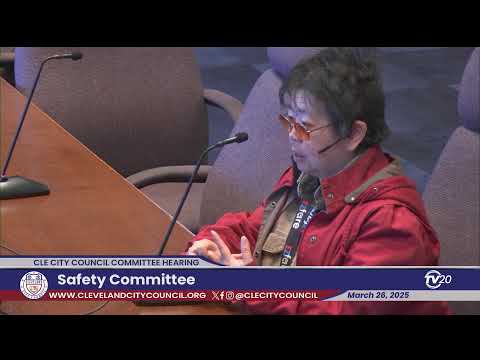
At a Cleveland City Council committee meeting, Assistant Safety Director Nicole Carlton presented Ordinance 228-2025, a proposed amendment to Sections 6.30.01 and 6.30.02 of the Codified Ordinances of Cleveland that would broaden the definition of nuisance activity, clarify how probable cause is established, and change the notice and abatement process for properties linked to repeated disorderly conduct.
The changes aim "to ensure that effective action can be taken against properties associated with repeated nuisance activities that threaten public safety and quality of life in our neighborhoods," Carlton said. Under the draft ordinance, a property would be at risk of nuisance declaration if three or more nuisance activities occur within a six-month period; the property owner would be required to submit an abatement plan within 10 days or face a $100-per-day fine until a plan is filed.
The measure would expressly allow police personnel to rely on witness statements and other documented interactions short of an arrest or citation. "To be a nuisance activity, criminal conviction, citation, or arrest is not necessary," Assistant Director Jason Schachner told the committee, noting the amendment clarifies prior ambiguity about whether a mere police warning or documented officer interaction could be counted. The draft also expands the list of nuisance offenses to include drug offenses under the Ohio Revised Code cited in the draft and equipment/vehicle-safety violations and reckless operation (street racing, stunt driving and street takeovers) in local code sections identified by staff.
Staff described several procedural updates to section 6.30.02. The draft replaces references to the "Cuyahoga County Auditor" with the "Cuyahoga County Fiscal Office" for owner notices; it allows the Director of Public Safety discretion to declare a property a nuisance if another incident occurs at least 13 days but no more than six months after a written warning; and it adds a $100-per-day assessment for failure to file an abatement plan within 10 days of notice.
Sergeant Reginald Lanton, who oversees nuisance tracking for the division, described the operational practice: staff run a weekly report of calls for service and then review the incident details. He said the division already issues letters and tracks calls for service but that a previous information-technology gap and earlier administrative practice limited the number of notices sent under prior leadership. "We had to develop a way to track the calls for service," Lanton said, adding the office has been rebuilding that capability since leadership changes.
Council members asked for enforcement history and metrics before taking further action. Several members pressed the administration for numbers on how many assessment letters and $100-per-day fines have been issued in recent years and asked public safety to coordinate with the Division of Assessment and Licenses and housing court on implementation and appeals. Council Chair Mike Polensek (co-sponsor of the 2018 nuisance law) said he and others have filed repeated complaints that did not produce consistent notices under the previous administration and asked for verification that the penalty mechanism — including collection via county tax procedures — has been used in the past.
After discussion, the committee did not vote on the ordinance. The chair said the item would be held for one week to allow the administration to provide requested data from Assessments and Licenses, clarify internal procedures for generating nuisance reports, and follow up with the housing court and other affected offices. The committee also asked staff to supply the number of nuisance-related letters sent and any fines levied over the last three years, and to document the weekly report process used to identify addresses for review.
Why it matters: The proposed changes broaden the range of conduct that can trigger a nuisance finding (including behavior by patrons, visitors, and people "associated with property"), lower the evidentiary barrier by explicitly allowing warnings and witness statements to count, and add a quick abatement timeline with daily fines. Those changes affect landlords, businesses and residents in neighborhoods where repeated police calls or disorderly conduct occur.
What happens next: The administration will provide the requested enforcement and assessment data and coordinate with the Division of Assessment and Licenses and housing-related offices. The committee will reconvene in one week to consider the ordinance with the additional information.