Get Full Government Meeting Transcripts, Videos, & Alerts Forever!
Get email alerts on the Critical Minerals Acmc topic
No spam. Unsubscribe anytime.
University-led Alaska Critical Minerals Collaborative seeks NSF "engine" and state support to speed mineral production
Summary
The Alaska Critical Minerals Collaborative told the Senate Resources Committee on March 26 that it is competing for a $160 million, 10-year National Science Foundation "engine" award and asked the state to consider up to $3 million a year in additional support to accelerate mineral research, pilot processing and workforce development in Alaska.
The Alaska Critical Minerals Collaborative told the Senate Resources Committee on March 26 that it is competing for a $160 million, 10-year National Science Foundation (NSF) “engine” award and is asking the state to consider up to $3 million a year in supplementary support to accelerate research, pilot processing and workforce development across Alaska.
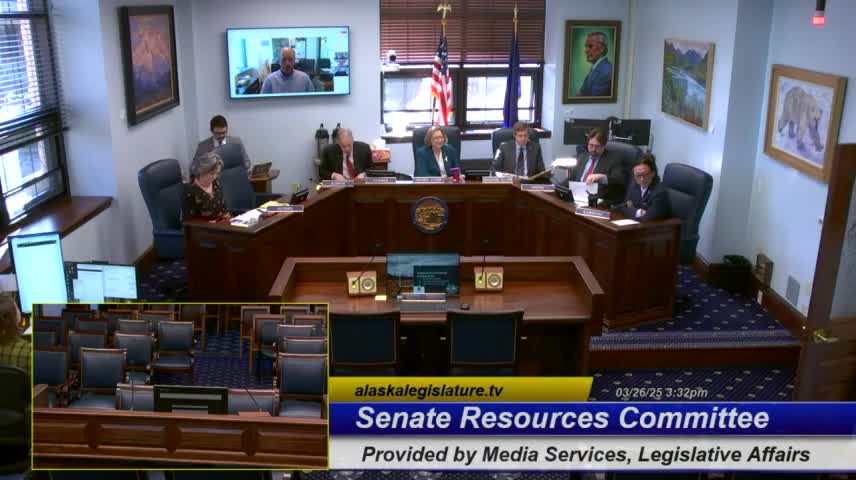
The collaborative, based at the University of Alaska and led by Director Dr. Leanne Monk, presented the coalition’s vision and a list of near-, mid- and long-term production opportunities to senators at the committee’s March 26 meeting in Juneau. Dr. Monk said the ACMC is “one of the 71” teams invited to the next stage of NSF review and that the application will be uploaded by April 11.
Why it matters: Alaska contains a broad range of critical minerals and existing mine infrastructure that ACMC leaders say could be used to produce byproducts the nation now imports. Committee members expressed support for the proposal while asking about refining capacity in Alaska and whether state funds or federal subsidies would be needed to support in-state processing.
ACMC leaders and the coalition
Dr. Leanne Monk, director of the Alaska Critical Minerals Collaborative at the University of Alaska, introduced the collaborative’s mission to “advance interdisciplinary critical minerals and materials research, education, technology and partnerships.” She told the committee the ACMC grew out of earlier state funding and university summits and now seeks to act as a hub connecting industry, government and academia.
Lance Miller, vice president of natural resources for NANA Regional Corporation and advisory board chair for ACMC, framed the effort as a response to cyclical mineral markets and limited long-term private investment in exploration. “Minerals are truly building blocks of our world,” Miller said, describing how demand rises with new technologies and how investment typically follows commodity price spikes.
Steve Masterman, deputy director of ACMC and former Alaska state geologist, emphasized Alaska’s endowment of critical materials. “We do have a lot of critical minerals in Alaska, and as Leanne mentioned, we have 49 of the 50 critical minerals on the USGS critical minerals list,” Masterman told the committee, listing Alaska deposits and existing producing mines such as Red Dog, Fort Knox, Pogo, Greens Creek and Kensington.
What ACMC is proposing and what it has secured so far
ACMC described three primary objectives for an NSF engine, called the Alaska Critical Mineral Accelerator: (1) use-inspired research and technology development that can be translated to industry; (2) workforce and entrepreneurial development; and (3) economic engagement that draws private and public investment into Alaska. The NSF engine program requires a coalition of partners; ACMC representatives said partners have already committed more than $300 million in combined cash and in-kind support, largely in access to mine sites, staff time and equipment.
ACMC staff outlined funding already received and ongoing projects: a state economic development appropriation of $7.5 million distributed across the University of Alaska campuses; UAF Institute of Northern Engineering awards from the U.S. Department of Energy (DOE); an ARPA-E–funded pilot project to examine bio‑recovery of rare earth elements at what the presenters called Baucan Mountain in Southeast Alaska; and market and permitting research at UAA’s Institute of Social and Economic Research.
Near-term production opportunities
Presenters identified near-term gains achievable at existing mines by modifying mill processes to recover byproducts. They cited examples discussed with industry partners: - Red Dog: zinc-focused operations with recoverable germanium. - Pogo: potential for bismuth and tellurium recovery; presenters said tellurium recovery at Pogo could supply roughly one-quarter of current U.S. annual imports if produced at scale. - Greens Creek and Fort Knox: opportunities to improve extraction or recover additional commodities from existing ore streams.
Permitting, processing and refining questions
Committee members asked how much of Alaska’s output could be refined in-state. Dr. Monk said the engine could support field pilots and processing demonstrations at Alaskan sites but emphasized that building a full refinery or smelter entails separate economic and permitting questions that rest largely with industry and government.
Lance Miller said U.S. processing capacity for many metals is constrained by global smelter market dynamics and overcapacity in some smelting segments. He told the committee that building a commercial smelter in Alaska would likely require long-term, large-scale public or federal support because global smelter economics currently favor existing overseas capacity.
Miller also noted that many critical minerals are recovered as byproducts of other primary mining operations; germanium at Red Dog, for example, would not be produced in quantity without the zinc concentrate that funds the operation.
Timeline and next steps
ACMC representatives described the NSF timeline: the collaborative advanced from the preliminary round and was one of 71 invited to submit a larger proposal; the next stage requires a full application and may include a site visit. Dr. Monk said the coalition plans to submit the application by April 11 and requested that the committee consider a letter of support from the Legislature; she said Governor Dunleavy’s office already provided a letter of support.
Committee response and follow-up
Several senators praised the coalition and offered to prepare a committee letter supporting the NSF application. Senators also pressed for more detail on how potential state support would be structured and emphasized limits on future state spending given the state’s fiscal gaps.
The collaborative did not request or receive any formal approval or funding vote from the committee during the March 26 meeting. Presenters said further conversations about possible state support and technical details of pilot projects would follow if the NSF process advanced.
Ending
ACMC leaders said they will return with more detailed materials as the NSF application progresses. The Senate Resources Committee adjourned after the presentation and said it would consider sending a letter of support if members can meet the coalition’s April 11 timeline.
Attribution: Quotes and attributions in this article are from participants at the March 26, 2025 Alaska Senate Resources Committee meeting: Dr. Leanne Monk (director, Alaska Critical Minerals Collaborative, University of Alaska), Lance Miller (vice president for natural resources, NANA Regional Corporation; ACMC advisory chair) and Steve Masterman (deputy director, Alaska Critical Minerals Collaborative).