Get Full Government Meeting Transcripts, Videos, & Alerts Forever!
Get email alerts on the Homelessness Safe Parking topic
No spam. Unsubscribe anytime.
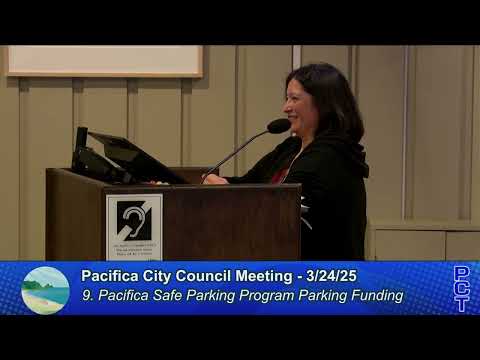
Pacifica Council approves $412,000 to extend safe-parking program at San Francisco RV Resort
Summary
The council voted unanimously to commit $412,000 from the Housing Action Fund to rent 10 RV spaces for one year and fund case-management services for the Pacifica Safe Parking Program, while residents and service providers urged continued funding for wraparound support.
Pacifica City Council on Wednesday approved funding to extend the city’s Pacifica Safe Parking Program by renting 10 spaces at the San Francisco RV Resort and by supporting the program’s case-management operations.
The council voted unanimously to commit $412,000 from the city’s Housing Action Fund to rent the resort spaces for one year and to cover a year of Pacifica Resource Center (PRC) case-management and program operations as currently run.
The approval follows a staff presentation describing an operational plan in which 10 resort spaces would rotate with on-street spaces at Oceana and Malaga Drive so participants could not remain in any one street location longer than four months. “The 204,000 represents rental of 10 spaces in SFRV for 1 year,” the city manager said in the presentation; staff also described an additional $208,000 annual cost to maintain current levels of case management. PRC Executive Director Anita Reese told council that the program had served 49 individuals from 31 families since September 2024 and that 31 percent of participants — 15 people — had moved to permanent housing.
Why it matters: PRC leaders, PRC board members and dozens of residents urged the council to fund both the resort spaces and case-management services. Speakers said case management is the core element that produces exits to housing and described how the availability of a resort site with hookups, laundry and water had led some people to consider alternatives to living full-time in their motor homes.
What council approved: The motion the council passed funds both the rental of 10 spaces at the San Francisco RV Resort and one year of PRC operations and case-management support for the program as currently operated. Staff said the $204,000 rent figure is the cost for the spaces; staff and PRC requested additional funding to cover case management. In debate, councilmembers described the city’s $2.9 million Housing Action Fund balance and weighed whether to commit one year versus six months of operating funds; the successful motion funded a full 12 months of both rent and operations (total $412,000).
Public comment and neighborhood concerns: More than a dozen Pacifica residents, service providers and PRC board members supported the extension. Suzanne Moore, a retired county nurse practitioner and PRC board member, thanked the city and asked the council to “collaborate with the county to further the life and success of the program.” Other speakers described motor-home harassment on Pacifica streets, the limited availability of subsidies (Reese said only three program participants received housing subsidies), and the program’s role in protecting public health and the environment by providing black- and gray-water disposal. Some neighborhood speakers said they wanted existing on-street program spaces moved into the resort and raised quality-of-life concerns about RVs parked on local streets.
Operational details and contingencies: Staff said the San Francisco RV Resort requires occupants to leave every four months, so the PRC’s plan pairs 10 resort spaces with five on-street spaces at Oceana and Malaga Drive that would cycle in and out. PRC said it has an active wait list of two households and an informal count of 25 to 30 motor homes in Pacifica on any given day. City staff recommended the council’s commitment act as a “catalyst” to secure matching contributions from San Mateo County or foundations; they said staff and PRC have already discussed the program with county executives and that county funding could be sought in this spring’s budget season. Staff said a minimum operating option (logistics only, no case management) would cost about $40,000 per year; continuing full case-management at current levels would cost approximately $208,000 per year.
Legal and program context: The program began in 2022 and was jointly funded by the city, the county and federal ARPA monies in its initial three-year period. Staff noted the program was created, in part, in response to litigation and a settlement directive; council members and public commenters referenced an ACLU judgment that previously required the city to provide a certain number of safe parking placements, and PRC and city staff said continuing the program may avoid additional legal and administrative costs.
Council discussion and vote: Council members debated the duration of the commitment (six months vs. one year), the city’s role in leveraging county or foundation funds, and operational details such as where on-street spaces would remain. Several members emphasized the need to fund the case-management component, not just rent spaces. The motion to commit the combined $412,000 — covering rental of sites and one year of PRC case-management operations — passed unanimously.
Next steps: Staff said the city manager will work with PRC and the resort to finalize rental terms and the operating agreement; staff also said they would continue discussions with the county and potential grant funders to supplement the city contribution. PRC said it would continue outreach to motor-home occupants in Pacifica and would return to council if additional appropriations or changes are required.
Votes at a glance: Approve funding to extend and expand the Pacifica Safe Parking Program — outcome: approved unanimously (motion moved by Councilmember Beer; second not consistently recorded in the transcript).