Get Full Government Meeting Transcripts, Videos, & Alerts Forever!
Get email alerts on the Molst Education Training topic
No spam. Unsubscribe anytime.
MOLST education subgroup outlines modular CT Train videos, pockets cards and launch tied to revised 2025 form
Summary
A state-level education subgroup working on Connecticut’s MOLST agreed to create modular training materials, narrated CT Train videos, pocket cards and updated FAQs aligned with a revised 2025 MOLST form.
A state-level education subgroup working on Connecticut’s Medical Orders for Life-Sustaining Treatment (MOLST) said it will create modular training materials, narrated PowerPoint videos on the CT Train platform, pocket reference cards and updated FAQs to accompany a revised MOLST form expected in 2025.
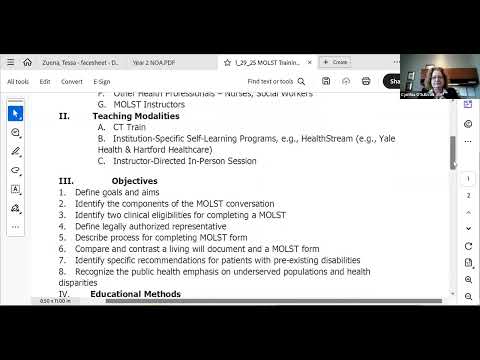
The subgroup discussed designing a short general introduction (4–5 slides) that would be common to all audiences, then branching modules tailored for eligible providers (MDs, APRNs, PAs), emergency medical services personnel, other health professionals (social workers, case coordinators) and lay audiences including seniors and faith groups. Members said the Department of Public Health (DPH) has a studio and that the group can produce materials without new funding if members supply content and a “super user” manages CT Train administration.
Leaders framed the plan as a practical effort to shorten and modernize existing CT Train content, which several members described as dated and long. They identified these specific deliverables: a revised narrated PowerPoint series on CT Train, four sets of frequently asked questions targeted to the identified audiences, a laminated pocket card for quick reference in clinical settings, and scripts for video segments. The subgroup asked volunteers to draft a bare-bones introductory script and to reconvene on the timeline at the next full MOLST meeting.
Substantive implementation questions raised in the meeting included how the new training will reflect statutory changes (members noted that the revised form eliminates a required witness signature), how to keep recurring trainees updated as the program moves to electronic forms and a possible registry, and whether to pursue continuing medical education or continuing education unit credit. Members said Yale and Hartford HealthCare might help sponsor CME credit but that fees and accreditation logistics remain to be resolved.
The subgroup also discussed outreach and partnerships: coordinating with DPH staff and the agency’s legislative liaison so legislators are aware of the changes; connecting with the attorney general’s office, which issues guidance on advanced directives; and integrating EMS training through regional EMS training councils. Members proposed labeling the campaign as a “revised” or “refreshed” MOLST education effort (examples discussed: “MOLST 2025” or “Revised MOLST 2025”) so learners know the materials reflect the updated form and procedures.
On timing and resources, participants said a launch timed to the release of the revised form would be ideal. The subgroup discussed a working goal of redoing the training and launching within the calendar year, while acknowledging the registry/electronic repository might come later and could affect final materials. Multiple members emphasized that a core introductory module should remain brief to preserve learners’ attention and that provider-specific modules may contain more technical material.
Next steps the subgroup recorded: volunteers will draft a basic introductory script and proposed slides before the next meeting; members will check CT Train learner comments and feedback; at least one participant will reach out to Yale’s CME office and to Hartford HealthCare to explore CE/CME sponsorship; and the group will place the launch date and timeline on the next full committee agenda. The full committee planned to revisit policies, procedures and the anticipated launch at the next Tuesday meeting.
The discussion produced no formal motions or votes at this meeting; members noted several dependencies (DPH approvals, accreditation logistics and the timing of the revised form) that will shape final materials and rollout timing.
Ending: The education subgroup will report back to the full MOLST committee at its next meeting with draft bullet points for the introductory module, updates on CT Train feedback, and any information gathered about CME/CEU accreditation and timing for the revised 2025 form.