Get Full Government Meeting Transcripts, Videos, & Alerts Forever!
Get email alerts on the Polst Registry Electronic Transition topic
No spam. Unsubscribe anytime.
Oregon POLST registry director briefs panel on digital-first approach, signatures, photocopy validity and funding
Summary
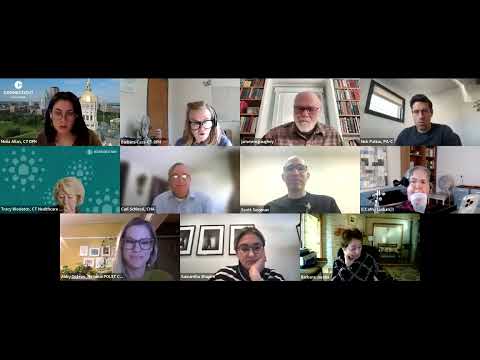
Dr. Abby Dodson, director of the Oregon POLST Registry at Oregon Health & Science University, briefed the Department of Public Health advisory group on a digital-first approach to POLST forms and the longer-term work of building a registry.
Department of Public Health meeting — February
Dr. Abby Dodson, who leads the Oregon POLST (Pulse) Registry at Oregon Health & Science University, told the advisory group the registry and form program are shifting toward a digital-first approach while preserving paper options for areas with limited connectivity.
In her presentation, Dodson said roughly 65% of submitted forms remain handwritten in some jurisdictions and that early registries were designed before modern electronic health-record connections were available. “When we started this registry… there were no ePULSes,” she said, noting the original registry began in February 2009 and was rebuilt in 2020 to modernize infrastructure and support research use.
Key points from the presentation and Q&A
- Digital-first strategy and tools: Dodson said states developing registries now commonly start with electronic-only forms, but Oregon will preserve printable forms for patients who want a hard copy. She described a standalone portal and a SMART-on-FHIR style app being developed for Epic systems under a Providence-supported grant; the code will be free and open source so health systems can adapt it to local workflows.
- Signatures and workflows: Practices differ by state. Dodson said Oregon does not require a patient or surrogate e-signature for a valid form; Massachusetts requires signatures and is implementing a workflow where the provider fills the form and then the patient or representative signs electronically. Dodson warned that workflows that separate completion and signature may leave incomplete forms “hanging out in the wings.”
- Photocopy and version control: Committee members raised concerns that policies requiring an original colored (neon green) form — an approach used in some states — would conflict with electronic or printed copies. Samantha said in Connecticut currently only the original neon green form is valid; Dodson said limiting accepted forms undermines access and described options registries use to prevent confusion, such as database version control and watermarking older forms as “VOID.”
- Funding, ownership and hosting: Dodson said the original pilot launched with private philanthropic funding from the Greenwall Foundation (about $250,000) and the 2020 rebuild cost roughly another $250,000, with ongoing incremental improvements of roughly $75,000–$100,000 per year. The Oregon Health Authority owns the registry and contracts with Oregon Health & Science University to operate it; the Oregon POLST Coalition controls the content of the form. Dodson said other states (Massachusetts, California, Washington) plan to run registries through state departments of health.
- Timing and priorities: Dodson recommended the group prioritize completing a usable electronic form and training before launching a registry. She said registry development typically takes multiple years and recommended collecting completed forms before a registry goes live.
Training, guardianship and DDS DNR process
Members asked about how training should address patient-facing workflow and the role of guardians. Barbara Cass, a bioethicist on the call, emphasized that electronic forms must not become a distraction during sensitive patient conversations: “I would caution people not to have the computer be the object in the room,” Cass said, and recommended using a sample form to guide discussion.
The group also discussed guardianship and DNR procedures for clients of the Department of Developmental Services (DDS). Staff clarified that the statutory language is not specific but has been interpreted to include plenary guardians appointed by the probate court; DDS requires a separate DNR review procedure including two physician opinions and internal review under a longstanding consent decree.
Votes at a glance
- Motion to approve January meeting minutes — moved by Dr. Susman; seconded by Jim; outcome: approved. - Motion to adjourn — moved by Barbara Cass; seconded by Mary; outcome: approved.
What’s next
Members said they will continue work on a coordinated training plan while advancing the electronic-form work stream. Dodson offered to connect states working on registries and noted the National POLST Collaborative seeks additional staffing for its coordination role.