Get Full Government Meeting Transcripts, Videos, & Alerts Forever!
Get email alerts on the Purpa Contract Terms topic
No spam. Unsubscribe anytime.
PURA hears Alco Finance challenge to United Illuminating over PURPA contract term and avoided-cost method
Summary
At oral argument in docket 240822, Alco Finance told the Public Utilities Regulatory Authority that Connecticut law allows PURPA contracts up to 30 years while United Illuminating’s tariff limits terms to seven years; the commission took the matter under advisement and scheduled a vote for March 26.
The Public Utilities Regulatory Authority heard oral arguments on docket 240822 on March 12 in a dispute brought by Alco Finance Limited against the United Illuminating Company alleging violations of Connecticut General Statute §16-243a, the state implementation of the federal Public Utility Regulatory Policies Act (PURPA).
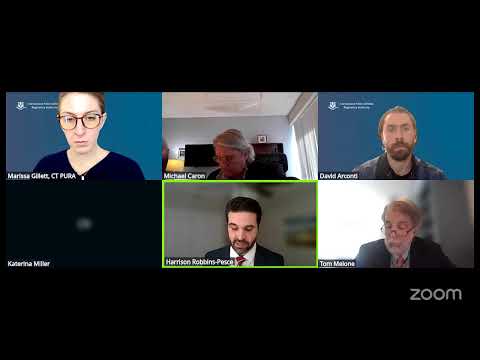
Chair Marissa Gillette opened the session and called appearances. Attorney Tom Malone, representing petitioner Alco Finance Limited, told the authority the core legal dispute turns on contract length and the proper method for calculating avoided costs under PURPA. "What this case is about, it's pretty clear from the proposed decision, is PURPA. And in Connecticut, PURPA is implemented under Connecticut general statute sixteen-two 43 a," Malone said.
Malone said Connecticut's statute allows a generator to choose a contract term "up to 30 years" and argued United Illuminating's tariff, which he said limits term to seven years, conflicts with that provision. Malone described two offers his client made: an energy-only contract for 20 years with rates he said ranged from about 5.1¢ to 9.4¢ per kilowatt-hour, and an alternative that would combine a 15-year period at a 7-year-tariff rate and other terms to reach 20 years for financing. Malone also criticized the tariff's avoided-cost methodology as using a retrospective locational marginal price (LMP) rather than a forward-looking forecast, and cited a Vermont federal district court ruling that, in his view, found LMP-based pricing does not reflect long-term avoided costs under PURPA.
Attorney Robins Pesci, appearing for United Illuminating, told the commission the utility interprets Section 16-243a differently and that PURA retains authority to set rates and terms. "The company's position and interpretation is that it is a may and not a shall," Robins Pesci said, arguing the statute does not give generators an unfettered right to a 30-year contract and that PURA-approved tariff terms remain available to qualifying generators.
Both sides referenced federal law and precedent. Malone cited FERC Order No. 872 and the Vermont district court's review of similar tariff approaches to contend LMP is appropriate only for "as-available" energy and not long-term avoided-cost calculations; Robins Pesci said he was not aware of a FERC ruling that categorically invalidates LMP-based pricing for contracts. Counsel for both parties mentioned prior PURA dockets and filings in which the tariff at issue was adopted.
No commissioners pressed either attorney with detailed questions during the one round of argument and brief rebuttal. After closing remarks, Chair Marissa Gillette said the commissioners would take the oral arguments and the written exceptions under advisement and that the matter was "currently slated for a vote on March 26." She added the external docket calendar would be updated if the date changed.
The dispute centers on two legal and practical points: (1) whether Connecticut law allows a selling generator to elect a contract term as long as 30 years notwithstanding a PURA-approved utility tariff that limits terms to seven years, and (2) whether the tariff's use of retrospective LMP reflects avoided costs for long-term contracts under PURPA or whether a forward-looking forecast is required. The commission did not issue a ruling at the hearing; a decision is expected after commissioners consider the written exceptions and oral argument.