Get Full Government Meeting Transcripts, Videos, & Alerts Forever!
Get email alerts on the Land Use Development topic
No spam. Unsubscribe anytime.
Gretna seeks approval to sewer 1,100-acre area; board asks staff for formal application and policy options
Summary
Mayor Mike Evans asked the Sarpy County and Cities Wastewater Agency to allow Gretna to temporarily serve a 1,100-acre area and retain a share of connection and user fees to seed future agency infrastructure. Board members asked staff to work with Gretna on a formal application, fiscal-impact analysis and a pioneering/reimbursement policy.
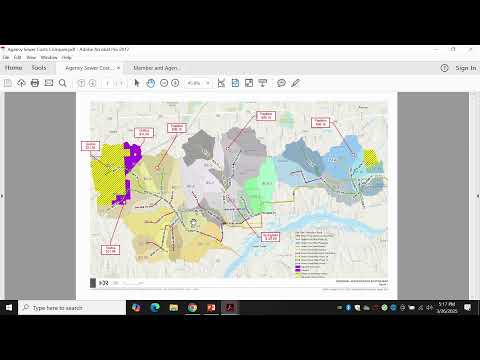
Gretna Mayor Mike Evans asked the Sarpy County and Cities Wastewater Agency on March 26 to allow his city to sewer about 1,100 acres now and remit a portion of fees back to the agency later, arguing the proposal would accelerate development and provide near‑term revenue to the agency.
The request, presented during the agency’s regular meeting, would let Gretna provide temporary sewer service routed to Omaha until the agency’s own infrastructure reaches the area. “We would…pay the connection fees and I think that’s a good standard…and let’s give 75% of that right back to the agency,” Mayor Mike Evans said, describing a proposed split in which Gretna keeps a share of fees to cover its bonds and construction and places the remainder into a fund for the future agency line.
The board’s majority did not adopt a final position but directed agency staff to work with Gretna staff on a formal application and fiscal-impact analysis. Agency staff and several elected members proposed developing a “pioneering” policy that would outline eligibility, reimbursement order, and expectations for temporary service and eventual connection to agency infrastructure.
Why it matters: Gretna’s proposal, if approved in some form, could accelerate commercial and industrial projects that proponents say add jobs and property valuation while producing early connection-fee revenue for the agency. Board members repeatedly said any accommodation must protect the agency’s long-term finances and the agreed phasing plan for trunk lines.
What the board discussed: Evans emphasized missed opportunities and said a recent small parcel produced $1.8 million in connection fees and significant valuation. He suggested Gretna could keep much of user fees while building agency-standard piping and escrow 25% for the agency’s future line. Agency administrator Dan Hoynes said the request sits among “operational uncertainties” that include future connection-fee and user-rate revenues, alignment of trunk-line construction with demand, and the need to avoid drawing on county reserve funds.
Several members supported compromise but insisted on additional analysis. Douglas Kindig, mayor of La Vista, said he supported a reimbursement plan but opposed committing a fixed date for connection or a guaranteed surrender of future revenues. Mark Setout, agency treasurer, said the request needs a formal application and that “a fiscal impact study is required by our policies.” Don Kelly, Sarpy County Commissioner and board chair, summarized the board’s direction as asking staff to “find a way to make this happen” while preserving the agency’s financial integrity.
Points of contention and staff direction: Board discussion focused on two policy questions — whether members should be allowed to advance construction of agency-designated lines with a reimbursement commitment, and whether temporary service provided by another member (or Omaha) should be subject to agency rates and, if so, who retains those revenues. Some members favored allowing municipalities to retain most user-fee revenue during temporary service to help them finance construction; others, including agency staff, cautioned against using agency funds for infrastructure that will be abandoned when agency lines arrive.
Next steps: The board asked agency staff to work with Gretna staff to produce a formal application, perform a fiscal-impact analysis, and draft a pioneering/reimbursement policy for board consideration. Members said the draft policy should clarify that reimbursement applies only to infrastructure that will be owned and operated by the agency and should define the order of reimbursements and timing of fee transfers when agency connections occur.
Ending: No vote was taken on Gretna’s request; the board left direction to staff and signaled a willingness to pursue a negotiated solution but asked for concrete analysis and a formal application before adopting policy or commitments.