Get Full Government Meeting Transcripts, Videos, & Alerts Forever!
Get email alerts on the Hotel Occupancy Tax Grants topic
No spam. Unsubscribe anytime.
Alpine outlines hotel-occupancy-tax grant rules and opens applications through April 17
Summary
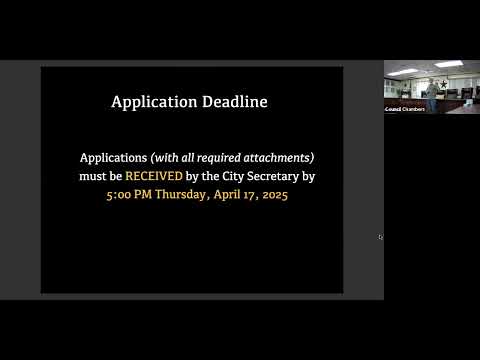
City tourism director Chris Ruggia explained eligible spending categories, application requirements and scoring priorities for the City of Alpine's hotel-occupancy-tax grants for the Oct. 1, 2025'Sept. 30, 2026 fiscal year; applications must be received by City Secretary Gio Calderon by 5 p.m. April 17.
The City of Alpine has opened applications for hotel-occupancy-tax grants for the Oct. 1, 2025 through Sept. 30, 2026 fiscal year, and applicants must deliver materials to City Secretary Gio Calderon by 5 p.m. on Thursday, April 17, Chris Ruggia, director of tourism for the City of Alpine, said during a public information session.
"The hotel occupancy tax is a state law, and the law, makes a 2 part test to determine whether any given expenditure is legal," Ruggia said, describing the test: an expense must (1) directly support the hotel industry in Alpine and (2) fit within one of the law's enumerated categories.
That two-part test is the threshold for eligibility and explains why certain categories and limits apply. Advertising is the largest category and, under both state law and Alpine's guidelines, Alpine must spend at least half of its hotel-occupancy-tax revenue on advertising targeted outside the city. Up to 15% of an awarded advertising grant may be used for production costs (video, photos, graphic or web design); the remaining advertising funds must be used to buy media space or placements. Ruggia said advertising placements must acknowledge the City of Alpine; staff must review and approve ad creative before payment.
Promotion of the arts and historic restoration each carry a maximum of 15% of the total hotel-occupancy-tax fund. Promotion-of-the-arts requests are highly competitive, Ruggia said, and typically fund music and artist fees; historic restoration funds may be used for significant structures that draw tourists (the city has previously supported work at Tokernot Field). Sporting-event grants are flexible but must show a substantial tourism component'a significant share of attendees from outside Alpine. Transportation grants are intended for event shuttles and require that one end of the route begin or end at a hotel to tie the service to tourism.
Ruggia walked applicants through required application materials and common reasons for disqualification. An application must include at minimum: a proposed budget, a marketing plan, a schedule or timeline for the event or project, an estimate of attendance and economic impact, and any required permits or surveys. If the applicant previously received funding, a report on the prior year's event must be attached; missing any of the required attachments will prevent the application from advancing to the review committee, Ruggia said.
The review committee is a citizen board appointed by city council with at least seven seats; the council member on the board and the city tourism director sit ex officio without a vote. Committee scoring emphasizes expected impact on hotel stays above all other criteria, Ruggia said; other scored factors include professionalism and clarity of the application, demonstrated capacity to host the event, and diversity of revenue sources (applications that rely less heavily on hotel-occupancy-tax funds score better). Ruggia said the committee prefers to see additional revenue sources and has historically downgraded proposals in which the hotel-occupancy-tax request represents a large share of the total budget.
Ruggia advised practical steps for applicants: if emailing an application on the deadline day, submit earlier than 5 p.m. (he suggested by 4 p.m.) and call City Hall to confirm receipt; paperwork must be dated within the fiscal-year window to match the auditor's expectations. He recommended that events partner with at least one local hotel to offer a promo code or discount, which provides an auditable method to verify out-of-town stays after the event.
Applicants asked if volunteer time should be monetized on budgets. Ruggia recommended listing volunteer hours as in-kind contributions rather than as expenses; hotel room donations can be recorded as in-kind contributions with a clear dollar value. On payments, Ruggia explained that the city generally reimburses organizations based on proper documentation but can issue checks directly when required; all payments processed by the city require a W-9 on file, a contract or invoice as appropriate, and supporting paperwork. Because municipal check runs are batched weekly, Ruggia advised submitting payment paperwork well before the event date to avoid timing problems.
The application package, guidelines and schedule are available on the City of Alpine website (cityofalpine.com) under the "Apply for" menu heading on the hotel-occupancy-tax grants page. Ruggia said slides from the information session and the recorded video will be posted to the city's YouTube channel; he supplied his contact for application questions as Chris Ruggia, director of tourism, chris@visitalpinetx.com.
The committee will score and award grants after the submission deadline; award amounts depend on available funds and committee scoring. Ruggia said he will monitor awarded grants for required paperwork and post-award reporting.