Get Full Government Meeting Transcripts, Videos, & Alerts Forever!
Get email alerts on the Involuntary Substance Treatment topic
No spam. Unsubscribe anytime.
Senate committee debates bill allowing involuntary substance-use treatment when judgment is impaired
Summary
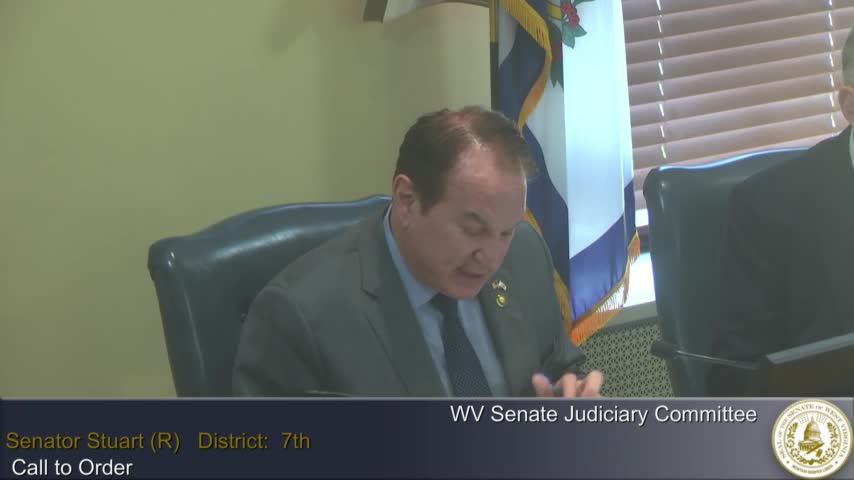
A state Senate committee heard extended discussion and witness testimony on a committee substitute for Senate Bill 761, the Joel Archer Substance Abuse Intervention Act, which would allow involuntary commitment proceedings for people with a substance use disorder when their judgment is so impaired by substance use that they cannot appreciate their need for treatment.
A state Senate committee heard extended discussion and witness testimony on a committee substitute for Senate Bill 761, the Joel Archer Substance Abuse Intervention Act, which would allow involuntary commitment proceedings for people with a substance use disorder when their judgment is so impaired by substance use that they cannot appreciate their need for treatment.
Committee counsel summarized the bill’s core change: "The proposed legislation addresses substance use disorder and permits the involuntary commitment process to proceed even when there's no likelihood of harm to self or others," provided the person "has lost the power of self control with respect to substance use" and "is incapable of appreciating his or her need for such services," among other criteria. The counsel said the substitute also would require, at the probable-cause stage, that a person released after detoxification agree to outpatient treatment before release, and would provide for restoration of firearm rights and removal from the mental-health registry when significant changes occur.
The bill borrows language counsel said is modeled on Florida’s Marchman Act and was described as structurally consistent with existing West Virginia mental-hygiene law. "This committee substitute attempts to weave essentially the Marchman Act into existing West Virginia law on involuntary commitment," counsel said, while emphasizing the draft seeks to make "surgical changes" rather than replace the current framework.
Why it matters: supporters said the measure would give families an additional legal option when an adult relative is deeply impaired by addiction and unable to accept help. Witness Stacy Archer, who identified herself as a parent of a son who had a substance use disorder, told the committee the proposal “gives parents hope” and described long personal efforts to find effective treatment for her son.
Court and process questions dominated the hearing. Lisa Tackett, director of circuit and family court services for the West Virginia Supreme Court and the official who oversees the state’s mental-hygiene process, explained the existing sequence: a commissioner reviews an application, a sheriff may be ordered to pick up the individual, an evaluator conducts an assessment and a probable-cause hearing follows. Tackett said many cases that start with applications do not result in involuntary hospitalization; she told the committee that evaluations and the mental-hygiene review determine whether the statutory criteria are met.
Several senators pressed whether the bill’s requirement that an individual "agree to" outpatient treatment as a condition of release after detox could allow facilities to hold people for extended periods if they refuse that agreement. One senator said the draft language might create "a loophole" by which a person could be held beyond an initial detox period. Committee counsel and the court representative differed somewhat on how long a person could be held without further court action, and on how the term "detoxification" is applied in practice. Tackett said detoxification is typically treated as the period until the illicit substance is out of the body and cautioned that "detoxing someone and putting them back out on the street, is really not a safe thing." Counsel and other senators discussed whether procedural rules could fill gaps on timelines and enforcement.
Committee counsel provided a statistic on current practice: of several thousand applications, only about 200 progress to involuntary hospitalization, a point used to underscore that many cases resolve via voluntary treatment after evaluation.
The hearing also touched on who may file a petition: counsel noted the substitute would permit a broader class of adults to seek a mental-hygiene petition than some other states’ statutes, saying "this is a broader any adult could proceed under this" compared with a prior law that limited petitions to specified family members.
No final action was taken on the committee substitute during the hearing. Senators asked counsel to revise language to clarify timelines, the relationship between detoxification and any initial hold, and the mechanics of enforcement when a person does not comply with a voluntary outpatient agreement. Members indicated they may ask the courts and treatment providers to help draft procedural rules or amendments clarifying acceptable types of outpatient programs and time limits.
The committee heard additional testimony about local treatment capacity, including references to a Recovery Point women’s facility in Charleston and broader concerns that residential and post-detox supports are limited, which witnesses and members said affects the statute’s practical effectiveness.
The committee approved minutes from its prior meeting at the start of the session; the minutes approval was moved from the vice chair and the chair declared them approved. The bill discussion will continue at a later date as members seek language and procedural changes requested during the hearing.