Get Full Government Meeting Transcripts, Videos, & Alerts Forever!
Get email alerts on the Travel Demand Models topic
No spam. Unsubscribe anytime.
How regional travel‑demand models shape long‑range transportation plans, presenters tell Transportation Commission
Summary
The California Transportation Commission hosted a webinar on measuring transportation impacts where regional planners described how travel‑demand models feed into long‑range regional transportation plans and the Sustainable Communities Strategy required under state and federal law.
The California Transportation Commission hosted a webinar on measuring transportation impacts where regional planners described how travel‑demand models feed into long‑range regional transportation plans and the Sustainable Communities Strategy required under state and federal law.
Clint Holson, planning manager at the Sacramento Area Council of Governments (SACOG), said travel models are used both to develop regional plans and to test implementation of projects after plans are adopted. “We use the model both in our planning process, but also in our implementation processes and looking at, development proposals in comparison to our long range plan,” Holson said.
Why it matters: the models produce the vehicle‑miles traveled (VMT), congestion, mode‑share and accessibility results planners use to demonstrate compliance with the federal Clean Air Act and California’s SB 375 greenhouse‑gas requirements, and to generate inputs for CARB’s EMFAC emissions model. Antoinette Meyer, director of planning at the San Diego Association of Governments (SANDAG), said achieving SB 375 targets is especially challenging because the metric is a per‑capita VMT reduction: “We have to develop a plan that will lead to people driving much less in 2035 than they do today,” Meyer said.
How the models work: SACOG describes a parcel‑level land‑use base plus population and demographic projections; SANDAG uses an activity‑based model (ABM) that simulates daily activities to predict trips, modes and timing. Bhargav Sana, manager of regional models at SANDAG, explained that ABM “predicts where they go, when, why, with whom, and perhaps more importantly, how they get there.” Outputs include traffic volumes and speeds that feed EMFAC to estimate emissions.
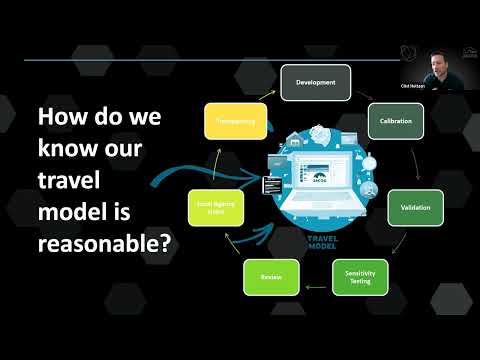
Calibration and data: presenters emphasized continuous validation. Holson described calibration against household surveys, counts and big data and noted SACOG makes its model available for free to local agencies and consultants. Sana and Meyer said SANDAG updated model parameters with 2022 survey work to reflect post‑pandemic travel patterns and conducts external peer review and public documentation of code and methods.
Policy and programs: both agencies stressed that projects alone do not deliver VMT reductions. Meyer said pricing and transportation demand management (TDM) measures — such as fare subsidies, guaranteed‑ride‑home programs and managed‑lane pricing — are major contributors in model scenarios. “Projects only go so far… it’s really these policies that make certain modes more attractive,” she said.
Equity, safety and outreach: Commissioners and staff asked how models account for perceptions (safety, convenience) and rural conditions. Presenters said perception is difficult to represent directly in equations but can be approximated through survey updates and a “catch‑all” parameter; agencies pair modeling with targeted outreach and programs. Holson and Meyer described community engagement: SACOG reported outreach to roughly 6,000 residents for its plan update, and SANDAG contracts with nearly 20 community‑based organizations to broaden participation.
Rural and cross‑border issues: speakers said models are adaptable to rural travel patterns through tailored inputs (on‑demand or commuter services instead of high‑frequency fixed routes). SANDAG noted daily cross‑border trips from Mexico require specialized data collection and modeling components.
Induced demand and land use: presenters acknowledged induced demand is a key modeling challenge. Sana described tests in the models to measure how added capacity affects VMT and said adjustments are made when the model response falls short of literature‑based expectations; CARB reviews induced‑demand treatment in regional conformity work. Holson explained the long‑range plan ties transportation investments to land‑use forecasts and phasing so predicted travel effects reflect likely development timelines to 2050.
Timing and updates: SANDAG said it will release a draft 2025 regional plan in May and that federal, state and regional plans are updated every four years; both agencies said continual data collection is necessary as travel choices and technologies evolve.
Public priorities: commenters emphasized case studies of successful transit systems, the need for transparent evidence of what TDM and outreach approaches work, and services for aging populations and people with disabilities. Presenters responded that outreach findings and program evaluation inform the modeling and implementation work and that some outcomes (for example, health benefits from active transportation) are assessed outside the core travel model but are included in plan performance reporting.
The webinar closed with the commission noting future sessions will cover how transportation impact analyses are used in the California Environmental Quality Act process.