Get Full Government Meeting Transcripts, Videos, & Alerts Forever!
Get email alerts on the Transportation topic
No spam. Unsubscribe anytime.
Committee hears detailed debate on road‑usage charge for all‑electric vehicles; Carlson’s bill moves to taxes committee
Summary
Senate File 1480, proposing a vehicle‑miles‑traveled (VMT) road‑usage charge for all‑electric passenger vehicles and an account‑provider reporting system, drew extended discussion on privacy, equity and technical feasibility before the committee moved the bill without recommendation to the Taxes Committee.
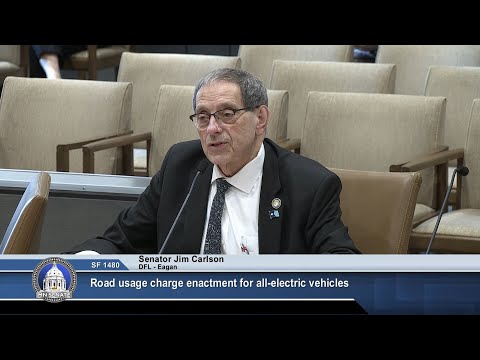
Senator John Carlson presented Senate File 1480 to the Minnesota Senate Transportation Committee on March 26, 2025. The bill would impose a road‑usage charge on all‑electric passenger vehicles based on miles driven, with reporting supplied by vehicle telematics or odometer data and managed by account providers under contract with the commissioner.
Nut graf: Supporters framed the approach as a precise way to align road funding with use as EV ownership grows; opponents and several committee members raised concerns about administrative complexity, data privacy and the limited scope of taxing only electric vehicles.
Senator Carlson offered an A‑1 amendment to ensure revenue would deposit into the Highway User Tax Distribution Fund and to address constitutional coordination. The amendment was adopted.
Nick Hague, senior associate for electric vehicles at Fresh Energy, testified against SF1480. Hague said electric vehicles remain a small share of Minnesota passenger cars (under 1% in his testimony) and that EV owners already contribute through higher motor‑vehicle sales tax and tab fees. Fresh Energy and other testifiers urged that a distance‑based fee, if used, be comprehensive across all vehicle and fuel types rather than targeting only EVs.
Committee members pursued technical questions about how the system would distinguish in‑state from out‑of‑state miles, whether the reporting would rely on telematics vs. odometer readings, and the frequency of billing (annual vs. quarterly). Senator Farnsworth asked whether border crossings could be differentiated; Senator Carlson said programing could place borders in the records. Members also raised fairness and administrative concerns, with several preferring broader solutions (kilowatt‑hour fees, surcharges, or a full VMT program for all vehicles).
Senator Carlson said he views the bill as a precise method using existing vehicle data; he moved SF1480, as amended, to the Taxes Committee without recommendation. The committee recorded the motion and moved the bill by voice vote.
Ending: The bill will be considered next by the Senate Taxes Committee where technical questions about data privacy, administration and a possible expansion to all vehicle types are expected to be revisited.