Get Full Government Meeting Transcripts, Videos, & Alerts Forever!
Get email alerts on the Public Broadcasting Funding And Bias topic
No spam. Unsubscribe anytime.
House Oversight Subcommittee Questions NPR, PBS on Federal Funding, Bias and Rural Emergency Role
Summary
The House Oversight and Reform subcommittee held a contentious hearing in which Republican members pressed NPR and PBS executives over alleged political bias and federal subsidies while public‑media leaders defended the networks' local services, emergency communications role and educational programming.
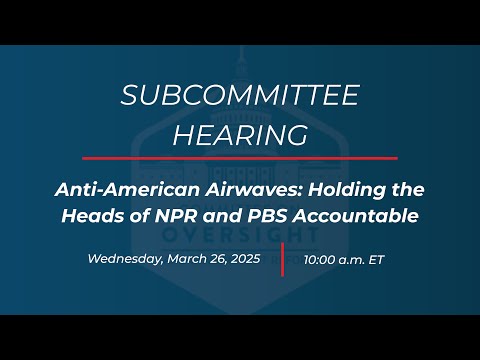
The House Oversight and Reform Subcommittee on Delivering on Government Efficiency convened a full hearing to examine federal support for public broadcasting and to question executives from National Public Radio and the Public Broadcasting Service about political bias, programming for children and the networks' role in rural emergency communications.
Chairwoman Marjorie Taylor Greene opened the hearing saying the panel was "continuing our war on waste" and challenged witnesses to justify more than a half‑billion dollars in federal support for public radio and television. Greene repeatedly characterized NPR and PBS as politically biased and cited specific programming she said was inappropriate for children; she also pressed executives on social‑media posts and past editorial decisions.
Katherine Maher, identified at the hearing as president and CEO of National Public Radio (NPR), told the committee she views public media as an essential local service. "Nearly 100% of Americans live within range of a public radio station," Maher said, and she said NPR has about "43,000,000 listeners from every state in the nation." Maher described steps she said NPR has taken since her arrival in May to strengthen editorial review and increase engagement with local newsrooms.
Paula Kerger, president and CEO of PBS, made a similar defense of local stations and children's programming. "There's nothing more American than PBS," Kerger said, and she emphasized that local stations provide programming—ranging from high‑school sports and candidate debates to educational preschool content—that she said cannot be replicated by commercial broadcasters in some communities. Kerger told members that "more than 70% of the CPB funds from Congress go directly to our stations" and that local stations typically raise roughly seven dollars in nonfederal support for each federal dollar, a figure she and other witnesses used to describe a public‑private financing model.
Witnesses for the hearing included Heritage Foundation senior fellow Mike Gonzalez, who argued for defunding public media. "Public media needs to be defunded and the CPB needs to be dissolved," Gonzalez testified, citing what he described as partisan bias in programming and news coverage. Alaska Public Media president Ed Ullman defended the service role of local public broadcasting in remote areas, describing stations that provide lifesaving weather and emergency alerts and a statewide network of stations that reach communities with limited commercial media options.
Republican members focused questions on a range of topics: whether NPR and PBS had violated FCC rules on underwriting and underwriting announcements (committee members referenced an ongoing FCC inquiry), whether editorial decisions had been politically motivated in coverage of major stories including the Hunter Biden laptop and the COVID‑19 origins debate, and whether specific pieces of programming were suitable for children. Democrats on the panel and several Democratic witnesses defended public broadcasting as a cost‑efficient public good that sustains local journalism in news deserts, supports educational programming for preschoolers and provides critical emergency communications in rural and remote areas.
The hearing record included multiple documents and letters entered by members on both sides of the aisle highlighting local stations' reliance on federal support and critiques of national coverage. Committee members emphasized different metrics to argue their positions: several Republicans cited audience declines and individual editorial failures as proof of bias; witnesses and Democrats cited the national reach of local stations, emergency‑alert capabilities and research linking public broadcasting to civic engagement.
No formal vote or legislative action was taken at the hearing. The committee chair closed by saying the hearing record would remain open and that members could submit written questions and materials for inclusion in the record.
The transcript records strongly divergent views about public media's mission and future federal support: proponents described an interdependent national system that funnels appropriations to local stations and supports emergency communications and preschool education; critics framed federal support as an unfair subsidy to institutions they describe as politically partisan. Several factual claims were contested on the record and remain matters of dispute between committee members and the witnesses. The committee made no final determination on funding during the session.