Get Full Government Meeting Transcripts, Videos, & Alerts Forever!
Get email alerts on the Library Governance topic
No spam. Unsubscribe anytime.
Public, trustees and council clash over library-board oath to state constitution
Summary
Public commenters and library trustees debated whether members of the Charleston County Public Library Board must take an oath to the South Carolina Constitution after council members discussed an Attorney General opinion and a recent change in council practice.
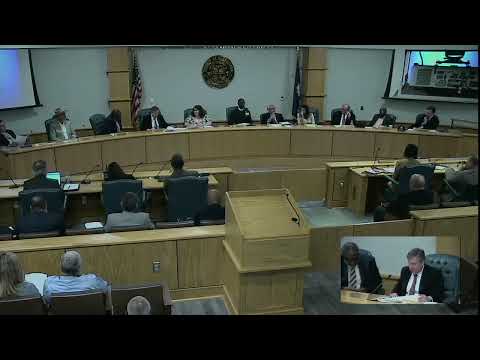
Several members of the public and two library trustees addressed Charleston County Council on March 20 over whether members of the Charleston County Public Library Board of Trustees must take an oath to the South Carolina Constitution.
Alyssa Bertoluzzi, who identified herself as a library trustee, told the council that she had planned prepared remarks but had been told she could not read them because of a perceived conflict with her role on the board. "Charleston County Public Library does not record their meetings so the details of discussions are available like they are when public watches this year, meeting," Bertoluzzi said, adding that she had filed the oath "with no problems" and was disappointed she could not fully speak on it.
Melanie Collins, who said she serves on the library board but was speaking as a citizen, criticized what she described as misrepresentation of trustees by a council liaison and framed the debate as one about free thought in the library stacks. "This is about diversity of thought and how it is reflected in both the stacks of our library," Collins said.
The Rev. Nelson B. Rivers III, pastor of Charity Missionary Baptist Church, urged trustees not to be compelled to take the oath, citing the 1895 South Carolina Constitution and its historical role in disenfranchisement. "No black person should be compelled to take the oath to the 1895 constitution of South Carolina because it was diametrically opposed to the United States constitution," Rivers said.
Vice Chair Kobrowski addressed the council and read the language of the oath as it appears in the state constitution. He also quoted an Attorney General opinion that, he said, concluded members of the Charleston County Public Library Board of Trustees are officers under article VI and therefore are required to take the oath prescribed in article VI, section 5. Kobrowski said the council had recently changed its approach to the issue: "Before that night, we had a requirement for all of our boards and commissions to take the oath. And after that night, that no longer applies. So they no longer have to do it. So we took it away," he said, and added he regretted the change.
The discussion in public comment reflected sharply different views: some trustees and residents said taking the oath is a civic duty and should be done without controversy; others said the specific historic origins of the 1895 constitution and its connection to segregation and voter suppression made the oath objectionable for some. The council did not take a formal, recorded action on the item during this meeting.
The county attorney and the cited Attorney General opinion were referenced during remarks but the meeting transcript includes no alternate statutory authority disputing that opinion. Council members said the issue had been handled differently in recent council business and that there is disagreement among trustees and the public about whether the oath should be required.
Charleston County Council did not vote on a change to library-board requirements during the March 20 meeting; speakers said the matter had been the subject of earlier meetings and of an Attorney General opinion that the board members are officers required to take the oath.