Get Full Government Meeting Transcripts, Videos, & Alerts Forever!
Get email alerts on the Wage Theft Criminalization topic
No spam. Unsubscribe anytime.
House Judiciary Committee adopts committee substitute for HB97 adding wage-theft offenses
Summary
The House Judiciary Committee adopted a committee substitute for House Bill 97 as its working document, adding new organized-theft and wage-theft offenses, restitution for wage theft and an exemption for certain correctional employees; invited testimony from the Department of Law and Department of Labor is scheduled next week.
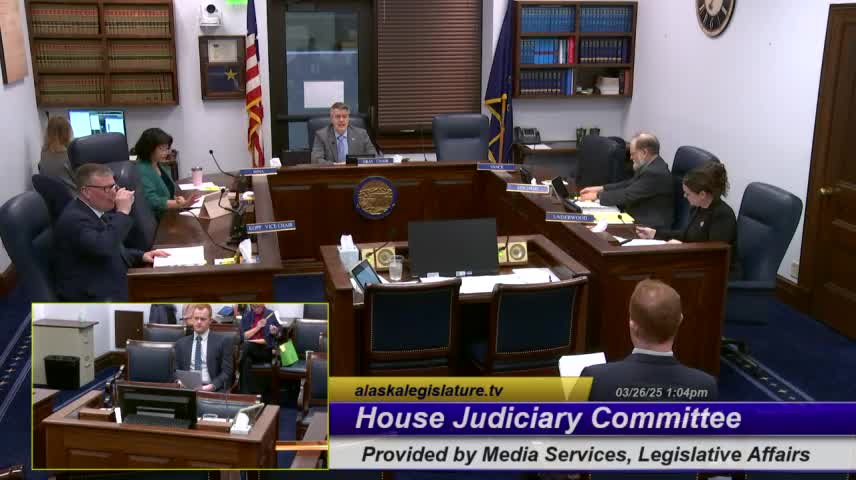
Representative Gray, chair of the House Judiciary Committee, opened the March 26, 2025 committee meeting and introduced a committee substitute for House Bill 97, which the committee adopted as its working document by voice action after an initial objection was withdrawn.
The substitute adds a new crime of organized theft, incorporates language from other bills including House Bill 106 (governor) and House Bill 77 (Representative Colombe), and creates first-, second- and third-degree wage-theft offenses with restitution provisions. "Wage theft is a serious crime, and it's time that our laws reflect that reality," Gray said, citing a study by the Economic Policy Institute that estimates wage theft costs U.S. workers about $50,000,000,000 annually. "The average amount stolen in these cases is just under a thousand dollars," Gray added.
Nut graf: The committee substitute for HB97 broadens Alaska's criminal code to treat certain employer nonpayment as criminal theft rather than only a civil labor claim, while carving an exemption for employees of correctional, juvenile detention and juvenile treatment facilities. Committee members and staff said the proposal will be followed by invited testimony from the Department of Law and the Department of Labor next week to clarify enforcement roles, statutory interactions and whether additional exemptions are needed.
Committee staff summarized the substitute. Nate Graham, staff to Representative Gray, said the bill: contains conforming language in multiple sections; borrows organized-theft language from HB106; removes some changed thresholds for degrees of theft in earlier drafts; adds an exemption for correctional and juvenile facility employees drawn from HB77; defines "aggregate value"; creates wage-theft offenses in three degrees; and establishes restitution and an effective date. Graham said he would follow up with the committee about the specific states used as models for the wage-theft provisions.
Deputy Attorney General John Skidmore, appearing online for the Department of Law, told the committee that section 6 (the mail-theft exemption for facility employees) does not address adult treatment or civil-commitment facilities and that some form of exemption for the Department of Corrections likely is needed. "I agree with you that this particular section is not dealing with adults. And there does need to be some sort of exemption for DOC," Skidmore said, and he offered to research whether a comparable exemption already exists in other statutes and report back.
Committee members asked several procedural and substantive questions. Representative Mina asked which agencies would investigate or prosecute wage theft; staff and members noted the Department of Labor's Wage and Hour unit currently handles unpaid-wage complaints and that the Department of Law could receive forwarded cases for criminal prosecution. Evan Anderson, staff to Representative Fields, said Wage and Hour is under-resourced and that adding a criminal statute would provide an additional enforcement tool for regulators and victims.
On penalties and repeat offenses, committee staff explained that a first offense involving under $1,000 would be classified as a class A misdemeanor under the substitute; a person with three or more convictions within 10 years for the same offense could face upgraded penalties up to a class C felony. Staff also said the substitute includes an "aggregate value" definition and that Department of Law will analyze how that interacts with existing aggregate-value statutes.
Formal action: a committee member moved to adopt the committee substitute for House Bill 97 as the committee's working document; an objection was entered for purposes of discussion and later withdrawn by Representative Mina. Chair Gray stated, "Hearing no more objections, the committee substitute for House Bill 97 ... has been adopted as our working document." The committee set HB97 aside and announced it will reopen the bill next week for invited and public testimony. The chair also removed the prior amendment deadline for this version and invited stakeholders to consult with staff about potential amendments.
The meeting concluded with a preview of the next session, which will include an initial hearing on House Bill 137 (PFD child support) on Friday. The committee's invited testimony from the Department of Law and the Department of Labor on HB97 is scheduled for next Wednesday.
Ending: The committee adopted the substitute as its working document and will reconvene with state-agency testimony before proceeding further on substantive amendments or votes on final passage.