Get Full Government Meeting Transcripts, Videos, & Alerts Forever!
Get email alerts on the Mental Health Education topic
No spam. Unsubscribe anytime.
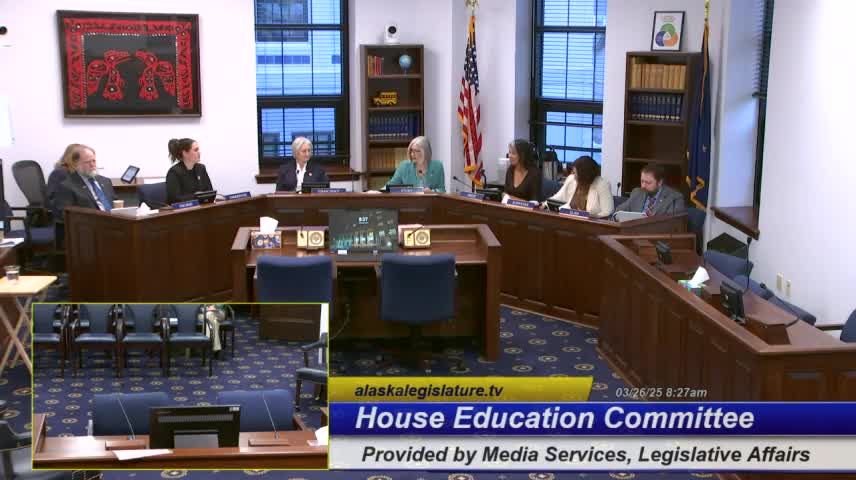
House Education Committee advances mental‑health education bill after debate over scope and funding
Summary
The Alaska House Education Committee voted 4–3 on March 20 to report House Bill 105, a bill to develop statewide guidance and curriculum for K–12 mental‑health education, after defeating an amendment that would have restricted terminology to promotion and prevention.
The Alaska House Education Committee voted 4–3 on March 20 to report House Bill 105, a bill to develop statewide guidance and curriculum for mental‑health education in K–12 schools, moving the measure out of committee with attached fiscal notes.
Committee members debated how far school curriculum should go in addressing mental health and whether the state already provides adequate standards and district flexibility. Representative Elise Galvin is the sponsor (staff: David Jang); Representative Himshut moved the committee motion to report the bill with the attached fiscal notes.
Sponsor staff said the bill focuses on education, awareness and instruction "rather than prescribing specific treatments," and that the work would be done in consultation with the Department of Health, the Department of Family and Community Services, tribal health organizations and national and state mental‑health organizations. Representative Schwanke offered an amendment (34‑LS0558.A.3) meant to limit the bill’s terminology to the promotion and prevention side of a public‑health continuum developed by the Institute of Medicine/National Academy of Medicine; advocates of the amendment said schools should not engage in case identification or treatment. Schwanke told the committee she wanted a clear “hard stop” so schools would not be placed in the role of diagnosing or recommending treatment.
Opponents of the amendment said the bill is designed to cover promotion and prevention and that consultation with health agencies and professional groups can produce consistent terminology. Representative Hemshute and others said clearer standards would help districts choose appropriate curricula and that many districts lack consistent access to counselors and nurses. Representative Divert and others described rural staffing shortages and supported giving teachers curriculum and guidance that could be used where local mental‑health services are scarce.
Committee members also questioned the bill’s fiscal note. The document attached to the bill includes $216,000 estimated for two facilitated working‑group meetings for about 30 professionals; several members asked for more detail on who those professionals would be and what the meetings would accomplish, calling the figure “unbelievably expensive” without a clearer scope.
The committee first voted on the Schwanke amendment; the amendment failed, 3 yeas to 4 nays. The committee then voted to report House Bill 105 from committee with fiscal notes; the motion passed by roll call, 4 yeas to 3 nays. (Roll calls in the transcript named Representative Divert as a yes vote and both co‑chairs, Story and Hemshute, as yes votes; other roll‑call entries are recorded in the committee minutes.)
Supporters said the bill will produce uniform guidance, parental notification provisions are included in the draft, and the working groups would help ensure materials are age‑appropriate and developed with health partners. Opponents said current Alaska content standards already allow many schools to teach about emotional health and worried the bill’s language was too vague and could duplicate existing district efforts.
The committee chair said the bill will continue through the legislative process and scheduled further committee work. The committee also noted that some districts have already implemented mental‑health instruction and said the bill’s guidelines are intended to provide uniformity rather than mandate a single curriculum.
Votes at a glance • Amendment 34‑LS0558.A.3 (limit terminology to promotion/prevention): failed, 3 yeas, 4 nays. • House Bill 105 (mental‑health education): reported from committee with attached fiscal notes, passed, 4 yeas, 3 nays.
Next steps: HB105 was moved out of committee with fiscal notes and will proceed through the legislative process; the committee did not adopt the Schwanke amendment and did not vote to strike funding. The transcript records committee discussion about consultation with state health agencies and tribal organizations and requests for further detail on the proposed working groups and the fiscal note.