
All Alaska Pediatric Partnership urges statewide coordination, workforce growth after infant mental‑health needs assessment
Get AI-powered insights, summaries, and transcripts
Sign Up Free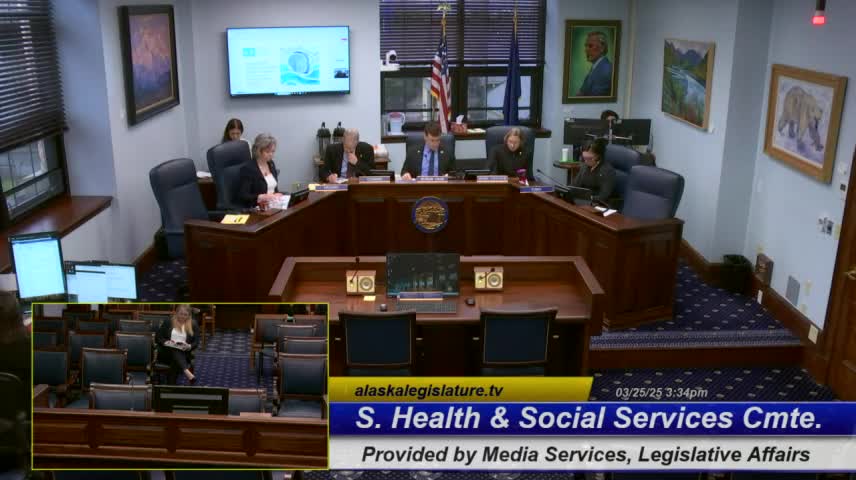
Summary
A2P2 presented a 2024 infant and early childhood mental health needs assessment to the Senate Health and Social Services Committee, urging a new state‑level coordination role, workforce training, and expanded prevention and consultation services to reach children and caregivers across Alaska.
Tamar Ben Yosef, executive director of the All Alaska Pediatric Partnership (A2P2), and Carmen Wenger, director of programs at A2P2, briefed the Senate Health and Social Services Committee on a 2024 infant and early childhood mental health needs assessment on March 20 in Juneau.
The presentation explained that “infant early childhood mental health” covers young children’s ability to form secure relationships, manage emotions and engage in learning, and noted that services often focus on supporting parents or providers rather than directly on the child. Ben Yosef told the committee Help Me Grow Alaska — an A2P2 program launched in 2018 — has served more than 5,000 families in over 80 communities and that more than half of Help Me Grow cases are for children ages 0 to 8.
The report, developed with the Mental Health Trust and statewide stakeholders, used secondary indicator data, surveys of coaches and consultants, interviews with state and program leaders, and focus groups. A2P2 said awareness of the field is limited among clinicians and policymakers, which creates a barrier to families finding appropriate supports. “There’s limited awareness and understanding of this,” Ben Yosef said, adding the field has existed under other names but lacks a consistent statewide framework.
Wenger outlined six broad recommendations from the assessment. The first is creating a state‑level coordinator to align infant and early childhood mental health efforts across programs and fund sources. Recommendations two and three call for public education to build a common language and expanded professional development so educators, health providers and early childhood staff can recognize needs and intervene early. Wenger emphasized infant early childhood mental health consultation — a classroom‑level model that supports whole settings rather than only individual children — and recommended expanding consultation capacity and growing the specialized behavioral‑health workforce required to deliver it.
The report also advocates targeted prevention by increasing access to high‑quality early childhood education, home visiting and caregiver wellness supports. Wenger said several implementation projects are already underway since the report’s August 2024 release, including a financing and policy work group preparing a social marketing campaign, a Preschool Development Grant‑funded training cohort for infant and early childhood mental health consultants, and pilots to make consultation accessible to rural providers via teleconsultation or other remote supports.
Committee members asked about age definitions and examples. Ben Yosef said A2P2 uses a 0 (prenatal) to 8 framework because transitions into K–12 eligibility and services are important to track. Senator Tobin asked about attachment and early relational health in foster care; Wenger explained infants and young children who move repeatedly between caregivers can fail to develop regulatory skills and secure attachment, which affects behavior and learning trajectories.
Ben Yosef and Wenger also described workforce and funding pressures: Help Me Grow funding largely comes from federal grants and contracts with the Department of Health, and some federal prevention funds the group relied upon were described as at risk for cuts. A2P2 said sustaining and scaling consultation and prevention services will require deliberate coordination and funding across state programs and partners.
A2P2 left the committee with copies of the full report and invited further questions and follow‑up. The presentation closed with an appeal to consider infant early childhood mental health as part of the broader early‑childhood system rather than an isolated set of programs.