Get Full Government Meeting Transcripts, Videos, & Alerts Forever!
Get email alerts on the Hb53 Language Package topic
No spam. Unsubscribe anytime.
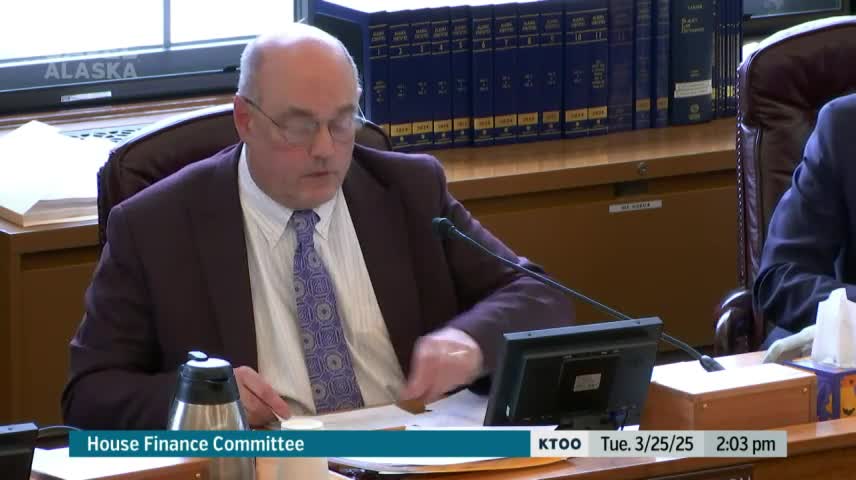
House Finance extensively debates chair’s large language amendment for HB 53 — education contingency, receipts authority and surplus splits draw scrutiny
Summary
Co-chair Josephson opened discussion of Amendment 4 to HB 53, a sweeping chair’s language package that would reassign receipts authority, add education and transportation contingencies, create agency receipt appropriation language, and add surplus-trigger (kicker) language.
Co-chair Josephson opened extended discussion of Amendment 4, the chair’s comprehensive language package to the operating bill (House Bill 53). Alexander Schroeder, staff to the chair, walked members through the amendment’s in-line changes and identified the primary substantive elements, including agency receipt appropriation language, contingency and one-time appropriations for school funding and pupil transportation, a backstop for the Alaska Marine Highway System, and surplus-distribution language tied to specified revenue triggers.
Schroeder explained several technical changes: the amendment deletes a supplemental appropriation for the Alaska Seafood Marketing Institute and removes Alaska Energy Authority funding from that language section to move it to a numbers amendment; it adds a standard appropriation structure for the Alaska Industrial Development and Export Authority to appropriate the authority’s interest earnings and loan fees; and it corrects a cross-reference to reflect that labor-relations functions were transferred to the Department of Law in 2024.
Members pressed staff on multiple policy specifics. Representative Stepp and other members asked whether adopting language amendments now would complicate member amendments later; Legislative legal counsel Megan Wallace answered procedural questions, explaining that subsequent amendments that conflict with adopted language would, if adopted later, supersede earlier language (the last-adopted amendment controls in the drafting manual’s harmony rules). Wallace advised members that technical conforming changes typically occur during engrossment and that legal staff would work to preserve members’ stated intent when possible.
Fiscal staff described contingency and funding mechanics. Lehi Painter of the Legislative Finance Division told the committee that one-time language provisions are used when the exact appropriation cannot be finalized (for example, student counts for foundation formula calculations) and that the numbers section and language section together determine final funding. Painter noted that the correctional-officer contract was resolved by arbitration in January, explaining why those costs did not appear in the governor’s budget.
The amendment’s education provisions drew sustained attention. Amendment 4 includes contingency language intended to provide a one-time supplement so the Base Student Allocation (BSA) would reach $1,000 if a separate bill (HB 69) did not pass or passed at a lower amount. Schroeder and members clarified that the contingency is a one-time appropriation and that the underlying statutory BSA change would remain the responsibility of the separate bill. Members asked for fiscal summaries showing the dollar impacts; Painter agreed to provide staff-level numbers.
Amendment 4 also includes special-appropriations “kicker” language: a trigger formula would allocate up to $700 million of surplus revenue, splitting that amount 50/50 between a one-time energy-relief payment (a payment to dividend recipients, described as similar to prior combined dividend/energy-bonus practice) and the state’s budget reserve until a higher revenue threshold is reached. Ken Alper, staff to the chair, explained that prior combined payments have been issued as single checks and described the revenue trigger bands used to determine distributions. Members raised tax and policy questions about the design of such payments and whether they provide meaningful relief to high-cost households.
Several items in the amendment were technical corrections or routine appropriations but were notable because of their budgetary effect: pupil-transportation contingency ($6,781,200 one-time), a $5,000,000 backstop to the Alaska Marine Highway System if federal funds fall short, a $6,666,700 additional community assistance distribution (for a total of $30,000,000 under the fund’s formula), reductions to public-education fund capitalization to match statutory calculations, and an appropriation of WAMI program repayments to the Higher Education Investment Fund (language similar to past years).
After hours of questions and legal and fiscal explanations, members did not take a final vote on Amendment 4 on March 25. Co-chair Josephson scheduled continuation of amendment work for March 26 and asked staff to provide fiscal summaries so members could better assess the net budgetary impact before further votes.
Direct quotes on record include staff explanations: Alexander Schroeder said the amendment would, among other items, “add a new section with contingency language for a thousand dollar BSA increase from the statutory formula” and Lehi Painter noted that “these 3 contracts were the negotiations were concluded this year.” Megan Wallace advised the committee on process: “the last adopted amendment supersedes amendments previously adopted” when amendments are not harmonious.
Members signaled they will continue deliberations when the committee reconvenes; staff were asked to prepare consolidated fiscal impact summaries for the language items under discussion.