Get Full Government Meeting Transcripts, Videos, & Alerts Forever!
Get email alerts on the Rural Energy topic
No spam. Unsubscribe anytime.
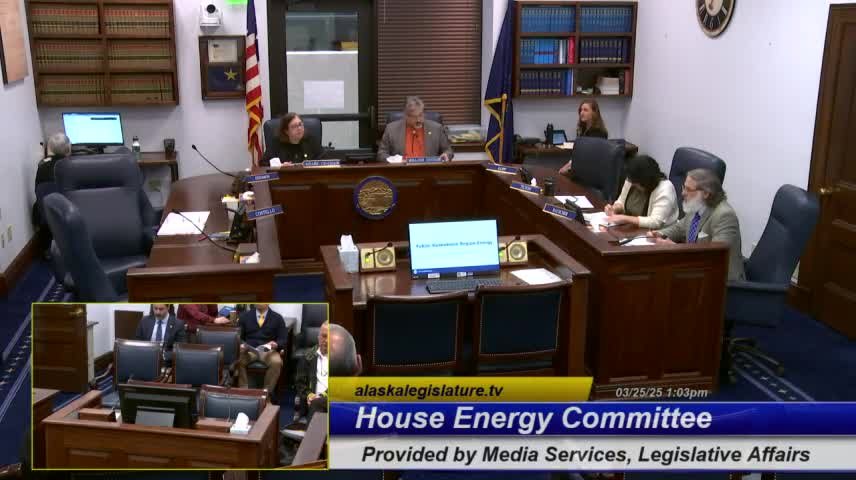
House Energy Committee hears rural Alaska leaders on high power costs, outages and PCE reliance
Summary
Witnesses from rural Alaska told the House Energy Committee on March 25 that communities face chronic outages, very high electricity and fuel costs, and heavy reliance on the Power Cost Equalization program. Presenters urged better oversight, rural representation on state bodies, and targeted funding for grid upgrades and renewables.
Juneau — The Alaska House Energy Committee heard community leaders on March 25 describe chronic electric service problems across rural Alaska, sharply higher retail power costs, and heavy local reliance on the state’s Power Cost Equalization (PCE) program.
Co-chair Representative Kai Holland convened the committee to focus on rural energy issues and invited four presenters who described regional conditions, gaps in oversight, and possible policy responses. “Today, we’ll be focusing in on rural, issues around energy,” Holland said as the hearing opened.
Ben Milat, identified in the transcript as president of the Alaska Federation of Natives (AFN), said energy stability is fundamental to community survival and cultural life. “Energy and having sustainable and stable energy is critical for sustainability of our communities,” Milat said, citing repeated long outages and high local costs that affect freezers, schools and broadband access.
Andrew Guy, introduced as president and CEO of Calista Corporation, described the economic and geographic constraints that make rural interties and economies of scale difficult. Guy told the committee that Power Cost Equalization “was never supposed to be the solution that it is right now” and said PCE should not be treated as a permanent fix for the structural gaps in rural power systems.
Wayne Morgan, identified as special projects coordinator for a tribal council that sponsored the AFN resolution, presented household and institutional electric bills from his community and described a utility billing and regulatory episode that he said lacked required public notice. Morgan said his community at times paid up to $1.87 per kilowatt-hour before PCE and that an arrearage of roughly $450,000–$500,000 was amortized by regulators over two years; he said the amortization raised current effective rates to about $0.94 per kilowatt-hour for his community’s customers. Morgan urged stronger rural representation on the Regulatory Commission of Alaska (RCA) and more active auditing of utilities.
Amanda Tordall, Community Planning and Development Program Director for Kawerak (the Bering Strait regional organization), summarized regional data: pre-subsidy residential power costs in her region range roughly from $0.46 to $0.72 per kilowatt-hour; fuel costs for heating and transport can exceed $8 per gallon in places; most communities are diesel-powered islanded microgrids; and there is a shortage of bulk fuel storage, aging grid infrastructure, and workforce capacity. “That endowment fund [PCE] is so important for our region,” Tordall said, while also noting the program’s limits when households exceed the 750-kilowatt-hour allowance now used for residential subsidies.
Committee members and witnesses discussed options that would not immediately disrupt PCE’s lifeline role while still moving toward longer-term solutions: creating or chartering a rural energy task force led by rural Alaskans, funding regional energy planning updates, increasing rural representation on oversight bodies, targeted investment in bulk fuel and microgrid resilience, and support for renewable integration with storage. Representative Holland and others stressed that many rural communities already pursue renewable projects and tribal-led independent power projects, and that policy changes should avoid undercutting those efforts.
The committee did not take formal votes at the hearing. Members asked staff to follow up on statutory details (including a power-cost equalization grant provision cited at the hearing) and on whether the Alaska Energy Authority’s funding and planning programs could better prioritize rural projects.
The hearing included multiple calls for improved transparency and regulatory oversight after Morgan’s account of rate changes that community members said lacked public notice. Several presenters urged the committee to consider how state and federal funds could be more effectively coordinated and routed to tribal entities and regional organizations to implement community-driven solutions.
The session concluded with committee remarks about upcoming legislation: co-chairs noted a renewable portfolio standard bill had been introduced to the floor and that additional hearings and briefings will follow. The committee adjourned after roughly 93 minutes of testimony and questions.
Ending — Witnesses and members agreed on the need for near-term protections and long-term planning: preserve PCE’s role as a lifeline, improve RCA oversight and rural representation, and fund targeted grid resilience, renewable-plus-storage, and bulk-fuel improvements so communities can reduce outages and lower long-term energy costs.