Get Full Government Meeting Transcripts, Videos, & Alerts Forever!
Get email alerts on the Education Outreach topic
No spam. Unsubscribe anytime.
Alaska Resource Education demonstrates classroom lessons on mining, permitting, energy and carbon capture at legislative lunch-and-learn
Summary
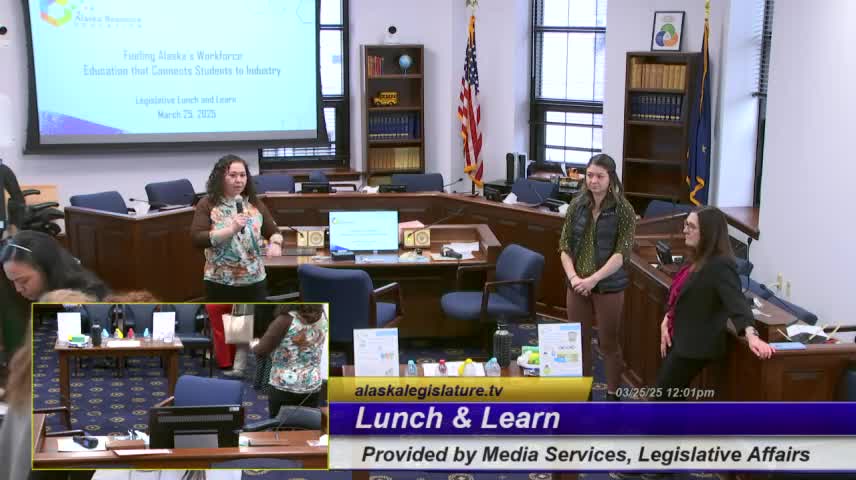
At a legislative "lunch and learn" hosted by Rep. Robin Burke, Alaska Resource Education showcased hands-on K–12 lessons that simulate mining, environmental baseline monitoring, energy chains and carbon capture and storage, stressing permitting complexity and workforce pathways.
Alaska Resource Education presented a hands-on overview of its K–12 curriculum, demonstrating classroom activities about mining, environmental permitting, energy transformation and carbon capture and storage at a lunch-and-learn hosted by Representative Robin Burke.
The session, led by Ella Eid, executive director of Alaska Resource Education, and Taylor Berg, the organization's operations manager, combined interactive exercises with discussions of agency permitting and workforce connections. "Alaska Resource Education is a 501(c)(3) nonprofit... our mission is to teach students about Alaska's natural resources," Eid said, introducing the group's reach and goals.
The presentation’s core purpose was to show how complex natural-resource topics can be made accessible to students while highlighting the regulatory and environmental work that accompanies development. Taylor Berg described the interactive format as "very interactive" and said the organization delivers classroom outreach, youth programs and teacher training statewide. Berg outlined three program tiers: SPARK (K–12, under three contact hours), Ignite (grades 4–8, deeper multi‑session units) and Launch (grades 9–12, with workforce development content).
Presenters used a mining simulation to teach several points at once: mineral values, cultural resources, environmental reclamation and the costs of acting without baseline data. In the activity, yellow beads represented gold ($600 each), black beads coal ($300 each) and orange beads copper ($400 each); sunflower seeds symbolized reclamation and were scored as a $100 deduction each. Participants chose tools (spoon, fork or toothpick) without prior knowledge of site contents; presenters used the exercise to show why pre‑project site investigation and equipment planning matter. Berg summarized the educational aim: students learn to avoid environmental harm and plan operations after gathering site information rather than acting blindly.
The group then demonstrated an "environmental baseline" exercise called Permit Pursuit. Attendees visited stations equipped with simple scientific tools (for example, heat guns and water sensors) and laminated data sheets, and matched observations to a provided permit list. In one station, participants identified signs of a polar‑bear den and named likely required consultations, including the U.S. Fish and Wildlife Service under the Endangered Species Act and NOAA (National Oceanic and Atmospheric Administration) for marine mammals. At another, participants uncovered artifacts and were directed to the State Cultural Resource investigation route via the Alaska Department of Natural Resources, Office of History and Archaeology.
Berg told the group that resource‑development projects in Alaska commonly require dozens of permits—"an average of 60 or more permits" across state and federal agencies—and gave Fort Knox mine as an example that operates under 104 permits with about 11,000 attached conditions. The presenters emphasized that permits come with conditions—operational requirements intended to reduce harm—and that environmental monitoring and reclamation obligations frequently extend before, during and after extraction.
The program also included an "energy chains" activity to teach the distinction between energy sources (for example, the sun) and usable energy types (electricity, heat, fuel). Attendees constructed chains linking sources through conversion, transport and storage to end uses such as charging a cell phone; Berg noted Anchorage's local mix of natural gas generation, Bradley Lake hydroelectricity and Fire Island wind as a practical example.
Finally, presenters introduced three new carbon lessons developed with the Alaska Department of Natural Resources that cover point‑source capture, direct air capture and storage design. A short demonstration using balloons to represent differing carbon footprints (coal, natural gas, airplane and a bicyclist) preceded a video explaining carbon capture: capture chemistry or direct‑air capture, pressurizing and liquefying CO2 and deep geological storage more than 2,600 feet below the surface. The video and hands‑on storage design challenge—students select materials to simulate caprock and porous storage and then test retention—are intended to teach the basic science and geological considerations for storage as well as highlight potential local economic opportunities in carbon management.
Presenters repeatedly framed the lessons as both educational and career‑oriented: students may become technicians or scientists who collect environmental data and advise whether projects should proceed. Eid and Berg said ARE delivers lessons statewide through four full‑time educators (three based in Anchorage and one in Fairbanks) and a volunteer board of directors, and offered to answer follow‑up questions after the session.
The event combined hands‑on learning with clear examples of regulatory complexity and environmental responsibilities tied to resource development in Alaska.