Get Full Government Meeting Transcripts, Videos, & Alerts Forever!
Get email alerts on the School Budget topic
No spam. Unsubscribe anytime.
Lynnbrook budget work session: retirement incentive closes $1.8M gap; transportation, insurance and special-education costs remain challenges
Summary
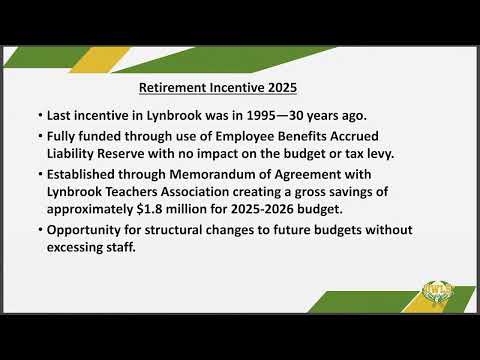
District leaders presented a proposed 2025-26 budget that narrows a roughly $3.9 million gap after a negotiated retirement incentive yielded $1.8 million in savings. Officials flagged rising transportation costs, higher insurance valuations and special-education spending as ongoing pressures and outlined four propositions headed to voters.
LYNBROOK, N.Y. — At a budget work session, Lynnbrook Union Free School District officials presented a proposed 2025–26 spending plan that they said reduces a roughly $3.9 million budget gap after a negotiated retirement incentive produced $1.8 million in savings.
The budget presentation laid out priorities tied to the district's Profile of the Owl (social-emotional learning, character, and critical thinking) and described a series of fiscal pressures: rebid transportation contracts, rising insurance costs tied to a recent property appraisal, and continued expense growth in special-education services. Officials said they are not asking the board to pierce the district's tax cap at this time and that, because of the incentive, "there will be no layoffs this year." (Dr. Thomas Lynch, superintendent.)
Superintendent Thomas Lynch framed the district's work as a response to what he described as "the most difficult budget that we have ever put together," citing earlier community input and a demographic decline in enrollment that affects long-term staffing needs. "There will be no layoffs this year," Lynch told the board, and he credited teachers who accepted the retirement incentive with preserving jobs.
Why it matters
The district said the retirement incentive, negotiated with the Lynnbrook Teachers Association, drew retirements and used an existing employee benefits accrued liability reserve to pay unused sick-time liabilities. Business official Matthew Press told the board the incentive closed most of the gap and that administrators remain "close" to presenting a balanced budget next week. The district stressed that unspecified federal funding tied to IDEA (the Individuals with Disabilities Education Act) remains a risk: "We depend on $1,200,000 of federal funding" and any federal changes could affect salaries paid from that grant (Lynch).
Key details
- Retirement incentive: Officials described a 2025 incentive negotiated with the teachers union and funded from the district's employee benefits accrued liability reserve. Lynch said the incentive produced $1,800,000 in savings and helped avoid layoffs. The district said it will announce individual retiree names next week.
- Budget gap and near-term outlook: Press summarized a budget-to-budget increase of about $3.9 million (roughly 3.65%). He said the district is "close" to a balanced budget and listed remaining options: avoid piercing the tax cap, continue targeted use of reserves, hold positions vacant ("thoughtful rehiring"), or seek additional state aid.
- Transportation: Press described an outsized, one-year hit after a longtime private transportation provider said it would not renew all contracts. The district rebid early, renegotiated with providers and reduced an initial estimated transportation increase of about $1.8 million; Press said subsequent negotiations trimmed roughly $200,000 from the worst-case numbers. Press also said increases in Nassau BOCES-related provider costs contributed to a roughly 30% rise in some BOCES transportation charges.
- Insurance and property valuation: Press reported large insurance increases, driven by rate changes and an outside appraisal that raised the district's insured property value. He said the appraisal reported about a 45% increase in assessed property value for insurance purposes and that insurance expense is rising "about 43%." Press said he plans to question the appraisal methodology.
- Pensions and benefits: The district reported an increase in the employer ERS (Employees' Retirement System) rate from 15.2% to 16.5% and a decrease in the TRS (Teachers' Retirement System) rate from 10.11% to about 9.6%; officials said the net pension changes increase costs overall.
- Special education: Officials said the district has invested in in-district services and that private tuition costs declined by nearly $1 million because more students are being served in district. At the same time, related services and out-of-district placements grew; Press cited a more-than-$400,000 increase in related services and said the budget includes one new 1.0 FTE occupational therapist. He also said some Northwell Health mental-health costs were reclassified from special-education codes to guidance and social-work codes.
- Mental-health partnership: The district's liaison for the Northwell Health partnership, Mrs. Boyce, said the district and Northwell conduct regular check-ins, monitor response times and have increased hiring at Northwell to reduce delays. "We're doing regular monitoring and accountability," she said, describing steps to track referrals and family follow-up.
- Propositions for voters: Press outlined four ballot propositions that will go to voters May 20: Proposition 1, the 2025–26 school budget; Proposition 2, use of $400,000 from the district's technology reserve for wiring and device replacements (no tax impact); Proposition 3, use of about $3.2 million from the facilities reserve for a high-school roof replacement and a North Middle School science-classroom renovation; and Proposition 4, reauthorization of the continuous facilities improvement reserve for three more years with a new maximum capitalization of $18 million and a $2 million annual funding cap. Press emphasized that the reserve uses do not affect the tax levy.
- Local revenue and reserves: The district projects state foundation-aid increases from the executive budget (Press said an increase of just over $1 million), and reported the general-fund state-aid projection near $21 million. Press also said the ERS reserve draw increased from $1.5 million to $1.7 million to meet pension obligations.
Board reaction and next steps
Board members praised administrators and the teachers union for the incentive and for targeting classroom priorities. Board members asked for follow-up details on the transportation contracts, the insurance appraisal and the Northwell partnership. Press said administrators aim to present a balanced budget at the board's budget adoption meeting the following week and reiterated the public schedule: required budget hearing May 7; last day to register May 14; and budget vote May 20, with polls open 7 a.m. to 9 p.m.
Ending
Administrators said they plan final budget adjustments in the days before the March adoption meeting and asked the community to watch the May 7 hearing and the May 20 vote. The board adjourned following a brief motion to close the session.