Get Full Government Meeting Transcripts, Videos, & Alerts Forever!
Get email alerts on the Age Appropriate Materials Act topic
No spam. Unsubscribe anytime.
Committee rejects bill to roll back aspects of Age Appropriate Materials Act
Summary
House Bill 1051, which would have altered how libraries and schools apply the Age Appropriate Materials Act and constrained removal of materials on certain grounds, failed in committee after testimony for and against the measure.
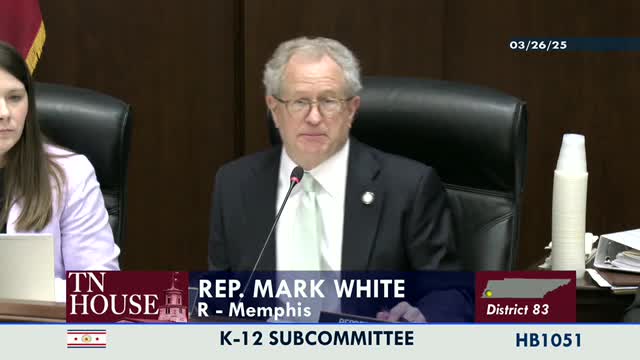
House Bill 1051 failed to pass the K-12 Subcommittee after extended testimony from an education librarian and discussion among members about the Age Appropriate Materials Act and library collection policies.
Zan Lasko, intellectual freedom chair for the Tennessee Association of School Librarians, testified in support of HB 1051. Lasko said the amended Age Appropriate Materials Act “has brought chaos and confusion to schools and school board meetings,” and that a TASL survey found “over 1,400 plus titles have been removed thus far.” She warned that librarians and administrators “fear for their jobs” and said the law had prompted some schools to pull books without a review process.
Representative McKenzie, sponsor of HB 1051, characterized the bill as restoring local school boards’ authority over library collections and said it would “maintain materials in the library connection collection that must be suitable for age and maturity level of the student” while preserving removal processes for violent or pornographic material. Representative Mabry said she had seen the law used to remove explicit material and opposed HB 1051 on that basis.
After debate and questions, the clerk announced “Mister chairman, you have 2 ayes, 4 noes” and the chair said, “The house bill 10 51 fails for lack of majority.” The transcript shows members debating whether the prior law had produced harmful censorship or had functioned as intended; no amendment or fiscal note was recorded in committee discussion.