Get Full Government Meeting Transcripts, Videos, & Alerts Forever!
Get email alerts on the Data Centers topic
No spam. Unsubscribe anytime.
Residents urge council to oppose hyperscale data centers near Wheeler schools
Summary
Dozens of residents told the Porter County Council they oppose proposed hyperscale data centers near Union Township schools, citing health, environmental, traffic and property-tax concerns. Public commenters asked the council to press county commissioners for a comprehensive plan and to consider school safety and water impacts.
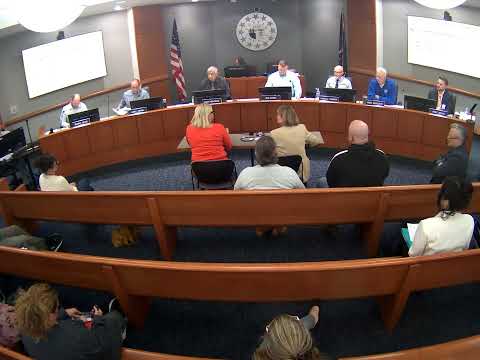
Dozens of residents told the Porter County Council on Oct. 8 they oppose proposed hyperscale data centers near Wheeler High School and Union Township schools, saying the projects could harm water supplies, raise noise and light impacts, lower property values and create an industrial “dead zone” near neighborhoods.
Speakers at the public-comment portion asked the council to press county commissioners to slow the process, require a comprehensive plan and protect school sites. “I don’t want my kid or my grandkid to experience this,” said Annie Hill, who identified herself as living on 650 West, describing how a data center footprint would surround two family farms.
The comments came amid several agenda votes the council conducted earlier in the meeting. Many speakers said councilors told them the council does not have the authority to approve or deny data-center siting, and several urged the council to use whatever influence it has with the county commissioners. Councilman Andy Vasquez told one speaker he had called and emailed constituents to respond to questions about the projects.
Why it matters: commenters said the developments would touch multiple county systems — schools, local roads, the watershed and emergency services. One resident said Union Township covers roughly 30 square miles and that the location under discussion could create nearly 10 square miles of effectively industrialized area, a change she said would reduce the area’s residential character and hurt the local school corporation.
Residents raised a range of specific concerns. Several asked about cooling methods and water use for the data centers and whether large withdrawals could affect the South Creek watershed and nearby Lake conditions. Another recurring issue was tax abatement: speakers warned that tax-incentive packages, combined with large, specialized industrial sites, can shift maintenance and emergency-service burdens to local taxpayers. “How do you create a fire department for a massive industrial complex with taxpayer money when they have no maintenance?” one commenter asked, urging scrutiny of public-safety and cost-shift risks.
Speakers also called for updated planning and public engagement. Kyle Duarte and others said the township’s last comprehensive plan dates to the early 2000s and urged the county and commissioners to complete an up-to-date plan “before we go forward with any sort of large project.” Dan Mullen, a resident who described researching public records, said he feared undue influence because some contractors and development interests have made large campaign contributions in other cases.
Several parents described choosing Wheeler schools for their small-community character and said potential industrial neighbors would undermine that environment. “I sent my kids to Wheeler because it is a small community,” a parent told the council. “If it comes to a decision, if you have a relationship with those commissioners, I urge you to talk to them and understand that your constituents are not happy about this potential idea.”
What the council can and cannot do: multiple speakers noted the Porter County Council does not directly decide siting or county zoning for industrial projects; those powers typically lie with county commissioners and planning/zoning boards. Several commenters asked the council to press commissioners for more detail and to insist on a comprehensive plan and environmental review before approvals or tax abatements proceed.
Next steps mentioned at the meeting included organizers continuing to petition commissioners and to seek further public hearings. Several commenters referenced state-level incentives and recent legislative activity affecting tax abatements; the council discussed the broader issues but did not take any formal action regarding the data-center projects during this meeting.
Ending: Commenters closed by repeating a request for the council and commissioners to hear residents’ concerns: “Hear us. We vote,” said Natalia Dalvin, who said she had traveled from a nearby township to stand with neighbors. The council’s record of the public comments will accompany future agenda items if or when the commissioners or planning bodies bring formal proposals for tax incentives, zoning changes or site-specific approvals.