Get Full Government Meeting Transcripts, Videos, & Alerts Forever!
Get email alerts on the Firearm Questions In Healthcare topic
No spam. Unsubscribe anytime.
Tennessee committee hears hours of testimony on bill to ban routine firearm-ownership questions by health providers
Summary
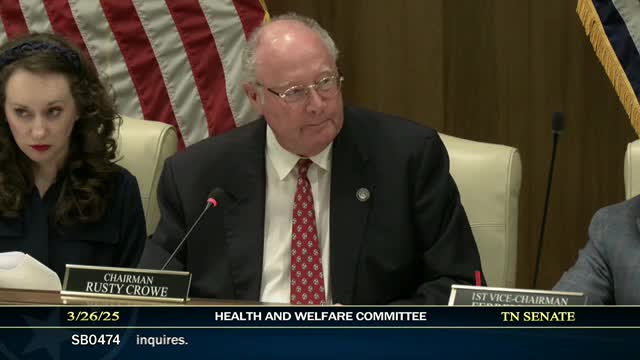
Senate Bill 474, sponsored by Sen. Bolling, would prohibit most health care providers from asking patients about firearm ownership; the bill was rolled to the second calendar of 2026 after extended testimony from physicians and questions from senators.
Senate Bill 474, introduced by Sen. Sandra Bolling, would prohibit a health care provider from asking a patient about firearm ownership in most clinical encounters while carving out exceptions for emergency care, first responders, and licensed mental-health professionals. The bill was discussed at length before the Senate Health and Welfare Committee on May 20, 2025, and the sponsor asked that the measure be carried over to the second calendar of 2026 for further work.
The measure’s sponsor, Senator Sandra Bolling, said the bill is intended to protect patients “from having to subject themselves to an ideology-based inquiry” and to preserve the doctor–patient relationship when questions about guns are unrelated to the medical visit. She told the committee the bill “carefully carves out exceptions for situations when a question about a patient’s firearm possession is legitimate, such as in an ambulance or if a patient or a person accompanying the patient shares information.”
Multiple physicians and trauma surgeons testified in strong opposition. Dr. Mayer Patel, chief of acute care surgery at Vanderbilt, said trauma and recovery care often requires open conversations about firearms and that those conversations “transcend the chain of survival through recovery.” Dr. Kelsey Gastonaw, representing the Tennessee chapter of the American Academy of Pediatrics, described cases in which asking about firearms led to concrete safety actions — in one account a grandmother who had not considered firearms in the home accepted secure-storage resources after a clinician’s counseling. Dr. Jay Wellens, a pediatric neurosurgeon, and Dr. Joe Chiles of East Tennessee Children’s Hospital warned the committee that firearm injury is a leading cause of death for U.S. children and that clinical counseling on safe storage reduces pediatric injury risk.
Physicians said counseling is a routine safety conversation similar to car-seat or pool-safety counseling and asserted that a majority of gun owners support physician counseling on secure storage. Several witnesses said it is standard practice to raise firearm safety when relevant to suicide risk, accidental injury or a family’s circumstances. Vanderbilt and children’s hospital physicians described programs that distribute free gun locks and said they have provided thousands to families.
Committee members asked whether the bill would criminalize or discipline clinicians; Sen. Harshbarger questioned whether a $1,000 fine and an ethical charge would be appropriate for clinicians who ask routine questions. Supporters of medical counseling said they had not observed clinicians refusing care based on firearm ownership.
After testimony and questions, Senator Bolling asked to roll the bill to the second calendar of 2026 for additional work. The committee granted the request; there was no final floor vote on the bill at this meeting.
Why it matters: The bill would limit clinicians’ ability to ask about firearms in routine visits, which proponents say preserves privacy and prevents politicized questioning and opponents say would remove a preventive tool clinicians use to reduce accidental and suicidal firearm injuries.