Get Full Government Meeting Transcripts, Videos, & Alerts Forever!
Get email alerts on the Juvenile Detention topic
No spam. Unsubscribe anytime.
Shelby County juvenile court officials ask committee to delay bill while local MOU, transport plan finish negotiations
Summary
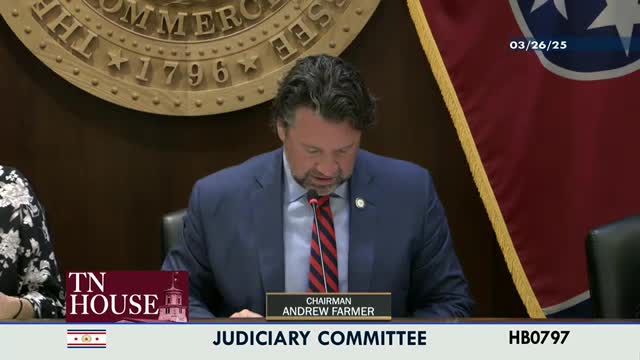
Judge and court managers from Shelby County told the Tennessee House Judiciary Committee that local officials are close to finalizing a memorandum of understanding to restore transportation and fuller court operations for detained juveniles, and they asked lawmakers to delay action on House Bill 797 while negotiations finish.
Judge and court managers from Shelby County told the Tennessee House Judiciary Committee that local officials are close to finalizing a memorandum of understanding to restore transportation and fuller court operations for detained juveniles, and they asked lawmakers to delay action on House Bill 797 while negotiations finish.
Why it matters: Sponsors introduced the bill amid a dispute over whether hearings for detained juveniles must be held inside the detention facility’s courtroom or may be transported to the larger downtown courthouse. Court officials and defense attorneys said holding all in-custody hearings at the detention center harms victim safety, attorney–client confidentiality and judicial capacity. Sheriff’s office leaders said the detention facility was built with an on-site courtroom and that transporting youth raises security and staffing concerns.
Judge Sugarman, who has overseen Shelby County juvenile dockets since the court’s displacement last spring, told lawmakers the court “has exceeded our docket slot capacity and are now having delays in our dispensation of cases.” She said the courtroom inside the detention facility offers only 32 docket slots per week compared with about 110 docket slots at the main courthouse on Adams Avenue. “A delay in justice is not only inconvenience, it is it affects the victim in this matter,” Sugarman said, urging time to finalize a local solution.
Matthew John, lead supervising attorney for the Shelby County District Attorney General’s juvenile unit, described the courthouse-in-detention setting as a disadvantage for victims and witnesses: prosecutors and family members must pass through secured pods and wait in small confined spaces, sometimes outside, and prosecutors lack office space at the detention site. John said he has to “tote my files through the security” and described difficulty arranging private conversations and witness support when hearings are held inside the detention center.
Bridal Evans, chief judicial officer for Shelby County Juvenile Court, told the committee negotiations are underway with the Shelby County mayor’s office and the county’s Department of Corrections to transfer daily operations and transportation responsibilities to county corrections; she said participants have met frequently and expect to resolve outstanding items by the fall. Curt Field, chief jailer for the Shelby County Sheriff’s Office, described the sheriff’s office role operating the Youth Justice and Education Center (YJEC) and said the office has run detention operations and programs since the new facility opened in July 2023.
Defense counsel and the juvenile defender panel warned of logistical problems and confidentiality issues if hearings remain at YJEC. Dorothy Ingram Miller, juvenile defender panel supervisor, said attorneys and clients often lack private interview areas and sometimes conduct interviews in classrooms, cafeterias or even parked cars; she wrote that parents have been turned away or confused when seating and access are limited, which has harmed client participation and representation.
Speakers on the panel gave cost and capacity estimates: a private vendor model used in Davidson County was cited at approximately $24,000,000 per year, while a national consortium estimated private operation in Shelby County could cost $35–40 million annually. Court leaders worried that, if local government cannot reach an operating MOU, a private contractor could assume responsibility without guaranteeing transportation or the victim-centered access they seek.
After roughly 90 minutes of testimony and questioning, Representative Bond announced an intention to offer an amendment to make the bill effective Oct. 1 and asked the committee to delay final action. The committee voted to roll House Bill 797 as amended to next week's calendar to give local parties more time to complete the memorandum of understanding and, if necessary, to allow the sponsor to file the effective-date amendment.
Committee action and next steps: The committee voted to postpone action on House Bill 797; members agreed to consider the bill again next week. Court and county leaders said they will continue negotiations and try to finalize a transportation and operations agreement between the juvenile court, the sheriff’s office and the Shelby County mayor’s office.
Ending: Court officials asked lawmakers for a short delay so local leaders could finalize the MOU and resume daily transport and broader courtroom scheduling; defense counsel and victims’ advocates asked that any solution preserve private attorney–client space and victim safety.