Get Full Government Meeting Transcripts, Videos, & Alerts Forever!
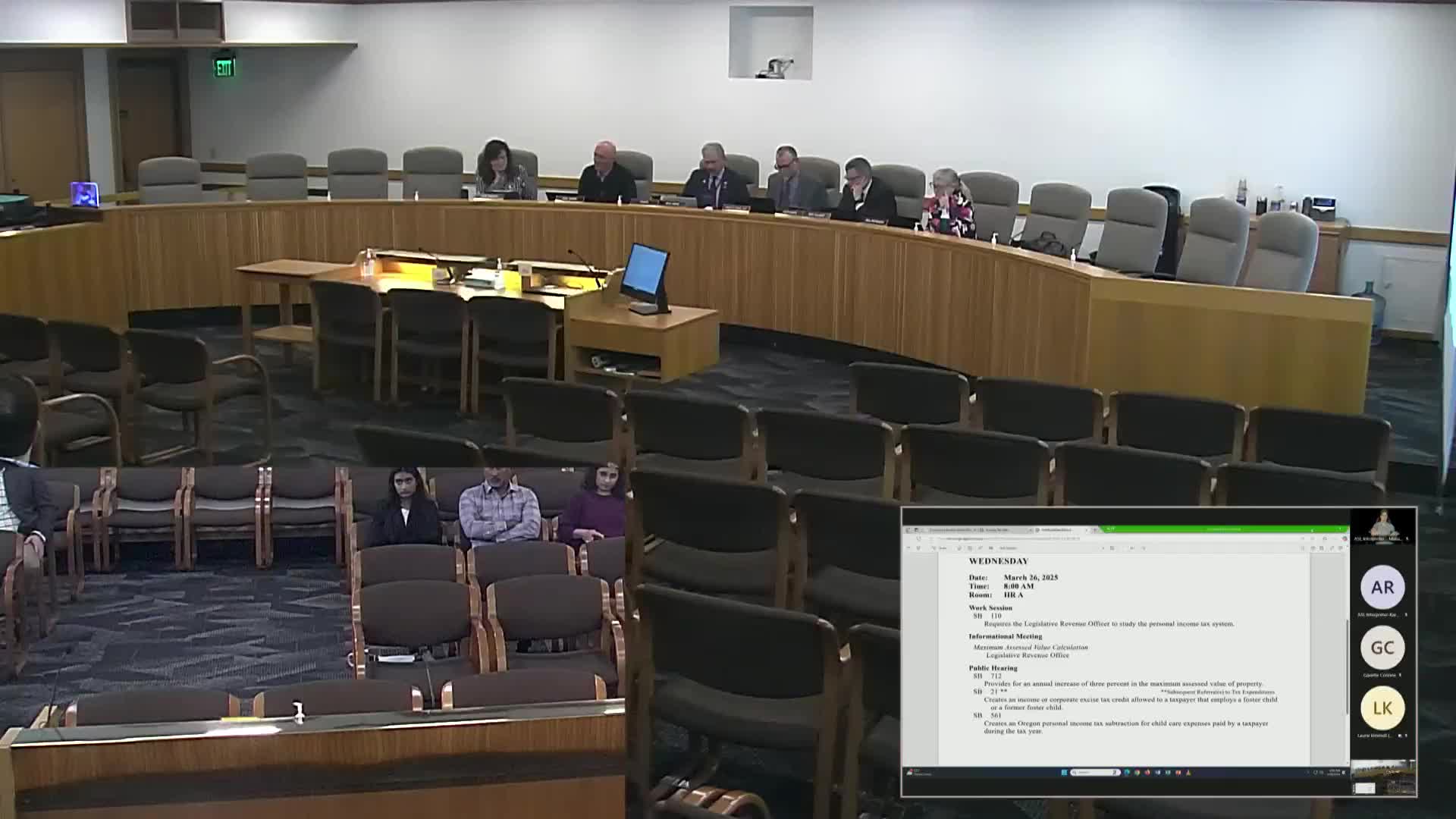
Senate hearing reviews Oregons maximum assessed value mechanics and hears testimony on SB 712
Summary
The Senate Committee on Finance and Revenue opened an informational briefing on Oregons maximum assessed value and then held a public hearing on Senate Bill 712, which would require MAV to increase 3% annually even during downturns.
The Senate Committee on Finance and Revenue opened an informational presentation on Oregons maximum assessed value (MAV) system and then held a public hearing on Senate Bill 712, which would require a propertys MAV to increase by 3% each year.
The Legislative Revenue Office (LRO) told the committee that MAV was established after Measures 47 and 50 in the 1990s and acts as a taxable-value cap that generally grows at 3% per year. "The maximum assessed value grows by 3% or 0% per year, but usually 3% under most conditions," a Legislative Revenue Office presenter said, explaining how MAV, assessed value (AV) and real market value (RMV) interact.
Why it matters: witnesses said the current MAV rules can create revenue volatility for local governments and horizontal inequities among neighboring properties. Senate Bill 712 would keep MAV growing by 3% even when RMV falls below MAV, which backers say prevents a long lag in revenue recovery after recessions; opponents said that change would raise taxes for fixed-income residents and vulnerable groups.
LROs presentation summarized three concepts required to understand Oregon property taxation: RMV (what a willing buyer would pay), MAV (a taxable-value cap set in the Measure 50 era and…
Already have an account? Log in
Subscribe to keep reading
Unlock the rest of this article — and every article on Citizen Portal.
- Unlimited articles
- AI-powered breakdowns of topics, speakers, decisions, and budgets
- Instant alerts when your location has a new meeting
- Follow topics and more locations
- 1,000 AI Insights / month, plus AI Chat